



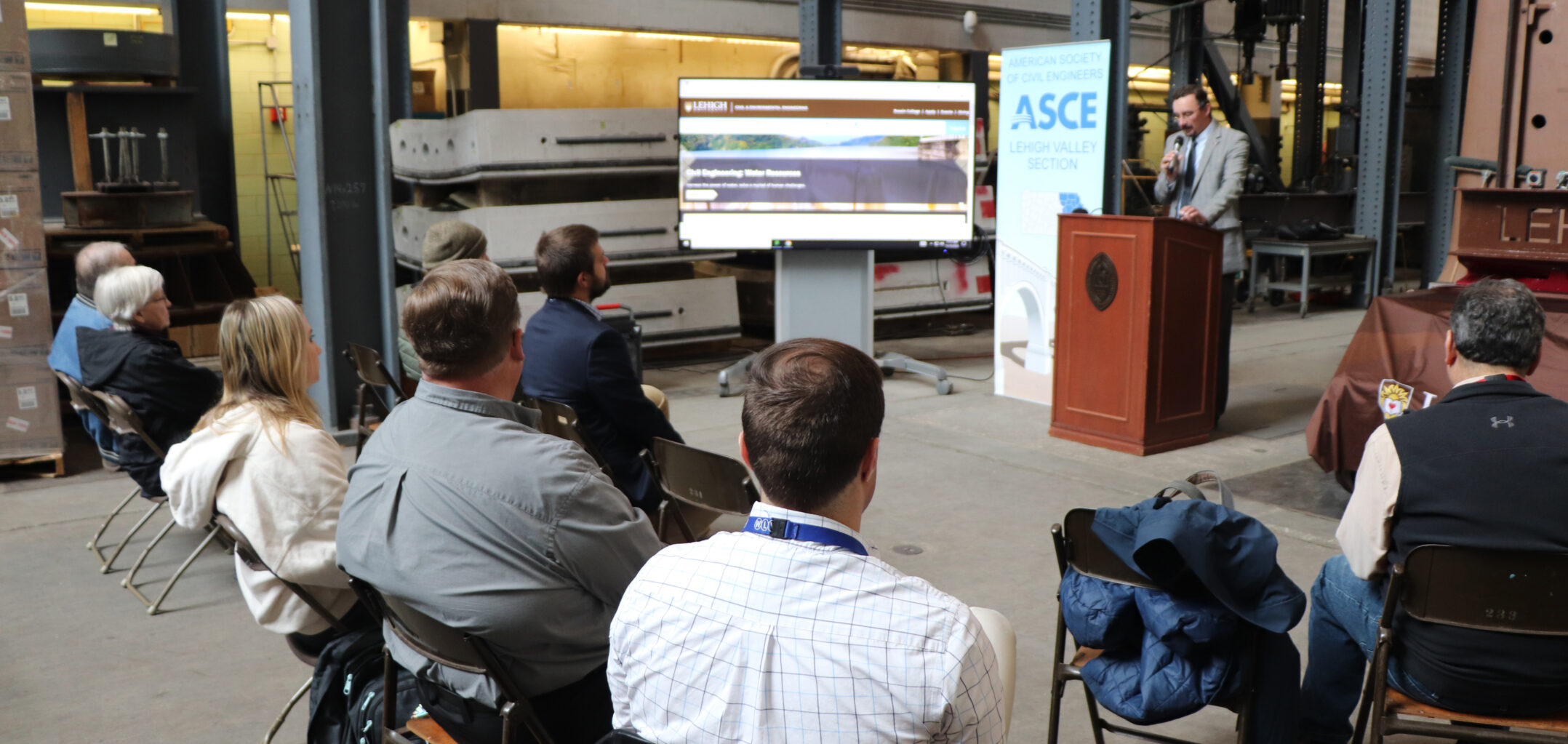
The American Society of Civil Engineers discloses the condition and performance of Pennsylvania’s infrastructure every four years. This year, the state’s system received a cumulative grade of C-. The report card includes 15 categories of infrastructure: aviation, bridges, dams, drinking water, energy, hazardous waste, levees, parks, ports, rail, roads, solid waste, stormwater, transit and wastewater.
Lehigh’s Department of Civil and Environmental Engineering collaborated with the Lehigh Valley section of the society to hold a news conference on Nov. 15 in Fritz Engineering Laboratory to announce and discuss the findings.
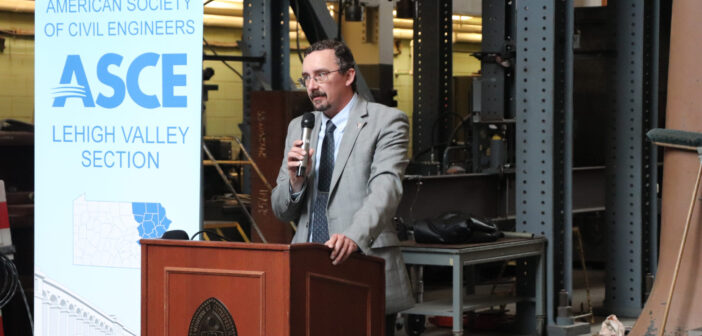
At the conference, John Caperilla, former president of the society, announced the performance results and discussed the areas of Pennsylvania’s infrastructure that are in need of more attention and investment.
Caperilla said Pennsylvania’s wastewater received the lowest grade in the report with a D-.
“The average age of most sewer systems (in Pennsylvania) is approaching 75 years with many plates over 100 years old,” Caperilla said. “The city of Philadelphia is using green and great infrastructure to address this issue. However, the entire state needs to do more to eliminate this health risk.”
Caperilla raised concerns during the conference about the state’s condition, including the presence of PFAs in Pennsylvania’s water. PFAs are a group of manufactured chemicals that are ingredients in various everyday products which can cause certain kinds of cancer and other serious illnesses.
“Roughly one-third of the drinking water systems in Pennsylvania have been tested for PFAs and they were found to have a number that is above the EPA supervisor,” Caperilla said.
Shamim Pakzad, chair of Lehigh’s civil and environmental engineering department, said the main thing Pennsylvania needs to do to improve the infrastructure is invest in resources.
Pakzad said an infrastructure bill that was passed a few months ago provides money for improvement, however, the resources need to be directed toward the places that need the most attention.
“I think it’s important for those resources to be put in the right places and find the best way to use these resources,” Pakzad said. “You will always be chasing the dollars because we will never have enough dollars to do everything. The smart way to do all of this is to figure out where the dollars would make the biggest difference.”
The civil engineering department at Lehigh works on identifying the main areas of need and deciding some of the best practices for repair and design to ensure resilience in the school’s infrastructure, Pakzad said.
Farrah Moazeni, assistant professor of civil and environmental engineering at Lehigh, addressed the interconnectedness of critical infrastructure systems and the impact of academic-industry-government partnerships.
Moazeni said that her academic research suggests solutions to improve the energy efficiency of modern water systems and explores different methods to leverage the interdependencies with critical infrastructure to enhance the operation.
“Thankfully at Lehigh we have a center called I-CPIE, Institute for Cyber Physical Infrastructure and Energy, where more than 90 faculty members are gathered to perform multidisciplinary research,” Moazeni said.
Moazeni said critical infrastructure systems including water, power, natural gas and transportation show evidence of being interconnected, which can both help and hurt our infrastructure.
Ralph Eberhardt, chairman of the Transportation Committee for the Lehigh Valley, spoke at the conference about The Greater Lehigh Valley of Commerce’s mission to improve transportation infrastructure in the Lehigh Valley. He said their mission includes a greater understanding of the issues and intensifying community understanding advocacy at the local, state and federal levels.
“The committee recognizes the economic vitality of regional businesses and the mobility of Lehigh Valley citizens depend upon safe, equitable, sustainable and efficient transportation infrastructure,” Eberhardt said.
In 2014 and 2018, the report card for Pennsylvania’s infrastructure reflected the same overall grade, a C-.
Pakzad said people are constantly surrounded by infrastructure and are reliant on it.
“There’s no way to overstate the impact of a well-functioning infrastructure on a citizen’s life,” Pakzad said.
1 Comment
Excellent piece and very timely. I am surprised that the overall system received a C-, I thought it would be lower (like other neighboring states). Infrastructure is something that I have been studying of late and the findings “jibe” with todays article….very concerning. If people realized how bad is the national infrastructure portfolio there would be major protests in the streets. The reason that it is not front page news is because bridges are not falling on a regular basis. By way of example, within the state of Pennsylvania alone, the number of substandard bridges is amazing. It seems that a major reason for this deficit is the lack of interest and will of the citizenry/elected representatives to address. People assume that the infrastructure is within tolerances and politicians do not get many votes for fixing the flaws. More votes are garnered for passing a new social program than fixing a piece of infrastructure that few people use. Though a cynical proposition – I have a feeling that this view is “spot on”. As time progresses the need will become greater and the trade-off will become more glaring. Had we been more attentive we would not be in today’s (tomorrow’s) situation. Pax
Comment Policy
Comments posted to The Brown and White website are reviewed by a moderator before being approved. Incendiary speech or harassing language, including comments targeted at individuals, may be deemed unacceptable and not published. Spam and other soliciting will also be declined.
The Brown and White also reserves the right to refuse the publication of entirely anonymous comments.