



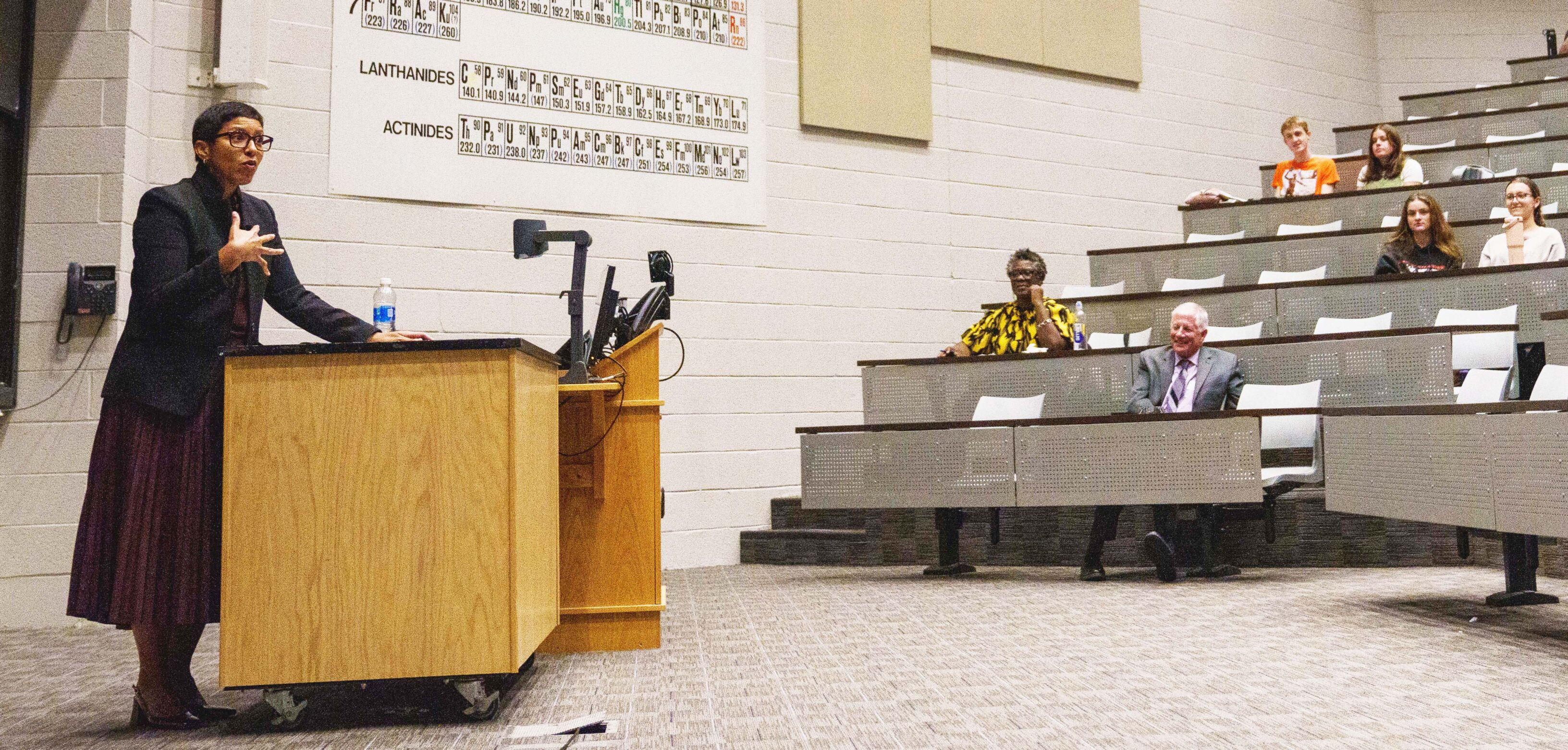
“This lecture is not a warm blanket. I hope this is a cold, embracing shot of adrenaline.”
This is the way Melissa Murray, guest speaker for the 43rd Annual Tresolini Lecture in Law, opened her discussion, “The Supreme Court in American Life and Judging the Supreme Court.”
Brian Fife, political science department chair, commended professor Vera Fennell, Tresolini committee chair, for selecting and helping organize Murray as this year’s speaker.
Murray, a constitutional law professor at New York University Law School, legal analyst for MSNBC and co-host of the Strict Scrutiny podcast, addressed more than 100 attendees at Neville Hall on Sept. 19 to discuss recent Supreme Court events, namely the Dobbs decision.
In her discussion of Dobbs v. Jackson Women’s Health Organization, which repealed the formerly precedented constitutional right to abortion, Murray dissected the Supreme Court’s notion of what democracy is.
“This cramped vision of democracy is even more pronounced when it is considered alongside the Court’s recent and active interventions to distort and disrupt the electoral landscape,” Murray said.
She said the court’s decision to put the question of abortion to the state level put the issue back up for “democratic deliberation,” which the court majority reasoned was necessary.
The court’s decision to desert stare decisis, the Latin term for “let the decision stand,” Murray said has the capability to change the standard in which other precedents are viewed — such as Obergefell v. Hodges, the 2015 landmark case that recognized same-sex marriage.
Fife said by analyzing the opinions of certain justices like Samuel Alito, Murray put the decision into not only a 19th-century context but also a 21st-century context.
However, she said this court has made it less likely for democratic processes to take place over the question of abortion because women who hope to utilize their right to choose face challenges both exercising their right to vote and being represented in government.
“Women are often the primary caregivers in the family, and have to surmount certain obstacles in order to participate in politics, even to run for office,” Murray said. “Women are so woefully underrepresented in the ecosystem that surrounds politics … all of this suggests that it is not simply a question of exercising power and voting, but how you’re able to exercise that power.”
While admitting she often takes pessimistic views of the trajectory of the Court, Murray said she appreciates how voter engagement has increased in response.
While this Court left the question of abortion up to the states, Murray said it is “likely just a weigh station.”
She said this decision will not be the end of the abortion debate, and it has already allowed states to make various decisions on the right to abortion under certain conditions
Political science professor Heather Swadley said she hopes people know they can make tangible efforts toward fixing the cultural and institutional aspects of the Supreme Court.
“One thing that makes me optimistic is that all of the things that have been happening with the Court, I think that they’ve made people more aware of some of the problems that need to be fixed and really galvanized a movement around Supreme Court reform,” Swadley said. “So, I’m hopeful and optimistic about that at the very least.”
Fife said the lecture emphasized the critical importance of elections, a theme that he conveys in his political science classes.
“Things aren’t going to change overnight, because elections have consequences,” Fife said. “Having said that, I do have a hopeful view of the future, because I imagine more citizen involvement.”
Olivia Byers, ‘25, said despite learning more about United States politics in her classes, what she has learned has actually made her apprehensive about pursuing a path in the field, and she may decide to venture into a different sector like security or technology.
“Being a political science (student) here, we’ve learned so much about the Supreme Court and how it was formed, but so much has changed recently that has made it more intriguing, to say the least,” Byers said.
Comment Policy
Comments posted to The Brown and White website are reviewed by a moderator before being approved. Incendiary speech or harassing language, including comments targeted at individuals, may be deemed unacceptable and not published. Spam and other soliciting will also be declined.
The Brown and White also reserves the right to refuse the publication of entirely anonymous comments.