



Editor’s Note: The following content may be distressing for some audiences. Reader discretion is advised.
According to Licensed Professional Counselor R. Samantha Williams, one in four people will experience a mental health issue at some point in their life.
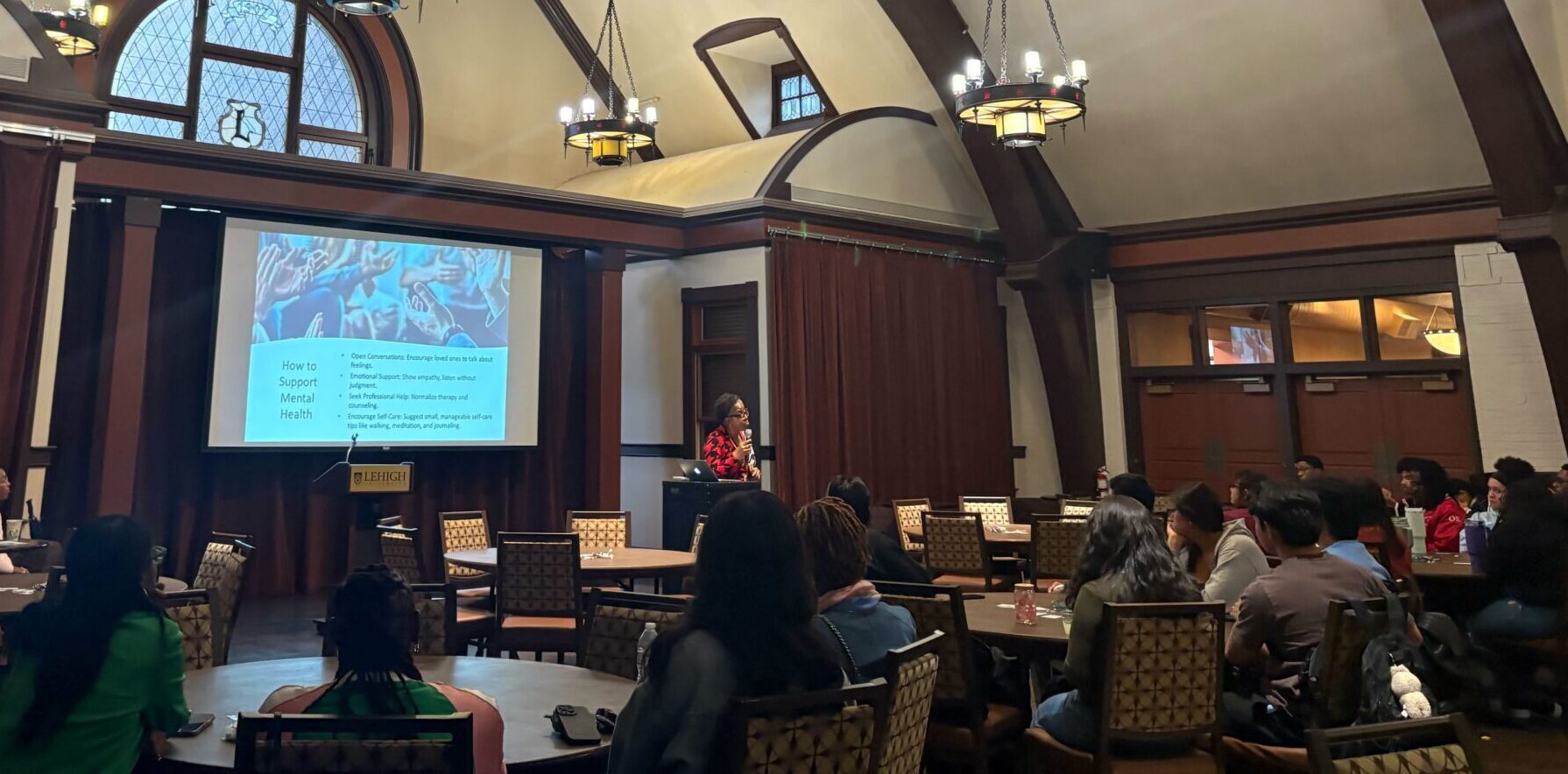
Williams brought awareness to these mental health crises by speaking at the event “Shattering Silence: Suicide Awareness and Healing in Communities of Color” on Wednesday in Lamberton Hall, hosted by the office for Fraternity and Sorority Life, Lehigh’s Cultural Greek Council and the Alpha Gamma Phi Omega chapter of the Alpha Kappa Alpha Sorority.
Along with Williams, Angel Reyes, a licensed professional counselor, and Cornelia Sewell-Allen, the dean of student life at East Stroudsburg University, also spoke at the event. Alexandra Smith, the associate director of fraternity and sorority life and a member of the Alpha Kappa Alpha sorority, was the primary organizer.
Smith, who had a friend die by suicide while in college, said she remembers what she was going through during that time, so she wanted to hold this event for students to not only raise awareness, but to offer resources and support.
“I think sometimes having folks of color who understand that experience and can speak to that is really important,” Smith said.
At the beginning of the event, Williams said at 16 she attempted to commit suicide, but that she is grateful every day her life did not end.
“I stand here trying to share information to help you and to help you in your relationships,” she said.
Attendees were asked to take a suicide-awareness quiz from the University of British Columbia that listed common phrases or thoughts about suicide, asking whether they were facts or myths.
Throughout the program, the speakers would return to the assessment quiz to discuss what was true and false, clarifying misconceptions and upholding important facts about suicide and mental health.
“Not everyone who attempts or dies by suicide has a mental disorder,” Williams said. “But sometimes mental health disorders can be contributing factors in the realm of suicide.”
After introducing himself, Reyes asked the audience members how many people practice self care. Multiple audience members responded, saying things such as watching a favorite show or practicing a skin-care routine.
Reyes said when he was in graduate school he had to remind himself and others that it is okay to just sit and rest sometimes.
“It’s just like, busy, busy, busy, and we’re constantly running around, whether we’re writing a paper or just doing different things, and we forget about ourselves, right?” Reyes said.
He told attendees they don’t have to always be busy, emphasizing the importance of having open conversations and taking care of oneself.
Reyes said from 2018 to 2021 the suicide rates among Black youth between the ages of 10 and 24 increased from 8.2% to 11.2%. In the past 25 years, self-reported suicide attempts in the Black community have increased by 73%, according to the Substance Abuse and Mental Health Services Administration.
Reyes said higher rates of suicide and mental illness found in communities of color stem from a lack of mental health resources, as well as an absence of transparency and discussion, making people who struggle less likely to seek help.
Sewell-Allen said representation is important because communities of color often have similar experiences as other groups, but they don’t see themselves represented.
“If I’m in the classroom and I grew up with one Black teacher, how can I imagine being that teacher or that professor?” Sewell-Allen said. “And so, hearing stories as they’re talking about them, hoping that it gives you some validation, like I’m not alone in this fight.”
As the daughter of Caribbean immigrants, Sewell-Allen said she experienced stigmas surrounding mental health and was hesitant to discuss it in her own life. Now, she said the stigmas have lessened and her daughters are much less hesitant to talk about mental health than her older relatives.
“Being a friend, a support, a listener, is so important to keeping somebody alive,” Sewell-Allen said.
Williams concluded the presentation by asking the audience to think about next steps and what they can do to support one another.
“We should start with respect, empathy and care,” Williams said. “Don’t dismiss the person’s identity to address what’s going on with them.”
She said there are many strategies to help those who may be struggling, such as communicating with them, sharing information, creating stronger community-connections and using mindful language when discussing suicide and mental health.
In a conversation with The Brown and White after the event, Williams said every community and individual needs support, no matter their identity.
“Mental health needs are not a result of weakness or some sort of deficiency in individuals,” Williams said. “Mental health concerns exist across race, gender, ethnicity, culture and nationality. You have to pay attention to other communities that aren’t within the majority.”
She also said seeing the sheer number of young people who are exploring mental health treatments and working to end the stigma surrounding it gives her hope.
“There is hope,” Williams said. “There is hope.”
If you or someone you know is struggling with suicidal thoughts please dial 988 for immediate assistance. Help can also be found at Lehigh’s Counseling & Psychological Services.
Comment Policy
Comments posted to The Brown and White website are reviewed by a moderator before being approved. Incendiary speech or harassing language, including comments targeted at individuals, may be deemed unacceptable and not published. Spam and other soliciting will also be declined.
The Brown and White also reserves the right to refuse the publication of entirely anonymous comments.