



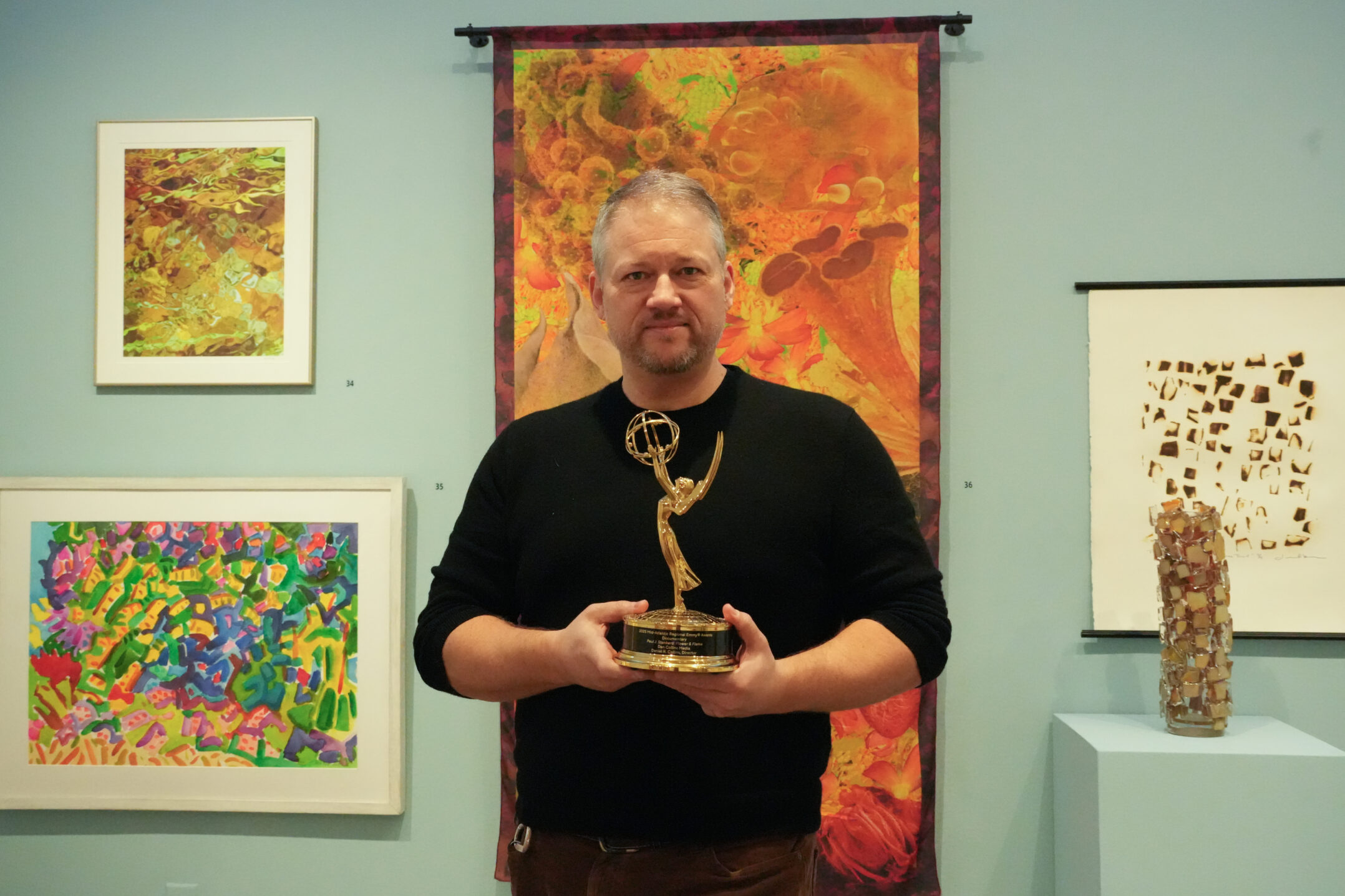
When Daniel Collins was in third grade, he wrote stories about his hiking escapades with friends, stapled the pages together and handed out makeshift books so they could relive their adventures.
Unbeknownst to him, it was the start of a lifelong devotion to storytelling — the same passion that would lead him to become an Emmy Award-winning filmmaker.
Collins now produces video content for Lehigh’s Office of University Communications and Public Affairs. He won a 2025 Mid-Atlantic Regional Emmy Award for his Documentary “Paul J. Stankard: Flower & Flame.”
The film profiles acclaimed glass artist Paul J. Stankard and explores both his artistic legacy and personal life. Collins said the documentary is the best creative work of his career because he was able to take the time to visually express the story as he envisioned it.
He purchased new equipment to capture sliding shots of Stankard’s glassblowing torch and filmed detailed close-ups of his tools, aiming to present the work in a visually compelling way.
Beyond documenting Stankard’s artistry, Collins portrayed the life of the 80-year-old artist, capturing reflective moments and conversations about mortality and legacy.
He also filmed Stankard’s relationship with his wife, who hadn’t previously appeared prominently in media coverage with him. Collins said when telling a story about an artist and his work, it’s important viewers recognize its beauty.
Collins said he built trust with the couple, which he believes is why she agreed to appear in the film and discuss the ways she supported his career.
“I think it’s one of the most beautiful scenes in the film, just the two of them being adorable on camera,” Collins said. “If you spend enough time with people to build trust, then good things like this can happen.”
As a storyteller, Collins said it’s essential to move beyond surface-level narratives and reveal something meaningful about the human spirit. He said he sees himself as someone who can translate other people’s stories in ways audiences understand and feel.
He said much of his inspiration comes from films and documentaries he’s watched since first becoming drawn to film. He credits his Irish heritage, where storytelling and folktales played a central cultural role.
Collins traces his interest in media creation to high school, when a photography teacher introduced him to shooting with older cameras and developing film in a darkroom. Taking still photographs gave him what he described as the “bug” for visual storytelling.
His interest soon expanded to film.
“I was always impressed by documentary films because it blew my mind that you could tell a true story that was as exciting and interesting as a movie you’d see in a theater,” Collins said.
One documentary that left a lasting impression on him was “Eyes on the Prize,” which chronicled the Civil Rights Movement and told the stories of The Rev. Dr. Martin Luther King Jr. and Malcolm X.
When applying to college, Collins said he applied to several film programs and was accepted to Ithaca College. Though he lacked the technical experience required by some prestigious programs, he said his passion and writing set him apart. He described the application process as “throwing a dart,” because while he didn’t know much about film, he knew he wanted to be a filmmaker.
In college, Collins studied sociology, human culture and film. He ultimately designed his own major — creative cultural expression — combining courses in film, photography, sociology, religion, art and poetry. He graduated in 1998 and remained focused on documentary filmmaking.
After graduation, he spent several years working various jobs before entering the industry. He hitchhiked, washed dishes and took kitchen jobs in Brooklyn.
“I guess you could call it a gap year,” Collins said. “But I was just exploring life before I could figure out what to do. And with a degree like mine, it was hard to know what professional path to follow.”
A few years later, Collins moved to Philadelphia and contacted a friend whose mother ran a small documentary company, Teleduction, in Wilmington, Delaware. He began by answering phones and completing small Photoshop projects while learning new digital tools.
Collins worked at Teleduction from 2001 to 2015. Because the company was small, he said he taught himself to edit and gradually learned all aspects of filmmaking. He credits his mentor, Sharon Baker, with teaching him how to create impactful documentaries on limited budgets and giving him opportunities to learn while telling real stories.
The first documentary Collins edited for the company, “His Master’s Voice,” explored the origins of music recording and won an Emmy Award in 2003. Although he didn’t direct the film, he said he was stunned that the first project he edited received such recognition.
“Sometimes what you do is just keep working hard, following your instincts and passions, and things just tend to work out,” Collins said.
After leaving Teleduction, Collins began working independently and refining his documentary process. He described it as centered on building rapport and trust with the people whose stories he tells, emphasizing their voices as the core narrative thread. He’s worked with groups ranging from veterans to undocumented immigrants, noting the critical role of trust in visual storytelling.
He continues studying visual elements — such as backgrounds, wide shots and framing — and experiments with those techniques to develop his style.
Collins said he long admired Stankard as a prominent figure in the glass art world, but the project formally began when Stankard’s assistant approached him and said, “‘Paul is about to turn 80 and we really need to tell his story.’”
Filming took place over 18 months before Collins submitted the documentary to film festivals and public screenings, which he said are critical for networking and gaining recognition for award shows like the Emmys. He said he believed the documentary would resonate with public television audiences given Stankard’s age and fan base, so he contacted public television directors throughout the region.
Having previously judged the Emmy Awards, Collins understood the submission process and felt confident that “Flower & Flame” was worthy of consideration.
“I knew it was going to be stiff competition because the Emmy’s are a major institution, but I had a feeling we might do well because I just thought it was that good of a story,” Collins said.
He attended the ceremony with executive producer Dave Graber and their wives in black-tie attire. Collins said he remained calm until about 10 minutes before the announcement, when nerves set in.
When the film won, he said he felt like he was “floating on air.”
“Whenever you do this kind of work, it’s really nice to hear an external organization, especially one with the prestige level of the Emmys, to say ‘this is good work,’” Collins said. “I don’t need to justify my artistic work, but it is nice to hear.”
Lehigh is Collins’ first job in higher education, a path he’d long been interested in but previously lacked the credentials to pursue. He produces video content for the Office of University Communications and Public Affairs, creating material for YouTube and social media. He said one of his biggest challenges has been learning to tell compelling stories in 30 seconds through short-form media.
Jordan Gruber, the director of multimedia content, said Collins has the ability to turn an idea into compelling storytelling.
“He has been able to take his skills from longform storytelling to make an impact with only 20-30 seconds of content,” Gruber said. “He tells stories beautifully and holistically.”
Brett Ludwig, the vice president of communications and public affairs, said Collins has been an asset in telling Lehigh’s story.
He said Collins brings not only the skills but also the passion and excitement of a documentary film producer to share the university’s work.
“(Collins) has a really positive outlook on what we do here and on the world around him, which is infectious in our office,” Ludwig said. “He is tremendously talented and his work speaks for itself.”
Collins said he came to Lehigh to explore new opportunities as a digital storyteller and to continue learning new skills in his field.
“I loved going to college so much that I kind of wanted to come back,” Collins said. “I always wanted to work at a university for the chance to do things like checking out the art galleries, talking to faculty and telling stories.”
Outside of work, Collins said he enjoys spending time at the Lehigh University Art Galleries because he’s drawn to the calm and reflective atmosphere.
Much like his own documentary work, he said art offers reflective moments of beauty that can be transformative.
“There’s room in everybody’s life for some calm moments of beauty and reflection,” Collins said. “They might not even know they need it until it happens to them.”
Comment Policy
Comments posted to The Brown and White website are reviewed by a moderator before being approved. Incendiary speech or harassing language, including comments targeted at individuals, may be deemed unacceptable and not published. Spam and other soliciting will also be declined.
The Brown and White also reserves the right to refuse the publication of entirely anonymous comments.