



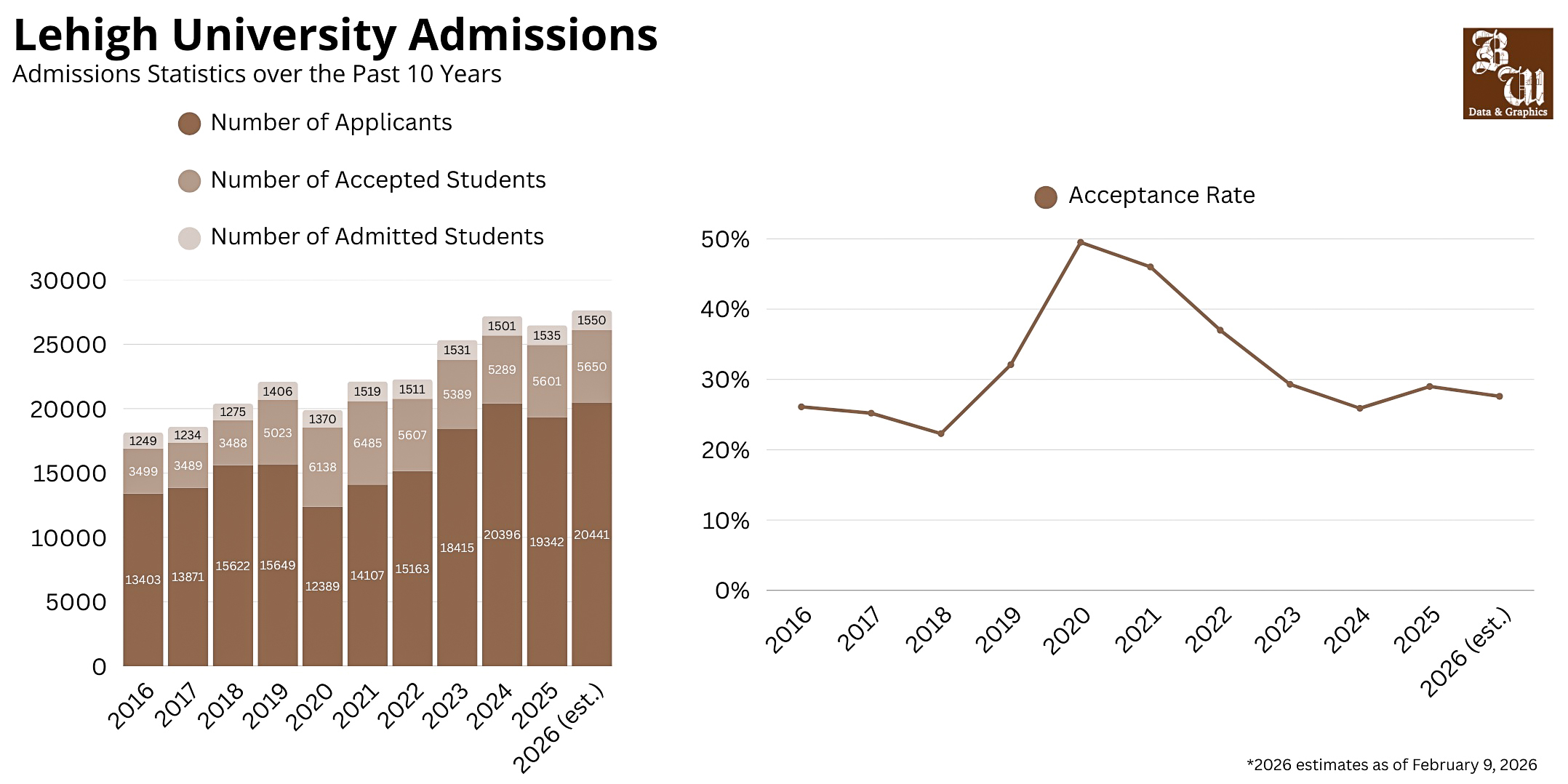
Lehigh received a record 20,441 applications for the Class of 2030, a 5.7% increase from last year’s recruitment cycle, according to an email from Amy White, the director of media relations in the Office of Communications and Public Affairs.
Dan Warner, the vice provost for admissions and financial aid, said applications increased about 10% in the Northeast and by 15% in other regions.
He said, applications rose across several demographics. Female applicants outpaced male applicants, and the university saw growth in local applications as well as from U.S. regions outside the Northeast, particularly the South and West.
At the same time, the university experienced a 20% drop in international applicants. Warner said the decline was reflected across early decision I, early decision II and regular decision.
“That’s not something unique to Lehigh, it seems to be a broader national trend,” Werner said.
According to The Associated Press, the number of international students entering the U.S. dropped by one-fifth in August. Fewer foreign student visas were issued during the past academic year, and a travel ban affected 19 countries.
Bruce Bunnick, the director of undergraduate admissions, said the political climate may have contributed to the decrease in international applicants this past cycle. At a time when many colleges and universities are bracing for the demographic cliff, he said the drop stands out.
The demographic cliff refers to declining birth rates over the past 17 years, a trend that began during the 2008 recession and continued through the pandemic. Warner said, this year marks the first college recruitment cycle in which fewer 17-year-olds are graduating from high school and applying to college.
“We’re happy the application pool is up, especially in a year when the demographic downtown in the Northeast has been felt more across institutions of higher education here in the Northeast — primarily in Pennsylvania, New Jersey and New York — where we draw many of our applications from,” Bunnick said.
He also said Lehigh’s domestic and international recruitment strategy include sending representatives to college fairs and regions where the university is looking to expand awareness. For international outreach, representatives travel to different regions on a rotating basis, and the university leverages its alumni network overseas, which is especially strong in the U.K.
Bunnick said the university has seen growth in applicants from Africa and Latin America, and that the geographic origins of its international students have become more diverse.
When he began reviewing applications 28 years ago, he said most international applicants were from China. In recent years, he said, applications have come from a broader range of countries.
According to Lehigh News, the university received 598 local applications this cycle, a 12.4% increase from last year and the highest number in Lehigh’s history.
Bunnick said the increase in local applicants is due to expanded outreach through guidance counselors and community-based organizations in the Lehigh Valley.
“It’s not to suggest that we had a dwindling number locally,” Bunnick said. “We certainly didn’t, but we felt that as a member of the Lehigh Valley — this community — we wanted to be good neighbors and good partners with the schools,” Bunnick said.
Warner said, applications to the College of Health also increased. The college recently celebrated its fifth anniversary and introduced a new interdisciplinary program, Integrated Business and Health. Warner said recent graduates have helped the program gain traction.
He also said Explore Lehigh, which allows first-year students to take courses across all four colleges during their first semester, received more than 400 applications this cycle. The university plans to enroll 15 more first-year students than last year, bringing the intended Class of 2030 to 1,550.
David Joseph, the executive director for auxiliary services for housing, dining and conferences, said current undergraduate housing couldn’t accommodate a significant enrollment increase. He said, small increases, however, can be managed with “flex spaces.”
He said flex spaces are small double rooms typically used as singles that are converted to doubles when additional housing is needed, often for first-year students.
“I’ve been here since 1983 and I can’t remember a year we did not use flex rooms,” he said.
Michaela Criswell, the associate director for housing services, said 50 to 60 students were placed in flex spaces for the 2025-26 academic year, occupying about 30 rooms.
To accommodate future growth, the university plans to construct a new residence hall, primarily for underclassmen, between the Drinker and McClintic-Marshall residence halls. Joseph said construction on the 370-bed facility will begin in the fall and is expected to be completed by fall 2028.
The new residence hall will increase overall on-campus housing capacity and allow existing spaces to accommodate more juniors and seniors.
Comment Policy
Comments posted to The Brown and White website are reviewed by a moderator before being approved. Incendiary speech or harassing language, including comments targeted at individuals, may be deemed unacceptable and not published. Spam and other soliciting will also be declined.
The Brown and White also reserves the right to refuse the publication of entirely anonymous comments.