



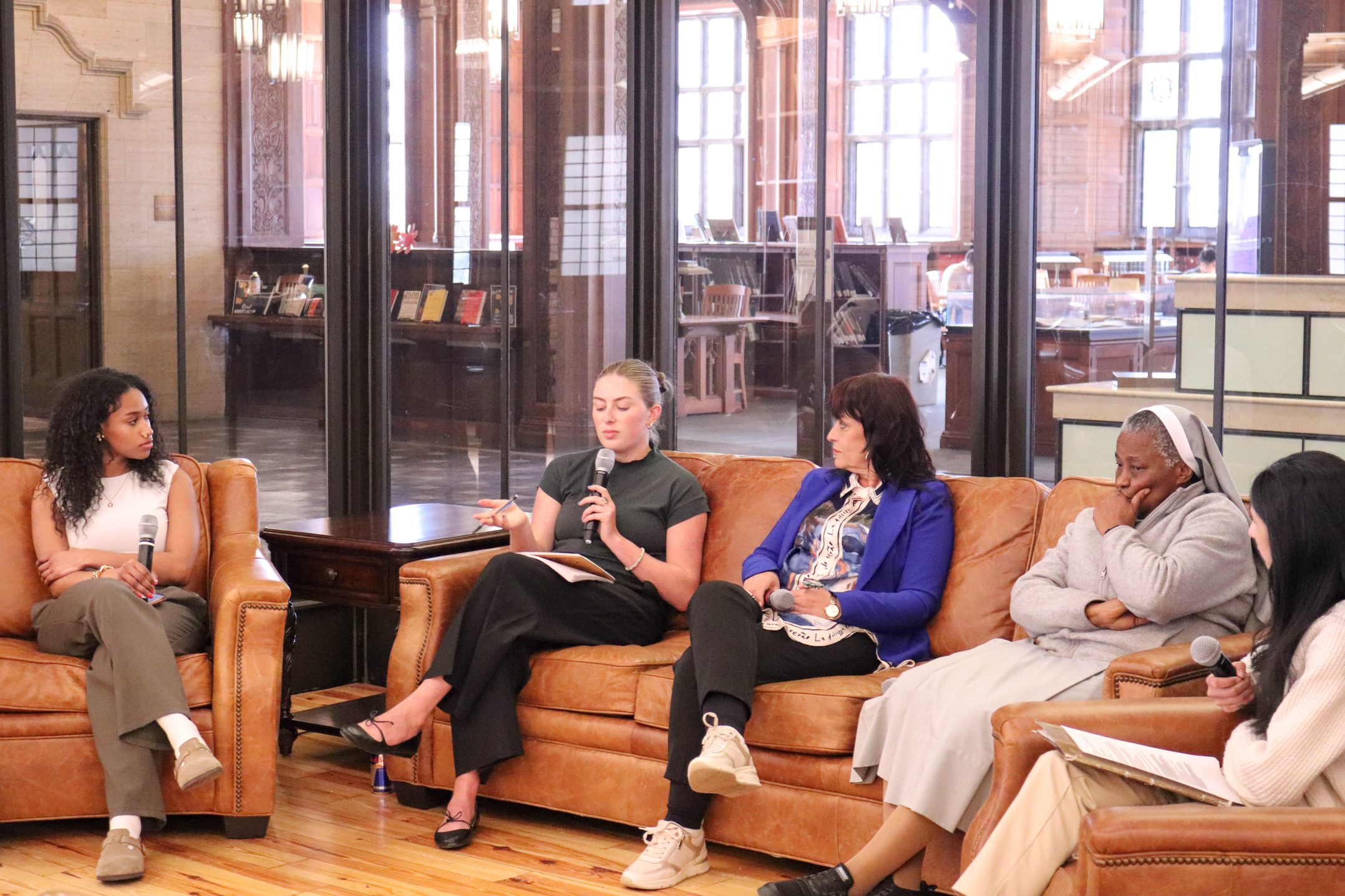
A panel hosted by the Lehigh United Nations Youth Representative program on Thursday discussed technology as a potential resource for women facing sexual abuse and isolation.
The panel, titled “From Access to Agency: Digital Participation and Women’s Rights Across Contexts,” took place in Linderman Library and featured Sister Francisca Ngozi Uti, founder and director of the Center for Women Studies and Intervention, Nataša Pavlovic Bujas, president of the International Public Relations Organization, Amelia Chandless, ‘26, youth representative for the Nadam Foundation and Risa Nkululeko, ‘26, youth representative for the Nor Luyce organization.
Around 12 students attended the panel, which was moderated by Diya Narayan, ‘28, a youth representative for the International Public Relations Association. Both Uti and Bujas said the gender gap is currently larger than ever, and society still has significant work to do to ensure equal rights for women worldwide.
“Thirty years ago, the gender gap was about invisibility,” Bujas said. “We were not visible. We wanted to show up somewhere and say something. Today it is about vulnerability, and this gap is getting bigger.”
Nkululeko said women’s perceived vulnerability contributes to high rates of domestic abuse worldwide. She also presented on the topic Friday at the United Nations Commission on the Status of Women.
Nkululeko said an estimated one in three women globally have experienced domestic abuse in their lifetime. She also said technology can be a tool to prevent abuse and help women in dangerous situations.
“Technology can be leveraged for women to receive help, especially when they are isolated from their communities, loved ones or families by their abuser,” Nkululeko said. “Nowadays, we’re able to have these platforms, these technical advances where people can locate you. We can also erase the stigmas around people who experience domestic violence and what that looks like.”
Uti said economic empowerment remains a major challenge for women globally. She said financial independence is key to improving conditions and increasing digital literacy.
Chandless said another obstacle for women’s rights is the loss of institutional protections globally and in the U.S. The U.S. hasn’t ratified the U.N. Convention on the Elimination of All Forms of Discrimination Against Women, which Uti said is a significant issue.
“We look at America as the most advanced nation in the world, but there’s still that gap,” Uti said. “That gender gap is still there.”
Panelists discussed both the positive and negative potential of technology to empower women. Chandless, who’s studied the female information technology workforce in Kerala, India, said digital literacy can improve female’s financial situation.
“With technology, you can have that income without migration and you just have more options available to you to have economic empowerment and to improve your situational life,” Chandless said.
Uti, who’s from Nigeria, agreed with Chandless, but said the impact of technology depends on location. Even when people have devices, she said there’s often limited access to electricity or Wi-Fi.
While technology has its benefits, Bujas said students should also be aware of its risks.
Chandless said she’s concerned about misuse of technology, like when women in countries such as India train artificial intelligence by classifying violent and pornographic content for pay without the ability to report it due to legal agreements.
“There was no legal recognition of psychological harm from these jobs so when talking about how AI affects economic empowerment, I think it’s a developing story,” Chandless said. “It’s hard to predict where things are going right now.”
Daniella Gibson, ‘28, said she attended the panel because she will conduct research this summer in Uganda on how globalized media and neoliberal reforms influence youth.
She asked panelists about media literacy, including how it can benefit young women in conservative communities and how a lack of media access can pose risks.
“By going to the panel, I feel like I got so many questions answered,” Gibson said. “I’m just in the early phase of my research, but I feel like I already got so much advice about what to do here and what to do when I’m actually there in Uganda.”
On Friday, Lehigh students serving as youth representatives presented at the United Nations Commission on the Status of Women. Narayan, who moderated the panel, is one of them.
Narayan said the panel helped prepare her for the presentation.
“It’s definitely helpful to talk about economic empowerment, but also how technology is on the rise, what we can do, and how many communities don’t have access to technology,” Narayan said.
Although global issues can feel overwhelming, Bujas said students can still make an impact by raising awareness. She encouraged students to use their phones at platforms and act as global citizens.
“You should develop cultural intelligence,” Bujas said. “That’s the skill of the future. If you know much more about other cultures, you should understand how people live and why their tradition is there.”
Comment Policy
Comments posted to The Brown and White website are reviewed by a moderator before being approved. Incendiary speech or harassing language, including comments targeted at individuals, may be deemed unacceptable and not published. Spam and other soliciting will also be declined.
The Brown and White also reserves the right to refuse the publication of entirely anonymous comments.