



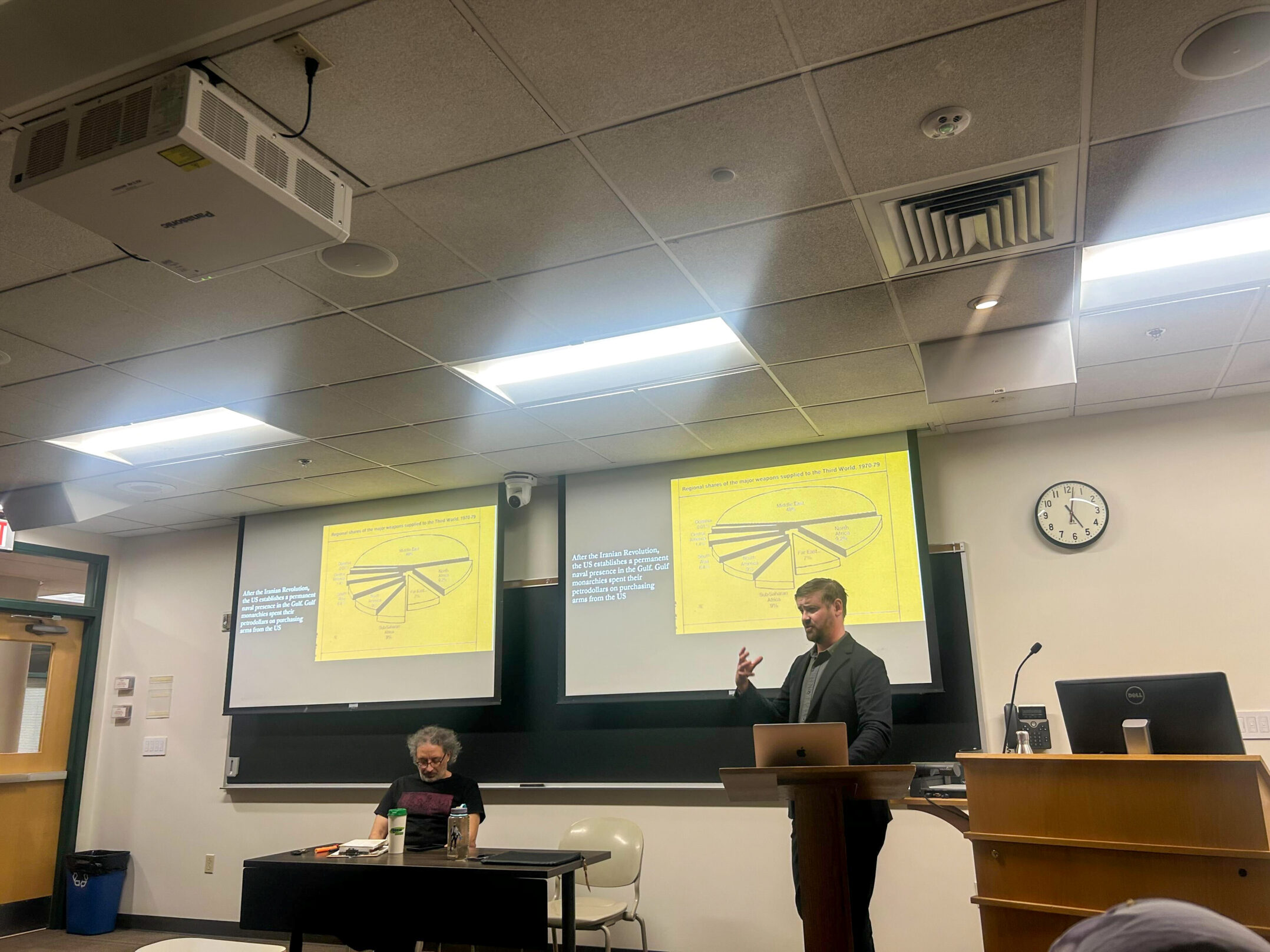
The Student Political Action Coalition hosted a talk on Monday exploring U.S. intervention and ongoing global conflicts to help students better understand current international political events.
The student-led group, focused on political education and activism, organized the event in Maginnes Hall, featuring presentations from faculty members and students on the history and consequences of U.S. involvement abroad.
Speakers included Owain Lawson, assistant professor of history, who studies 20th-century Lebanon and environmental justice, and Fara Farbod, ‘94G, a Moravian University adjunct instructor of political science, who discussed U.S.-Iran relations and imperialism.
Lawson began the discussion by outlining the historical context of U.S. military intervention.
He discussed the significance of the “Seven Sisters,” the seven major multinational oil companies — BP, Shell, Chevron, Gulf Oil, Texaco, Exxon and Mobil — which dominated the global oil industry and played a major role in shaping U.S. influence in the Persian Gulf.
Lawson said U.S. imperial power and Western oil companies like the “Seven Sisters” helped shape the Persian Gulf through oil and political control, working with Gulf monarchies and supporting dictatorships to protect oil interests.
He said this historical context is essential to understanding today’s political tensions in the region.
“What I was trying to do in my remarks was to help people understand the history of security and thinking about the political economy of oil and how that shapes the kind of moment,” Lawson said. “A lot of that history just doesn’t get talked about, or it’s very difficult to get a good grasp.”
Lawson said understanding this history should also lead to broader discussions about democracy and political power in the region.
“I think it’s really important to have open conversations about matters, questions of democracy,” he said.
Farbod discussed the history of U.S.-Iran relations, focusing on how past U.S. interventions have shaped current tensions in the region. He referenced the 1953 U.S.-backed coup in Iran and the 1979 Iranian Revolution, emphasizing the role of oil and geopolitical strategy in U.S. foreign policy.
He connected these historical decisions to present-day tensions, explaining how past interventions continue to shape ongoing conflicts in the Middle East.
“Awareness is key to becoming a good citizen,” Farbod said. “By awareness, I mean awareness in the context of a society in which a lot of discourses are created by the elites and the media to confuse and obscure what is going on in society, and also what’s going on in terms of policy.”
Farbod ended the discussion by encouraging students to advocate for what matters to them.
He encouraged students to identify their interest outside of academics and connect with others who share them, emphasizing the importance of not only building awareness and critical understanding but also taking collective action to influence both domestic and foreign policies.
Ibtihal Gassem, ‘27, lead organizer for the Student Political Action Committee, said many students are trying to better understand why the U.S is involved in global conflicts and what those decisions mean domestically.
“With everything that’s happening with Iran and what’s happening in Lebanon, I feel like students and Americans are just confused about what’s going on,” she said. “It’s easy to think something happening across the world doesn’t affect us, but when you consider what it means for our safety or where resources are going, it becomes very real.”
Gassem said Student Political Action Committee hopes to host similar events in the future that encourage student dialogue on current global and political issues.
1 Comment
The Student Political Action ***Coalition***, not “committee”. Let’s get it right B&W
Comment Policy
Comments posted to The Brown and White website are reviewed by a moderator before being approved. Incendiary speech or harassing language, including comments targeted at individuals, may be deemed unacceptable and not published. Spam and other soliciting will also be declined.
The Brown and White also reserves the right to refuse the publication of entirely anonymous comments.