



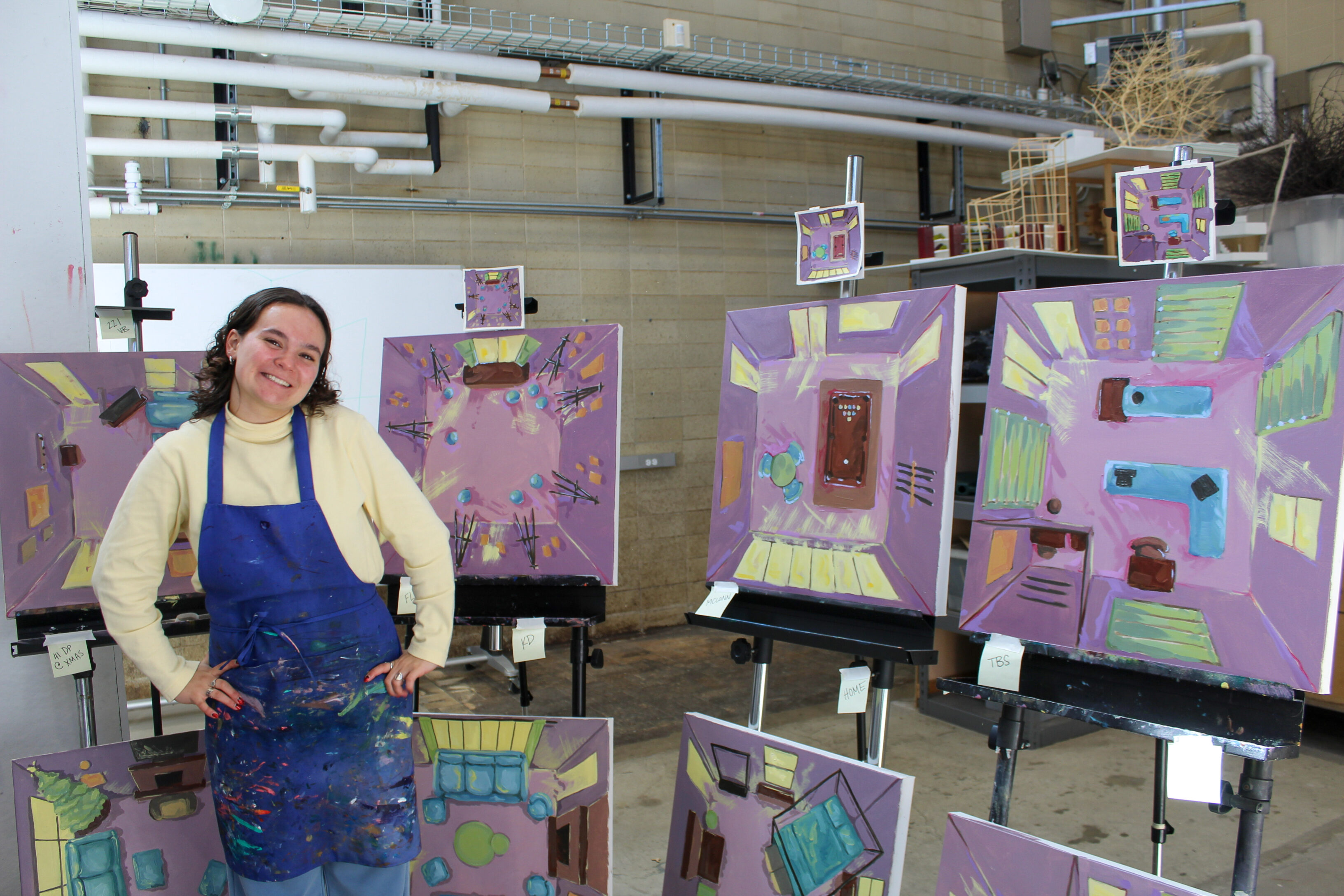
The mauve and purple walls of Cafe the Lodge are a hue that Charlotte Schwartz, ‘26, knows well.
She said that same shade filled her painting palette while working in Lehigh’s art studio over the past four years and now appears in nine of the 13 oil paintings hanging in Cafe the Lodge’s Cappuccino Room Gallery’s walls.
For her senior year capstone, Schwartz said she used a single color palette and a bird’s-eye perspective to depict nine physical spaces representing her strongest memories in an exhibition titled “INHABIT.” Installed April 3, the exhibit will remain on display through May 18.
In an artist’s statement displayed alongside the work, Schwartz explained the conceptual meaning behind the 13 paintings. She acknowledged the complexity of the series and said while the exhibit is visually accessible, it may be difficult to interpret.
Drenched in confident strokes of purple, buttery yellows, misty blues, earthy browns and greens, each canvas recreates a “room” from her life. When displayed together, she said the works form one cohesive painting.
Near the back of the gallery, four smaller canvases feature a darker, more contrasted palette. In these works, Schwartz said she applied looser brushstrokes and explored more subjective themes.
A target with an arrow piercing the bullseye.
An abnormally shaped hand.
Leaves in a mirror.
One shoe.
“These four works, although small, represent the looming presence of obsessive compulsive disorder in my day-to-day existence,” Schwartz said.
For her capstone, which she’s worked on since last semester, she created the exhibit to show how these two worlds coexist within her experience living with OCD.
Schwartz said she feels as though she inhabits two realities at once: one intangible, existing behind her eyes, and one tangible, existing in the physical world.
A New Jersey native majoring in studio art with a minor in marketing, Schwartz said art has always been part of her life. She remembers painting on mini easels during her preschool’s “art appreciation days” at 4 years old.
“My teacher pulled my mom aside,” Schwartz said. “She said, ‘This is all she wants to do. She has no interest in any of the other stuff we’re learning. I don’t know if you’ve noticed, but we’ve noticed that she really enjoys being creative and we think that this is something she should stick with.’”
Schwartz said her mother immediately signed her up for art classes and camps. While her peers attended sports practices after school, she said she spent hours at her art teacher’s house, developing her style and experimenting with different mediums.
Her father said she was “born” making things, and he and his wife always knew art was going to be an important part of her life.
“No matter (where Schwartz) goes from here, we always knew that making stuff is going to be part of who she is,” he said.
Schwartz said she knew she wanted to continue pursuing art in college but wasn’t drawn to a small, specialized art school. She said Lehigh appealed to her because it offers a strong art program within a broader academic environment.
In spring 2025, she studied in Florence, Italy, where she was immersed in a community of artists.
“I was surrounded by people who were in the (art) studio, day in and day out,” Schwartz said. “We’d order pizza to our studio at 1 a.m., drinking bottles of red wine and painting the whole time. We were constantly talking about art, surrounded by art and making art. It was the most transformative experience.”
Outside the studio, Schwartz said she lived with another artist who also has OCD. For the first time, she said she was able to connect deeply with someone over their shared experiences.
“It was the first time I saw eye to eye with someone,” Schwartz said.
Together, they explored ways OCD could take physical form through art.
Schwartz said her roommate encouraged her to create art that honors physical places tied to important relationships, milestones and the intangible “places” that exist in her mind.
“I am equally defined by physical, tangible places as I am by the spaces only my mind knows well enough to describe,” she said.
She said the concept for “INHABIT” was born during her summer in Florence. After returning to Lehigh in the fall, she began working with art professor Deirdre Murphy.
“When (Schwartz) asked if she could work with me for her capstone, I explained to her that capstones require an exhibition or public-facing presentation,” Murphy said. “I asked her if she was ready to really put in the hours to create a body of work that would be ready to share with the community. When she said yes, I said ‘let’s go.’”
Schwartz proposed her concept, which was approved by Murphy and art and design professor Anna Chupa.
Murphy said she encouraged Schwartz to create from memory rather than observation to stay committed to her vision, even through moments of doubt.
Schwartz said working on a single project for months can be frustrating, and she typically tends to “abandon ship” when work doesn’t align with her vision. This time, she said Murphy motivated her to continue.
“I could tell from the outside, as the teacher, that she just needed to keep pushing through,” Murphy said. “It was going to click. I could see that the bones of the paintings were structurally there, she just needed to keep working on it, and she did.”
When selecting a venue, Schwartz said Murphy’s eye for color played a key role. After months of preparation and approval from the director of Cafe the Lodge, the exhibit was installed in the Cappuccino Room Gallery.
Emma Valle, ‘26, said she recognized the first-year dorm common room she once shared with Schwartz in one of the paintings. She said Schwartz’s use of color stood out most.
“(Schwartz) has all of these different periods of her life that don’t necessarily look anything like each other in real life, and she was able to mentally rectify them all in the same style,” Valle said. “That is so whimsical, exciting, vibrant and purple.”
For Schwartz, the meaning of her capstone extends beyond the canvas.
She said she sees the beach house where she slept with her parents during fireworks, the common area of her first-year dorm where she met her boyfriend and current roommate and her family’s living room at Christmas.
She also sees her childhood bedroom, a lake house where she watched “The Notebook” with her friends, the Kappa Delta living room where she built a community, her Florence studio, her senior year house and her mother’s bookstore.
As she looks at the exhibit, Schwartz said she not only sees the spaces she’s inhabited, but also what inhabits her.
Schwartz said the bullseye, titled “OVERCOMPENSATING,” represents pressure to be “on target” and her tendency to overcompensate in relationships.
The hand, titled “KNOCK ON WOOD,” reflects a habit of knocking on wood to maintain good fortune.
The leaves in the mirror, titled “CHOSEN,” represent reliance on external signs for reassurance.
The shoe, titled “THE OTHER SHOE,” represents the feeling of waiting for something to go wrong.
“I’m a big believer that what I do within my mind directly affects what happens to me outside of my mind, which is where that superstitious aspect comes in,” Schwartz said. “I always think that if I behave a certain way internally, then good fortune will transfer over into how things play out for me externally.”
Schwartz said she’s struggled to explain her thought process in the past, but “INHABIT” allowed her to express those ideas visually.
“This is the first time I’ve seen, on paper and in color, a total, well-rounded display of how I am as a human being, tangibly and intangibly,” Schwartz said. “It felt like I was taking back the reins a little bit by showing that I am completely in touch with where I’ve come from and how that has shaped me into who I am, but also that I am completely in touch with what happens behind (my eyes and) that also make me who I am.”
As she’s grown older, Schwartz said she no longer views inhabiting two realities as a burden.
“What a privilege to have observed myself, both inside and out, as I’ve grown up in the places I call home,” Schwartz said. “Thanks to these pieces (people) are able to get a glimpse of not only the life I have led outside of my mind, but also how I experience life behind my eyes, within myself.”
Comment Policy
Comments posted to The Brown and White website are reviewed by a moderator before being approved. Incendiary speech or harassing language, including comments targeted at individuals, may be deemed unacceptable and not published. Spam and other soliciting will also be declined.
The Brown and White also reserves the right to refuse the publication of entirely anonymous comments.