



Update, Sept. 5: Senate President Drew Smith, ‘27, wrote to The Brown and White early Friday morning seeking to provide clarification and context to information we reported Thursday afternoon.
He also requested corrections to our description of the Senate’s procedures, including the fact that all proposed allocations were decided. Within the Student Senate, each allocation adjustment is an individual bill. Senators write, amend and vote on allocations bills throughout the year.
Senators designate funding in bills on a semesterly basis. On Tuesday, 14 bills pertaining to sponsored organizations funding were voted on and passed. Several bills were approved collectively in a single vote. We apologize for the error.
Smith said the votes are considered final unless a group issues an appeal or the Senate chooses to override its own decision. The original story has been corrected, and we apologize for the error.
As for the total budget, The Brown and White was told in an interview that the total allocations budget was unchanged from last year and would again be $536,000. Smith clarified Friday that last year they were allocating from a $491,735 budget. This year’s budget is $536,000.
Smith also said last year, the Senate gave away a total of $497,490 to sponsored and recognized organizations. Despite a 2% budget cut, the Student Senate drained their reserves and other funding in order to provide for recognized clubs.
Smith also clarified that for Senate-recognized clubs, budget requests are made on an event-by-event basis.
In the Student Senate meeting, members of the executive board stated that sponsored organizations have historically received funding once a year, whereas recognized clubs can request funding multiple times through forms submitted to the Senate. The allocated budgets listed in Senate’s bills on Tuesday reflect the allocation to sponsored organizations for the fall semester.
Smith also said the sponsored organizations designation originated in 2016, meaning many organizations have gone through the same club affairs paperwork, interviews and approval as the recognized clubs.
While not stated in the presentation, Smith also clarified that all recognized and non-political clubs get either $100 or $150 at the beginning of the year. The 78 clubs referenced in the presentation received additional funding on top of the designated $100 or $150.
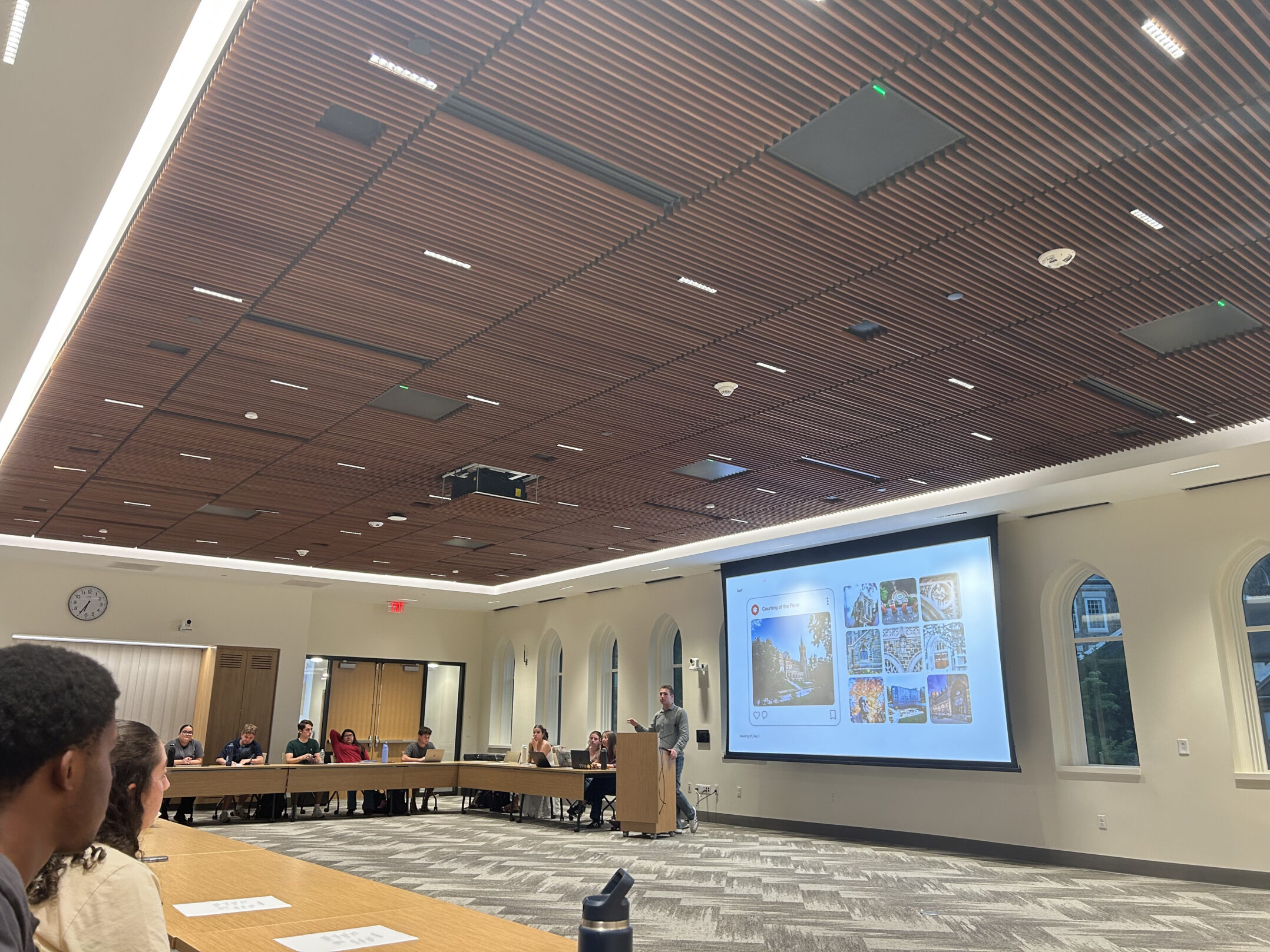
By and large, The Brown and White’s reporting came from a slide deck presented publicly at the Senate meeting, which we have published online along with this update.
Additional reporting in the original report was provided from recorded interviews — which we listened back to and verified. We stand by this original reporting, and we have published clarifications in the original story below if the information impacted the accuracy of the report.
Editor’s Note: During Tuesday’s allocations meeting, senators noted The Brown and White’s presence and asked for comment on the newspaper’s funding cuts. There solely to report on the event, The Brown and White did not discuss its opinions on the proposal or decision.
The Brown and White editorial and business staff at times work together, however the editorial team does not participate in assembling financial reports or funding requests, in line with a longstanding industry goal of maintaining distance between reporting and business decisions, which are handled by the business department.
The Lehigh Student Senate voted to slash the allocations of three longstanding sponsored organizations, and unveiled proposals to adjust the funding of 11 others, during its Tuesday meeting in the UC Boardroom.
It was the first Senate meeting of the year, continuing the annual task of doling out around a half a million dollars to Lehigh clubs and organizations.
Operating with a $536,000 budget, which rose from the $491,735 budget last year, the Senate presentation asserted that these cuts will allow it to reallocate funds to Senate-recognized clubs. The Senate was unable to provide the budgets from previous years after the meeting on Tuesday.
To accomplish its goal, the Senate is taking aim at what it classifies as sponsored organizations, which, according to the Senate’s bylaws, are organizations with close ties to a Lehigh department or office. These organizations receive funding from the Senate once per year.
Senate-recognized clubs, on the other hand, have gone through the process of filing Lehigh Club Affairs paperwork, interviews and have been approved by the Student Senate Club Affairs committee. These groups can ask for additional funding at any time.
Last year, sponsored organizations received $460,750 or 86% of the Senate’s budget, while recognized clubs received $36,740, or roughly 7% of the budget.
Nine sponsored organizations discussed at the meeting are slated to have their allocations cut, with two allocations held — or unchanged — and four to receive bumps.
Not all Senate clubs received funding. There are over 200 Student Senate-recognized clubs, but only 78 received additional aid over the past year.
Historically, the 21 sponsored organizations have received the vast majority of the funding in order to maintain school-wide initiatives, such as Lehigh arts programming and events for underrepresented groups within the undergraduate student body.
According to Article XIV of the Student Senate, and included in the presentation by Treasurer Avery Eskin, ‘28, the Senate is not to cut a sponsored organization’s allocation by more than 10% from the previous year, and no more than 5% for organizations that received over $10,000.
The Senate bylaws also state that cuts are up to their discretion “based on merited reasons.”
“We are legally able to cut as we see fit,” Eskin said, reading from her presentation.
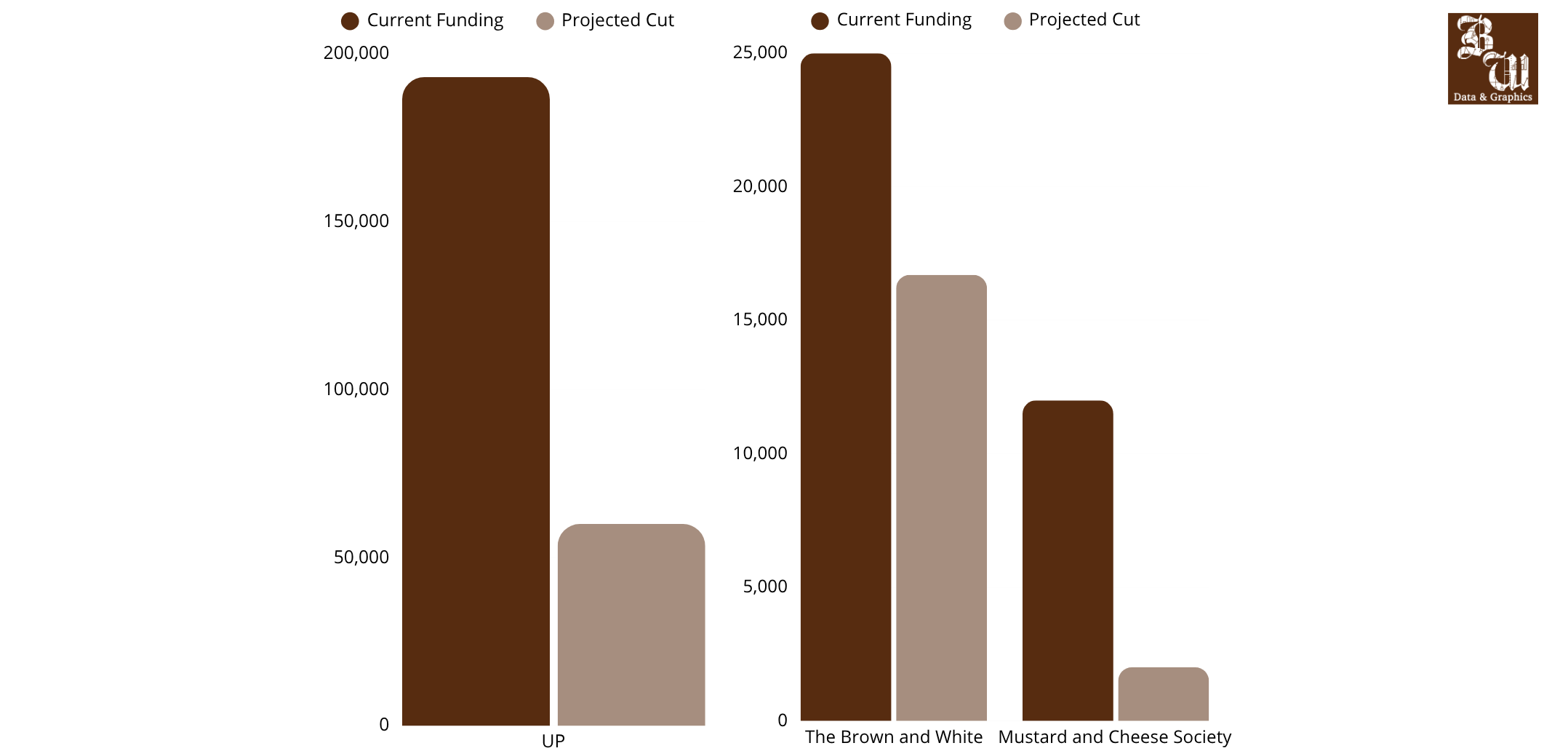
Cuts already voted on and passed include UP (68.9% decrease from $193,000 to $60,000), The Brown and White (33.2% decrease from $25,000 to $16,700), and the Mustard and Cheese Drama Society (83.3% decrease from $12,000 to $2,000).
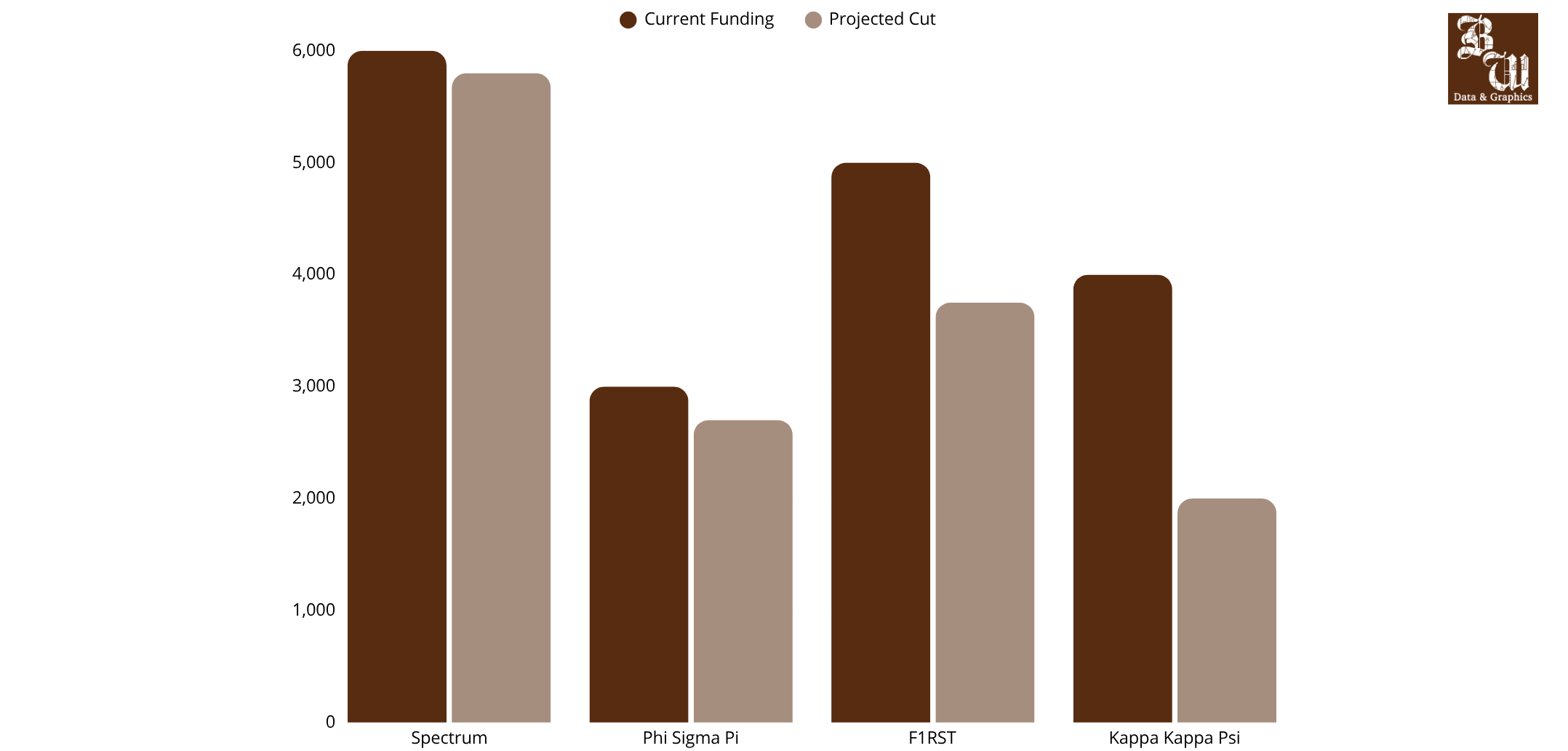
Senate has also approved cutting the allocations of the following organizations for this semester:
- Spectrum ($3,000 to $2,900)
- Phi Sigma Pi ($1,500 to $1,350)
- F1RST ($5,000 to $3,750)
- Kappa Kappa Psi ($2,000 to $1,000)
A member of the Marching 97 and two members of the Black Student Union attended the meeting as senators and gave rationale for their clubs’ spending. These were the only members of sponsored organizations who identified themselves at the meeting.
The Marching 97, which was initially proposed to have its annual allocation cut from $35,000 to $25,000, had its proposal amended and maintained its previous allocation following the discussion.
Black Student Union was initially proposed to have its budget cut from $9,500 to $8,700. Ultimately, an amendment to maintain its previous allocation passed after a round of discussions with Senate member Jackson Dancy, ‘28, who also sits on the BSU board serving as president.
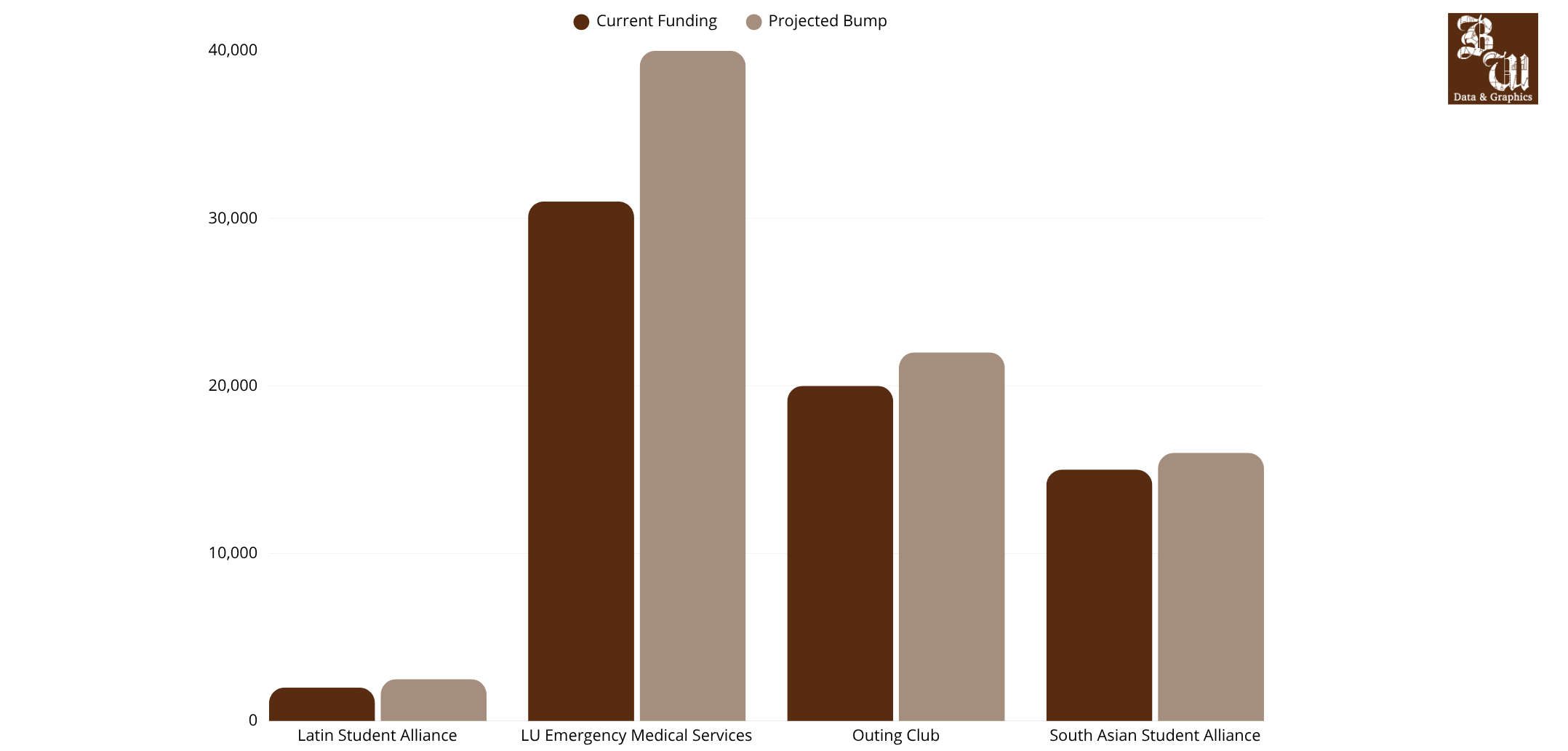
Meanwhile, four sponsored organizations will receive annual bumps to their allocation for the 2026-2027 school year:
- Latin Student Alliance ($2,000 to $2,500)
- Lehigh University Emergency Medical Services ($31,000 to $40,000)
- Outing Club ($20,000 to $22,000)
- South Asian Student Alliance ($15,000 to $16,000)
Seven organizations were not able to receive funding at the time of the meeting because the Senate didn’t receive their financial reports in time for review. These organizations include the Asian Cultural Society, Lehigh Choral Arts, Orchestra, ensembles including Wind, Jazz, Southeast Asia at Lehigh and the Society for Hispanic Professional Engineers at Lehigh.
(Lehigh Orchestra was not mentioned in Student Senate’s presentation Tuesday, but Smith clarified they are also awaiting financial reports from that group.).
System and rationale for cuts
The allocation process begins when sponsored organizations give budget request presentations in September of the previous year. The Senate treasurer then requests financial reports and receipts from all sponsored organizations and recognized clubs.
The treasurer communicates with club and organization executive board members, as well as their advisers, over the summer months. Eskin said when creating the designated cuts for sponsored organizations, she consulted with Student Senate President Drew Smith, ‘27, and the Senate’s two advisers, Ashley Lemmons, assistant vice president and dean for student life and leadership, and Sara Runyon, the assistant dean and director for student involvement.
Part of the allocation process this year included a formula Eskin developed to make cuts to the sponsored organizations and recognized clubs.
For all groups, she calculated the cost of each organization to host an event per person per hour. According to the formula, it costs $2.62 per person per hour for the Black Student Union to host an event, whereas it costs $37.17 for University Productions.
“We’ve been asking for hours of attendance and cost for the past fiscal year, so for fall of 2025 and 2026,” she said. “It did not come up for all (meetings with sponsored organizations and clubs) because that wasn’t necessarily the issue when I spoke to them.”
Eskin similarly cited attendance at UP events as justification for the cuts. As examples, the presentation noted the Ricky Montgomery concert cost $73,127.80, and with 400 students attending, she calculated that the average cost per student per hour was $94. Further, the presentation noted that the comedy show cost $38,141.34 with 150 students in attendance.
With the Senate having cut the UP allocation to $60,000, Eskin acknowledged that they may not be able to put on the spring concert this year.
UP President Ella Smith, ’27, initially spoke to The Brown and White but retracted her original statement and issued the following comment on behalf of the organization:
“After meeting with Student Senate, and we provided them University Productions financials for the past 10 years, they have decided to make a 67% cut to our budget, which now prevents us from providing Lehigh students with three of our biggest and most anticipated events of the year, being the spring concert, Spring Carnival, and the Fall Comedy Show. University Productions has decided to appeal this, and we hope the Senate will review our appeal and make the best choice for the student body.”
In some allocation review situations, a different rationale was presented.
Cuts to The Brown and White primarily impact its newspaper printing. Eskin and other senators in debate said that there is “not enough physical paper demand” to justify the number of printed copies, but the Senate did not present any tangible data explaining the assertion. She suggested that print issue counts be trimmed from 1,200 to 800 copies per issue, suggesting that the allotment “would support 800 copies.”
Brian Creech, professor and chair of the Journalism Department, said decreasing the amount of copies would actually drive up printing costs.
“The way in which The Brown and White printing contract is structured with our vendor is we pull together what is a minimum viable order, i.e. the minimum number of copies that make it worth the printer’s time to publish, and 1,200 is that minimum viable,” Creech said. “If we were to publish fewer than 1,200 copies, it would actually, ironically, drive our printing costs up.”
During the summer and spring every year, he said The Brown and White explores possible printing options in New Jersey and eastern Pennsylvania, and the printer that the paper uses now has consistently proven to be the cheapest available option for printing on newsprint.
He also said the cost of newsprint has consistently gone up, and the paper that newspapers are printed on is largely imported from Canada, which has also impacted pricing because of tariffs imposed on Canada by President Donald Trump.
“Our vendor has been really good about not passing along those costs, and so we’ve continued to maintain a reasonably cost-effective contract,” Creech said.
The Brown and White also asks for less money than it costs to print the paper every year.
Last academic year, the cost was around $31,000 for all of The Brown and White printing over the course of the year, and its request to the Senate was for $25,000. Creech said he recognizes the department and business side of The Brown and White always need to find a way to fill the gap.
As for the rationale behind eliminating the majority of the Mustard and Cheese Drama Society’s budget, Eskin’s presentation said the society used to put on shows, but now uses its allocated budget to take trips to Broadway shows, which is more costly.
In February of this year, members of the Mustard and Cheese Drama Society performed “The Importance of Being Earnest.”
The Brown and White has reached out to the Mustard and Cheese Drama Society for comment and is awaiting a response.
Black Student Union maintains allocation
The Black Student Union was initially proposed to receive an 8.4% decrease to its allocation, but survived the cuts after a lengthy back-and-forth.
The amendment to maintain BSU’s allocation passed 22-1. The Senate then moved to vote on the new bill, with the amendment to maintain BSU’s financial standing. The motion passed 23-0, with BSU President Jackson Dancy, ‘28, and BSU Vice President Mia Ware, ‘28 — also members of Senate — abstaining due to conflict of interest.
Eskin initially justified the cuts on the grounds that the union spent $1,310.82 on merchandise and were able to make back enough money to get the cost down to $651. She said they also spent $157.86 on gift cards, neither of which the Senate funds.
Dancy said he is only aware of these bylaws because he’s a senator, and he didn’t realize the organization would be penalized.
He said the merchandise was outsourced from Sacred Star, a clothing brand by Gabe Kagwanja, ‘27.
“When we made the initial purchase, nothing was noted,” Dancy said. “Nothing was flagged or anything. We didn’t know that we weren’t allowed to use merch or purchase merch.”
He also said the funds to purchase the merchandise came from a separate fund, which contains organization savings, alumni donations and funding from “various departments.”
In an interview with Eskin, she said the receipt she has from their financial report said the funding to pay for Sacred Star’s merchandise came from the Senate.
The Brown and White reached out to Eskin for the original receipt, which she provided. The receipt did not show where the funds came from.
Dancy said he was concerned BSU’s allocation would be cut because the club only serves 4% of the undergraduate student population.
Eskin said the formula is not intended to harm any clubs, including those serving underrepresented communities on campus, pointing to the vote to increase funding for the Latin Student Alliance from $2,000 to $2,500.
Yet, allocation cuts for Spectrum, which supports the LGBTQ+ community, and F1RST — Lehigh’s first-generation student community — were voted and passed at the Tuesday meeting.
“I think the attendance per hour is not a good system,” Ware said. “The thing is, I understand what we’re (Student Senate) trying to do because I would agree we do not give enough funding to recognized clubs. But I also — at the same time — don’t think we should be limiting the funds that the cultural organizations have just because they are also sponsored organizations.”
According to Smith, all organizations have the right to appeal these allocation decisions, though neither the process nor timeline was disclosed at the meeting.
4 Comments
Reporting worthy of the B&W
I just tripped over this article but it was enlightening to me, an alum from ‘84.
#shrink B&W budget. Posts nonsense lib material and moderates any disagreeing comment. A joke.
“Free Speech” wants to defund a news outlet.
Comment Policy
Comments posted to The Brown and White website are reviewed by a moderator before being approved. Incendiary speech or harassing language, including comments targeted at individuals, may be deemed unacceptable and not published. Spam and other soliciting will also be declined.
The Brown and White also reserves the right to refuse the publication of entirely anonymous comments.