



Update, Sept. 15: A federal court postponed the effective date of these changes on Sept. 14, prohibiting the Department of Homeland Security from implementing them.
The existing Duration of Status framework remains in place as litigation continues.
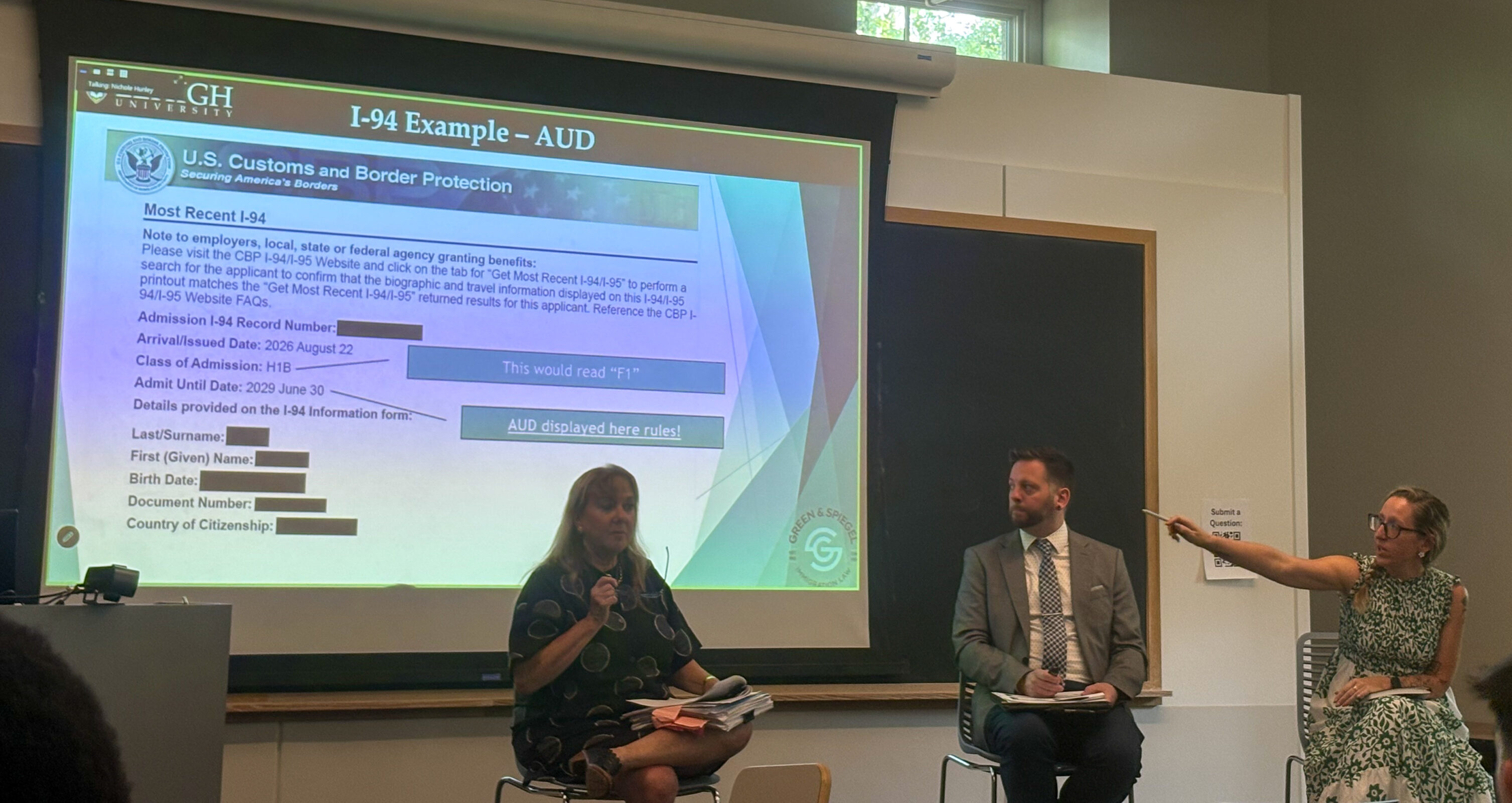
The Duration of Status Town Hall was held on Sept. 1 to learn about upcoming changes in federal immigration last Tuesday night in Chandler Ulmann. The changes are set to go into effect on Sept. 15.
This hybrid town hall featured immigration attorneys from Green & Spiegel, including Associate Attorney Andrew A. Fuller and Counsel Wendy Castor Hess. The meeting explained the federal Duration of Status rule change, its implications for members of the Lehigh community and answered community questions.
Cheryl Matherly, vice president and vice provost for international affairs, opened the discussion, recognizing immigration changes and uncertainty on campus.
“You’re not dealing with this kind of uncertain period alone,” Matherly said.
She left the event early, citing that she had to speak on the same topic at a faculty meeting.
The new policy will end the current Duration of Status (D/S) immigration framework that applies to both students and scholars with F-1 and J-1 status. It will be replaced with set time periods of allowed student admissions into the U.S.
Under the current D/S system, students generally don’t have a required expiration date on their I-94 and are able to stay in the U.S. as long as their immigration status is maintained and they participate in authorized academic activities.
The D/S system also allowed eligible students whose degree took longer to complete an updated I-20 or DS-2019.
Under the new system, students will get an Admit Until Date (AUD), a final date the stay is authorized through based on how long their program is, or a maximum of four years — whichever is shorter, followed by a 30-day grace period.
Fuller said one point of confusion regarding the new policy is whether all international students will automatically get four years of admission.
If students are enrolled in programs shorter than four years, or return to the U.S. after international travel with less than four years remaining in their program, they should expect to receive a shorter admission period.
“Eventually all international students will be impacted in some way,” Fuller said. “There are changes that will apply to every person.”
Students with current I-94’s marked D/S whose most latest entry into the US was before Sept. 15 may qualify for transition benefits, allowing them to stay in the current system for at most four more years. However, international travel, filings to extend F-1 status, hit the four year transition limit or the end of a student’s program may force a student out of the transition group.
The panelists said transition benefits will end for those who travel internationally and return to the country on, or after Sept. 15 and are given a new I-94 with an AUD instead of a D/S.
Those not in the transition group involved in Optional Practical Training are required to fill out additional forms as well.
Students were told to check the information on their I-94 thoroughly, including their AUD, immigration classification and personal information. Additionally, if any errors were found to report them to U.S. Customs and Border Protection as soon as possible.
Passport expiration may also lead to a shortened admission period.
“Always, always, always check your I-94 after every single time you travel,” Fuller said. “I can’t say it enough.”
The new program also changes the process for when students need more time to complete their degrees. The panelists explained how the Office of International Students and Scholars (OISS) may help students obtain an extended I-20 or DS-2019. Students can also obtain a new AUD by traveling internationally or filling out other forms.
After any international travel, students must upload any I-94s to iHome so OISS can review the documents and check for any problems.
The new program creates restrictions on students switching academic programs or transferring schools, requiring undergraduate students to stay at the original school for one full academic year, and placing harsher restrictions on graduate students.
Nichole Hunley, associate director at OISS, who also sat on the panel, said Lehigh will continue to support its students by continuing to provide updated information.
“We have been trying to get ahead of this so that we have time to not worry about this yet, so that other people can submit these applications and we can figure out what works and what doesn’t work,” Hunley said.
According to Hunley, OISS is working with other parts of campus to hold more information events and provide international students with short weekly updates as a part of a new program called the “Monday Morning Minute.”
Hunley said OISS is also reviewing and altering internal procedures with changes around implementation and federal guidance.
A motion hearing for a federal lawsuit challenging the new policy occurred Thursday.
Fuller said the litigation argues the Department of Homeland Security (DHS) didn’t consider the impact of the rule fully or address the thousands of concerns submitted during the public comment period.
He also said the lawsuit has the possibility to delay the policy changes, but other outcomes are possible.
Hess said Green & Spiegel is continuing to work with Lehigh’s ISSO and advising clients to follow the new policy unless a ruling changes that.
While the new rule, as published in the Federal Register, comes with many unanswered questions, Hess said that students should adhere to the new system while litigation is pending, until it is overturned.
Community members seeking more information can go to the Office of International Affairs website or contact OISS staff.
Comment Policy
Comments posted to The Brown and White website are reviewed by a moderator before being approved. Incendiary speech or harassing language, including comments targeted at individuals, may be deemed unacceptable and not published. Spam and other soliciting will also be declined.
The Brown and White also reserves the right to refuse the publication of entirely anonymous comments.