



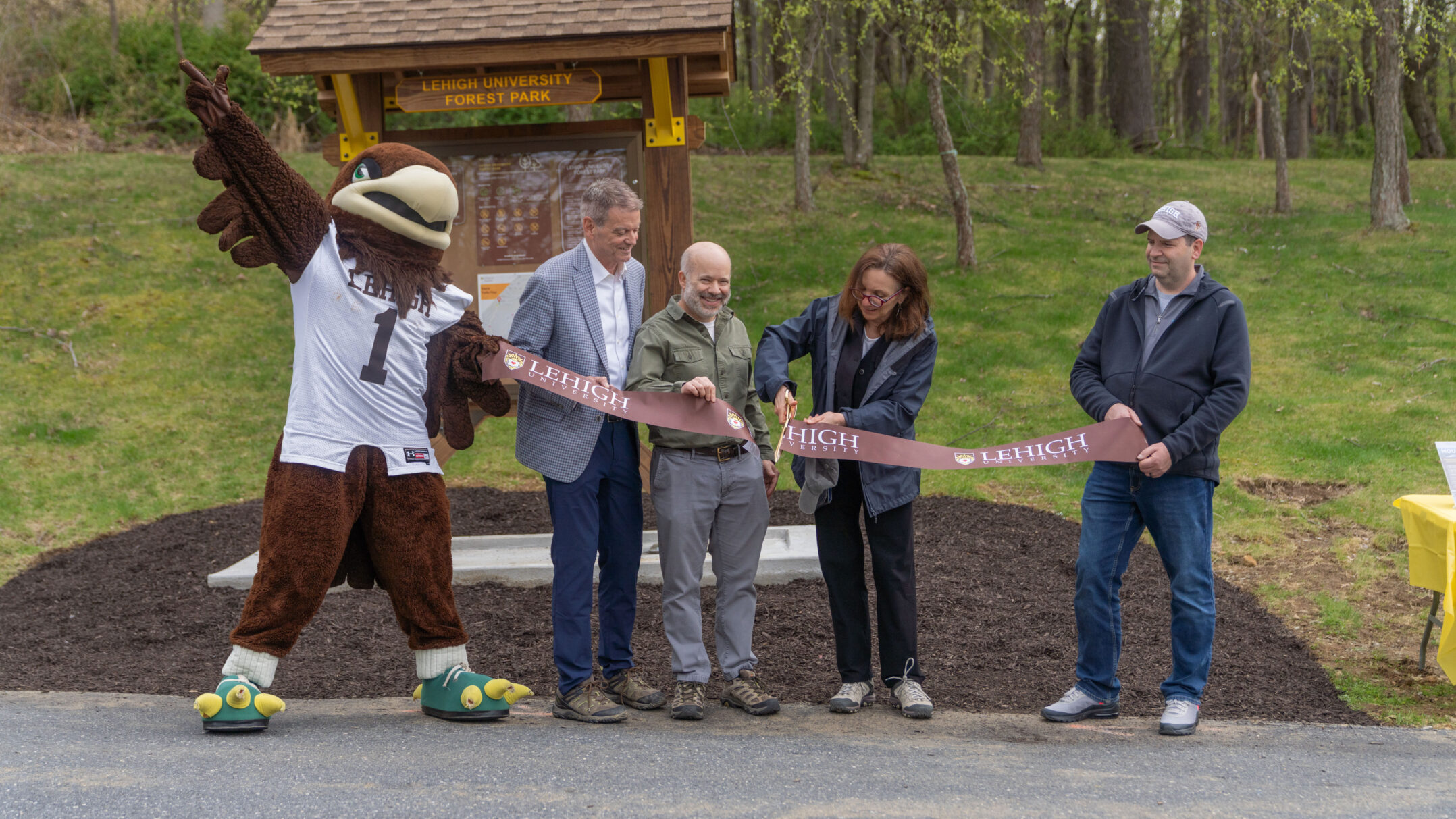
When Joe Klocek, ’98, graduated from Lehigh University, he never expected to be back eight years later as the senior director of design, construction and planning.
In his role, Klocek leads all building initiatives and campus changes at Lehigh. He’s now overseeing the Forest Park Initiative — a project that is transforming the trails through campus that he used to explore as a student.
Part of Lehigh’s 30-year “Making the Future: A Plan for the Lehigh Campus,” includes the Forest Park Initiative, a plan to enhance trails on South Mountain and Asa Packer Campus. They are working to make them more accessible for walkers, bikers and all pedestrians.
Klocek said there is much more space and uncleared trails Lehigh isn’t utilizing, and his goal is to open up more trails that provide people with a place to take a walk, mountain bike, discover Lehigh’s history or even get to other regions of campus.
“The goal is to make Mountaintop Campus more accessible to pedestrians from Asa Packer Campus,” Klocek said. “But the first step is to make people aware that the regions can be accessed easily through these trails.”
While Klocek went to Lehigh as a student, he loved to mountain bike through the trails between Asa Packer and Goodman Campuses.
Klocek said he had access to the few trails that were carved out for mountain bikers, but none of the area was civilian-friendly or generally open to the public.
“There were fewer trails, and even then not officially open to use,” Klocek said. “It was something you only knew about if you discovered it through word of mouth.”
In April 2026, two trails between Asa Packer Campus and Mountaintop Campus opened with a ribbon-cutting ceremony and a press conference at 109 Upper Sayre Park Road.
The Sayre Park Trail is open to Lehigh students, staff and faculty only. There is limited parking, so the trails aren’t open to the public.
The Sayre Park Trail is a 1.5-mile hike that begins at the yellow-marked trailhead and concludes at the blue-marked trailhead along Sayre Park Road.
“These trails have been around campus for a long time,” Klocek said. “I think it’s finally time that we use them for what they’re worth.”
Though access to the Sayre Park Trail is restricted to Lehigh students, staff and faculty, the South Mountain Trail is open to the public, beginning at the green trailhead, just off of Mountain Drive North. The loop includes 0.75 miles of cleared trail.
This trail includes the experimental forest and the arboretum, two sites historically used for research and owned by Lehigh.
Robert Booth, environmental science department chair, said the arboretum contained many tree species native to Pennsylvania, but it stopped being maintained in the 1950s.
“By all accounts, it was one of the most beautiful arboretums in the East,” Booth said. “So we want to build signage that will visualize that important part of Lehigh’s history.”
With the rich history of Lehigh research and activity surrounding the South Mountain Trail, the second phase of the Forest Park Initiative is to make its background known to the community.
Booth said they will achieve this with signage. Part of the signage will point out some of the trees from the arboretum that are still there and tell that history, while adjacent to the arboretum will be signs that describe the experimental forest.
“The experimental forest was planned to test some of the outstanding forest questions of the time,” Booth said. “People wanted to know what kind of trees would grow in the rocky, poor soils of Pennsylvania.”
The signage is expected to be posted along the South Mountain Park Trail by April 2027.
Lehigh Police Chief Jason Schiffer said the signage will provide a more dynamic experience for anyone who walks through the trails. It may include QR codes that discuss the history of the trails.
Schiffer serves on the Forest Park Initiative Board to monitor decision-making and execution from the safety perspective of the Lehigh Community.
“I represent the people around the area to make sure the plan will benefit them,” Schiffer said. “Specifically for the trails, we needed to get rid of any blind corners, overgrown areas and trees that had fallen.”
As the Forest Park Initiative continues, Schiffer said LUPD plans to collaborate with Klocek and his team to enhance access to the trails while preserving the history and natural beauty of Lehigh’s campus.
For Klocek, his entire career has been building, but he said being able to see Lehigh take advantage of areas that weren’t accessible when he was a student is what makes him happiest in his position.
“As long as this keeps going, I’m hopeful that we’ll be able to open up a lot more trails on the mountains,” Klocek said.
These trails might be newly opened for pedestrians, but there also are over 13 miles worth of cleared trails that haven’t been used since the 1950s.
Klocek said the next logical piece to think about is how to get campus involved with changing the forest space to be useful, and he believes that now is the right time to start.
Comment Policy
Comments posted to The Brown and White website are reviewed by a moderator before being approved. Incendiary speech or harassing language, including comments targeted at individuals, may be deemed unacceptable and not published. Spam and other soliciting will also be declined.
The Brown and White also reserves the right to refuse the publication of entirely anonymous comments.