



On a Thursday morning in October, Lauren Iorio, ’29, was walking down the stairs beside McClintic-Marshall House headed to her finance midterm, when she fell and hit her head.
She never took the exam. Instead, she went to the Health and Wellness Center, where staff confirmed she had a concussion.
“I was kind of scared of the stairs after,” Iorio said.
Lehigh’s campus is built into the side of South Mountain. For students who are injured or live with a disability, getting to class can mean navigating steep hills, long staircases and buildings without elevators.
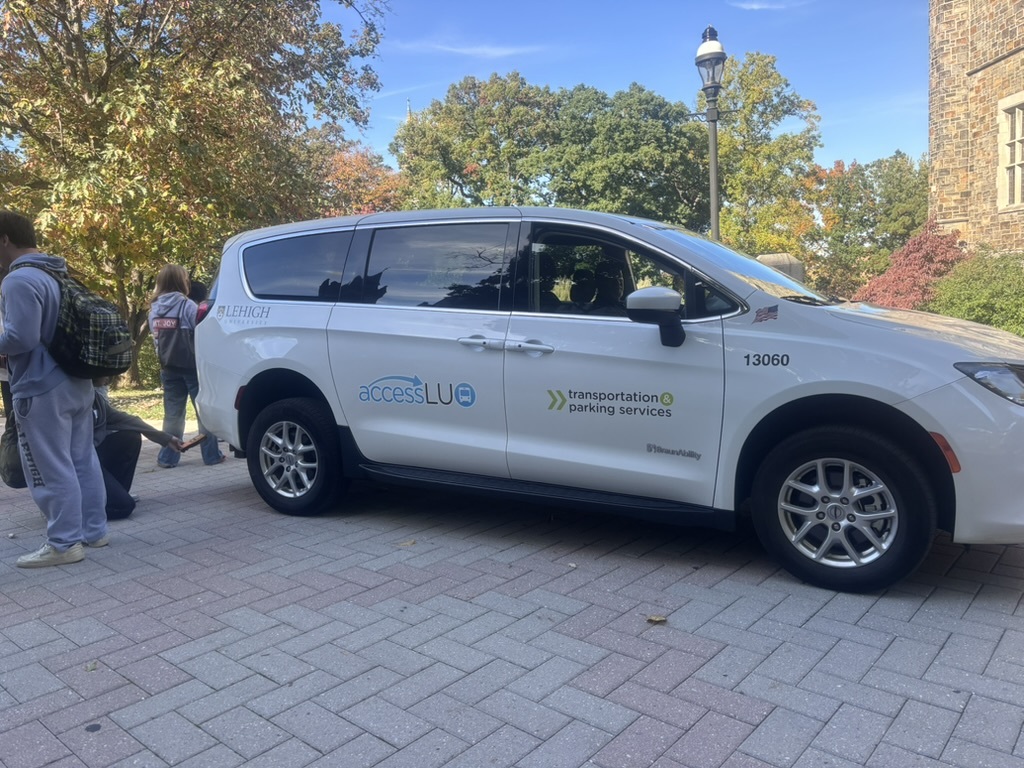
To help students with injuries or disabilities, Lehigh offers academic accommodations and AccessLU, a transportation service that drives around campus.
Although students said it can be difficult to know where to seek help, university officials said a planned change to the registration process could simplify the process.
For Iorio, the system moved quickly. She said after the health center administered a concussion test, they connected her with Student Affairs, who sent her a letter outlining her accommodations.
She said she was excused from the midterm and given extended homework deadlines.
“Getting accommodations for class was very easy because I got reached out to the next day,” Iorio said.
She also said going to the health center first connected her with Lehigh Student Affairs, whereas going directly to the hospital would’ve only provided a doctor’s note.
“I feel like it’s definitely not well known,” Iorio said, regarding available support.
She said the biggest frustration was sending the accommodation letter to each of her professors while recovering from the concussion.
“They still expected me to communicate with my teachers and send everything, and I wasn’t supposed to be on screens,” Iorio said.
She said part of the delay was on her end, since she was slow to fill out a form the office emailed her. Instead, Iorio would prefer the office to send letters directly to professors.
Aubrey Ide, ‘27, is a member of the women’s field hockey team, and said she had a different experience.
Ide tore her ACL during a spring scrimmage during her junior year. Two weeks after surgery, she returned to campus for preseason and was on crutches for the first four weeks of classes.
She said she never contacted Disability Support Services (DSS) and no one from the office reached out.
Instead, she relied on her teammates and the athletic trainer. Because she lives off campus, she said navigating the hill on crutches was impossible.
“Yeah, I just could not walk up the hill at all,” Ide said.
To get to Taylor Gym for a meeting with her coaches, she always had to ask for rides there and back.
In hindsight, Ide said knowing about the available transportation support could’ve changed her experience.
“I think definitely, if disability services reached out to me, I probably would have taken more action and could have saved money if I just took the disability bus,” Ide said.
Undergraduates with temporary injuries work with Student Affairs for academic accommodations, while Disability Support Services approves temporary transportation requests and serves students with permanent disabilities.
A student with a temporary injury can register with Disability Support Services and then be directed to contact the office of either Brandon Morris, assistant dean of students, or Lori McClaind, assistant vice president and dean for student success and advocacy, according to Maria Zullo, assistant dean of Academic Support Services and director of Disability Support Services. Other students may be directed to the services by phone.
Zullo said Lehigh is refining this process and hopes to launch the change at the start of the spring semester. Under the planned system, students with temporary injuries, particularly undergraduates, would register with Disability Support Services through its website.
The online intake form would let students choose temporary or permanent accommodations. If a student selects temporary accommodations, a coordinator would send the case to Morris and McClaind.
Zullo said the revised system may be fully implemented by the spring.
For now, the system relies largely on referrals. Zullo said Sports Medicine contacts DSS when an athlete has a concussion, and the Health Center also refers students.
Morris, who has been in his role for about a year, said his office follows up when an injury is reported.
He said many students he meets are anxious about falling behind academically.
“The priority is (students) first,” Morris said.
Zullo said disability services approves students for AccessLU transportation once they submit documentation, such as a note from the health center or a hospital.
“We can approve them for transportation on the same day,” Zullo said.
However, Zullo said the office is closed on weekends, so a request sent on a Saturday won’t be seen until 8:30 a.m. Monday.
After approval, students must download the goLehigh TRANSIT app and complete a Transportation Services questionnaire before booking rides, a step Zullo said some students miss.
Zullo said the number of students with permanent mobility needs increased this fall, prompting Transportation Services to expand its operating hours Monday through Friday.
Both administrators encouraged students to contact their professors and the appropriate university offices as soon as possible after an injury.
“It all starts with students letting us know if they’ve experienced some difficulty,” Zullo said.
Comment Policy
Comments posted to The Brown and White website are reviewed by a moderator before being approved. Incendiary speech or harassing language, including comments targeted at individuals, may be deemed unacceptable and not published. Spam and other soliciting will also be declined.
The Brown and White also reserves the right to refuse the publication of entirely anonymous comments.