



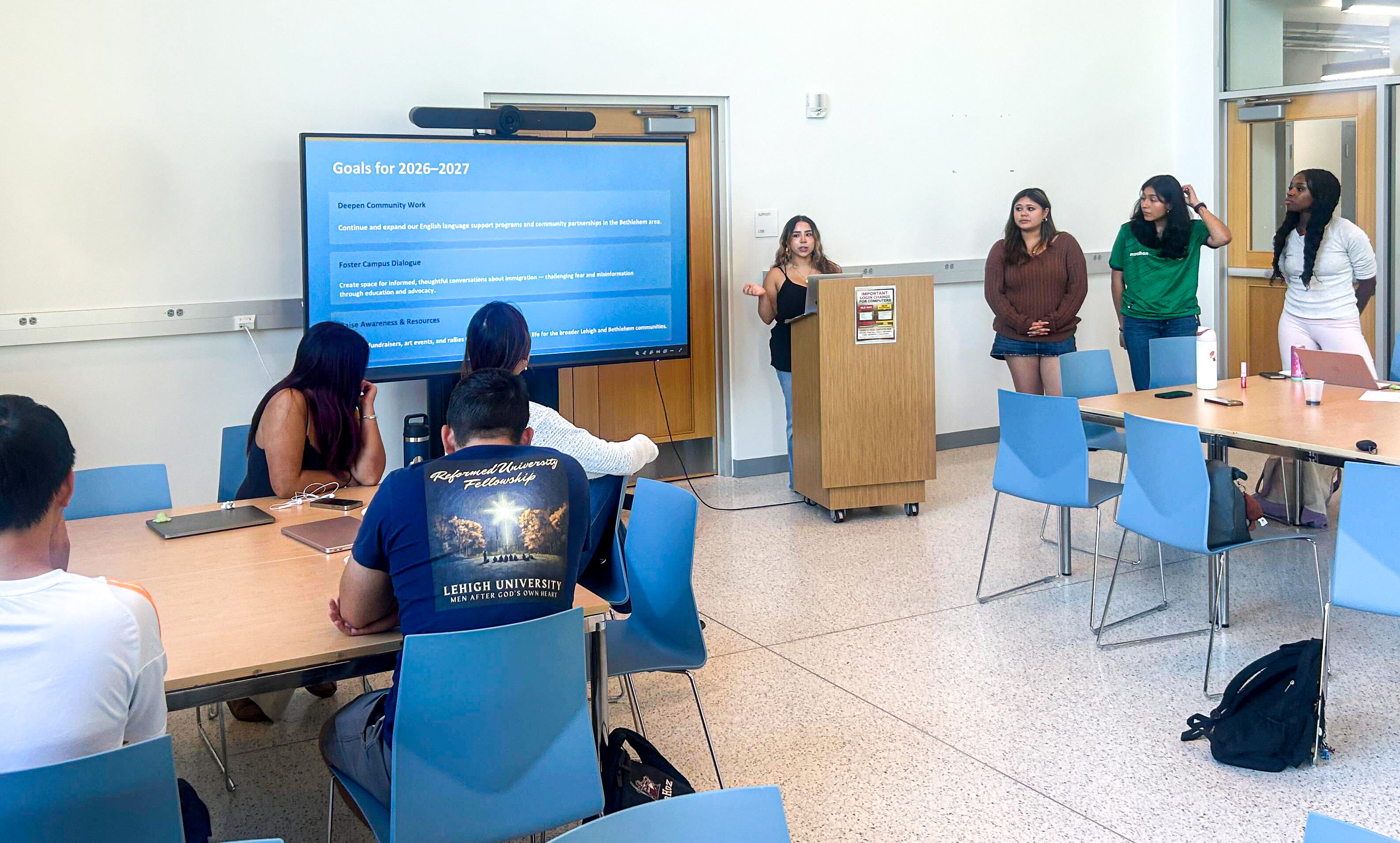
Update: No Lost Generation held their first English as a Second Language tutoring session on Sept. 15. These sessions are held from 7 to 9 p.m.
The club said the timing of these sessions is purposely later in the evening because many of the english learners attending are coming from blue-collar jobs. The timing gives them the opportunity to go home first and take time to present themselves at their best even after long work days, the organizers said.
No Lost Generation, a club focused on refugee advocacy and education, is rebuilding its Lehigh chapter this semester.
After a year-long hiatus following the graduation of its previous executive board, the club is working to connect students with immigration issues and the Bethlehem community.
No Lost Generation began as a national initiative in 2013 to engage college students in supporting refugees and displaced people through education, advocacy and community involvement.
When Beza Geberesilassie, ‘27, found No Lost Generation was no longer active, she decided to grow the chapter.
She loves being part of an organization that advocates for immigrants and refugees because her connection to the work is personal.
When she was six years old, Geberesilassie immigrated from Ethiopia to the United States and grew up in California.
She said the organization received significant interest at the Club Expo as it began recruiting new members this year.
Lehigh’s chapter was established in 2016 and initially focused on refugee advocacy and education.
By 2017, members were helping Syrian refugee students with English, homework and assisting with cultural adjustment.
The organization’s work has since expanded to include immigrant and refugee communities more broadly, both on campus and in Bethlehem.
One of its ongoing programs is an English-language support program with the Cathedral Church of the Nativity on the South Side, where Lehigh students work with adult learners in Bethlehem to build their English skills and confidence.
The program received a Student Life Leadership Award in 2024.
The sessions run from 7 to 9 p.m., a schedule that organizers chose in part because many of the adult learners come from blue-collar jobs. Many go home after work to change, wash up and take care of responsibilities such as cooking for their families before coming to the sessions.
Geberesilassie said one person she worked with told her that she sometimes works 12-hour shifts and comes to the program on days when she “only” works 10 hours.
The program also relies on community volunteers, many of whom are older adults. Geberesilassie said some volunteers drive long distances to participate, and many continued supporting the program during the year when No Lost Generation was less active.
The organization also held fundraisers, advocacy rallies and other events centered on the migrant and immigrant experience.
Bruce Whitehouse, a professor of sociology and anthropology, serves as No Lost Generation’s faculty adviser. He said students have always led its work, while his role has been to provide guidance and support.
As the organization rebuilds, Whitehouse said members are focused on addressing misconceptions about immigration.
Geberesilassie said she wants No Lost Generation to attract students who don’t know about immigration policies.
“I want anyone who’s passionate about social justice, or even someone who isn’t necessarily aware of immigration policies, to become informed and maybe interested in the community work that we do,” she said.
Anya Gelin, ‘29, a chemical engineering student, joined the organization this semester.
Gelin said negative experiences during her first year at Lehigh, including the BORG depicting blackface incident last March, made her feel uncomfortable, unsafe and underrepresented.
For Gelin, joining the organization gave her a place to connect with students who shared similar experiences.
“A lot of us are children of immigrants and refugees,” Gelin said. “Some of us are immigrants or refugees ourselves, and others have loved ones who are or grew up in communities with large immigrant and refugee populations.”
Gelin said she hopes No Lost Generation can give students a place to connect without feeling that their experiences separate them from the rest of campus.
“We’re a very small percentage of the students here, but that percentage has made a significant impact on the culture of Lehigh,” Gelin said.
As the organization grows, Gelin wants it to be a place where students can leave a meeting with a better understanding of what college students and other populations experience in the broader context of U.S. immigration.
Now a senior studying international relations, Geberesilassie plans to pursue international law and advocacy.
“These big, overarching policies really affect vulnerable communities, and at times there isn’t anyone to advocate for them,” Geberesilassie said.
This perspective is shaping No Lost Generation’s plans for the year. Geberesilassie said the club envisions a series of learning opportunities.
“The most important thing you can do is get off campus and interact with people whose lives are different from yours, and learn about them,” Whitehouse said.
Comment Policy
Comments posted to The Brown and White website are reviewed by a moderator before being approved. Incendiary speech or harassing language, including comments targeted at individuals, may be deemed unacceptable and not published. Spam and other soliciting will also be declined.
The Brown and White also reserves the right to refuse the publication of entirely anonymous comments.