



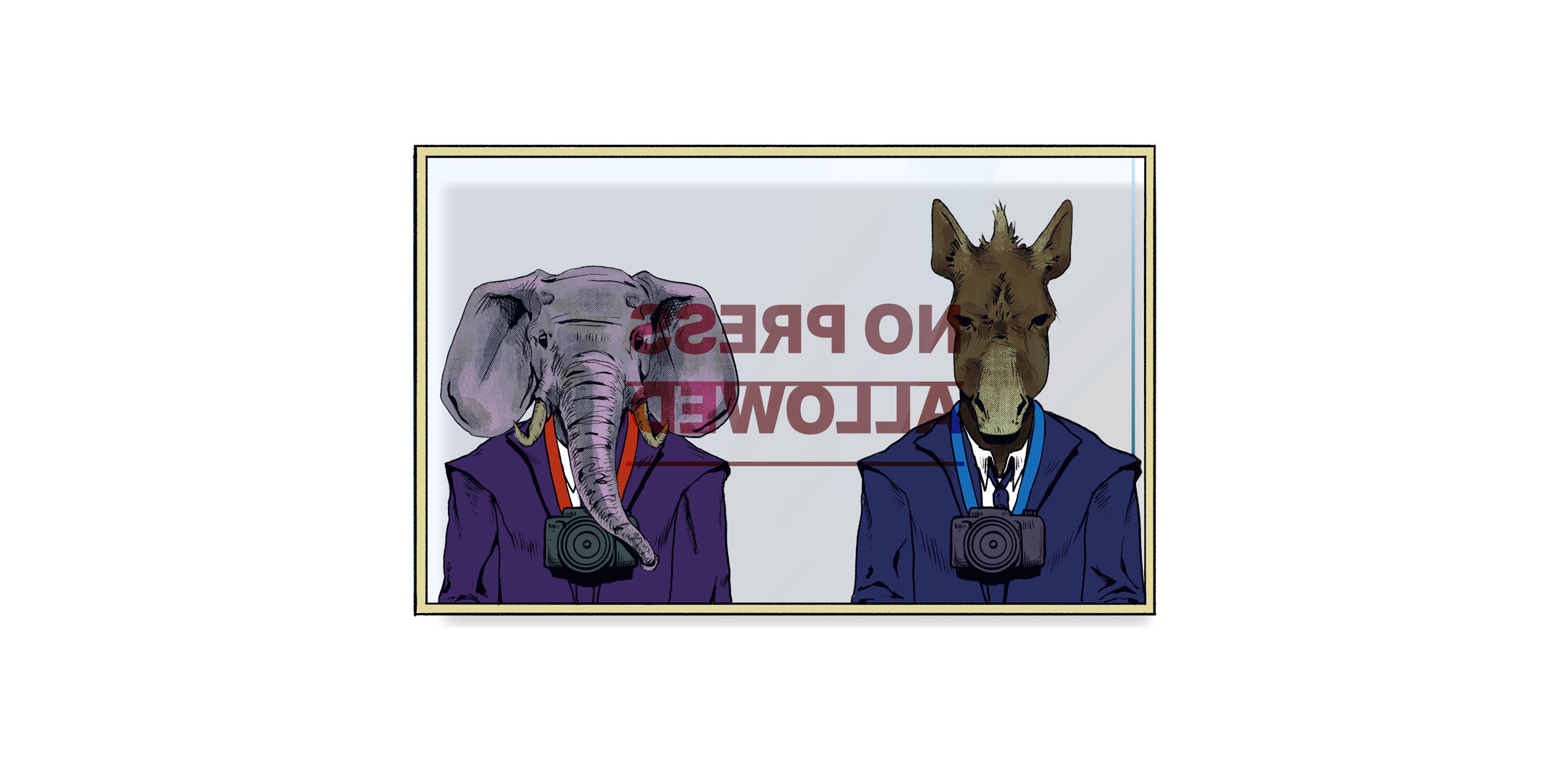
When President Trump banned CNN, MS NOW and Politico from the White House over what he called “fake news,” one of the most striking pushbacks came from an unlikely place: Fox News.
It was a rare moment of unity in a deeply divided media landscape, and a sign that some principles can still cut across political lines.
The three outlets sued the Trump administration on Sept. 21, arguing the ban violated their First Amendment and due process rights.
That same day, the chair of the White House TV pool, Fox News Washington Bureau Chief Bryan Boughton, announced the pool would stop covering the president while the ban was in place.
A Fox executive refused to let the White House cut CNN out.
Normally, five major networks — ABC, CBS, CNN, Fox and NBC — take turns filming the president and handing off the footage to one another. CNN was scheduled to travel with Trump to New York for the United Nations that Monday, Sept. 21.
When the White House blocked CNN, any of the other four could have simply taken its place, but none did. Instead, the networks released a joint statement declaring that no administration should restrict a news organization because it objects to its reporting.
Without a shared camera following him to his everyday events, far fewer images of the president reached TV screens and news sites and the networks made that choice together.
Three days later, a federal judge temporarily restored the outlets’ access while the case continues.
That kind of solidarity is unusual. Americans typically sort themselves into separate news worlds.
According to the Pew Research Center, Republicans are more likely to distrust CNN than trust it, and Democrats feel the same way about Fox. Fox and CNN are the last two networks you’d expect to find on the same side.
This isn’t the first time rival outlets have stood together. In February 2025, the White House barred the Associated Press from the Oval Office and Air Force One because it kept using the name “Gulf of Mexico” instead of “Gulf of America.”
According to The Hill, at least 40 news organizations reportedly signed a letter urging the administration to restore the Associated Press’ access. Among them were Fox News and Newsmax, a conservative network known for its pro-Trump coverage.
Newsmax explained its reasoning: it feared a future administration might dislike something Newsmax wrote and ban it next.
We can’t know exactly what motivated each network, whether it was principle, self-interest or both. But the result is the same.
These networks aren’t agreeing on politics. They’re agreeing that no government should get to decide which journalists are allowed in the room.
Skeptics could argue this isn’t unity, just self-interest. Newsmax said as much: it backed the Associated Press partly out of fear of being next. Even CNN’s own coverage raised the possibility, writing “maybe the unity will fizzle out.”
But, that’s the point. A free press doesn’t depend on rivals liking each other. It depends on them recognizing a power used against one outlet today, can be used against any of them tomorrow.
When networks that disagree on most things defend each other’s right to report, self-interest isn’t a weakness in that unity. It’s the foundation of it.
None of this means the networks have to start agreeing with each other on everything. Plenty of viewers will stick to the channel that confirms what they already believe.
Still, as long as rival outlets can all report, the other side of the story exists for anyone who wants it. Once the government starts deciding who gets in the room, that choice starts to disappear.
That’s the hopeful part. This month, rival networks agreed the fight over the story belongs to the public, not the president. If they can hold onto that, the rest of us can learn to disagree without trying to shut each other out.
Comment Policy
Comments posted to The Brown and White website are reviewed by a moderator before being approved. Incendiary speech or harassing language, including comments targeted at individuals, may be deemed unacceptable and not published. Spam and other soliciting will also be declined.
The Brown and White also reserves the right to refuse the publication of entirely anonymous comments.