



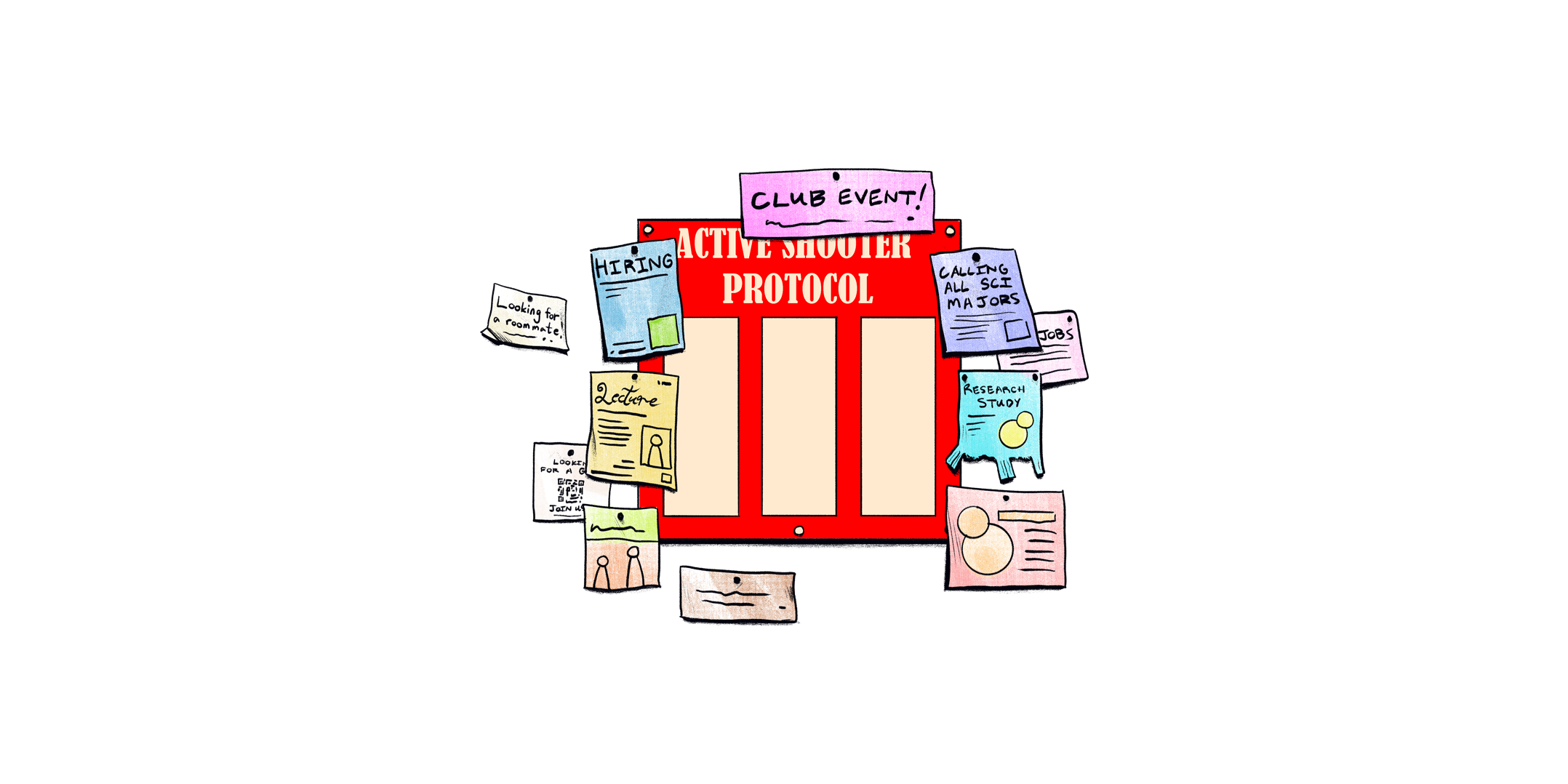
It seems like every year, school shootings dominate the news, generating national conversations about gun violence and school safety. As time passes, the headlines fade and public attention shifts elsewhere.
Until it happens again.
Nearly a year ago, on Dec. 13, 2025, two students were killed and nine others were injured when a gunman opened fire during a final exam review session at Brown University.
On Oct. 31, seven people were injured in a shooting just blocks away from the University of Delaware campus. Among them was a 20-year-old university student.
The university canceled classes Nov. 2 to give students time to process the tragedy and support one another.
According to CNN, there have been at least 16 shootings on college campuses in 2026 as of Oct. 15.
An October 2026 report from Everytown for Gun Safety found shootings on college campuses increased by an average of 20% each year over the past decade.
Repeated shootings have unfortunately become a familiar part of the news cycle. While each tragedy brings shock and grief, the frequency of these incidents has made the possibility of gun violence an increasingly pressing concern for students.
For college students living away from home, the threat of gun violence can be especially unsettling. Parents and guardians send their children to college trusting they’ll learn and grow in a safe environment.
A shooting near campus, even if it doesn’t occur on university grounds, can leave students questioning their safety in their daily lives. For parents, it brings the unsettling reality that they can’t always be there to protect their children.
The concern isn’t that people have stopped caring. It’s that these tragedies continue to happen despite the national attention and conversations they generate.
Gun violence can’t be solved overnight, but the continued occurrence of campus shootings should reinforce the urgency of prevention efforts — not leave us waiting for another tragedy to restart the conversation with more “thoughts and prayers.”
As gun violence continues to affect school communities, student-led advocacy offers one way to keep prevention efforts moving forward even when the issue is no longer dominating national headlines.
At Lehigh, Students Demand Action has organized voter registration efforts, canvassed in Bethlehem and advocated for gun violence prevention. Yet despite its involvement and established executive board, the organization was denied a six-week trial period for Student Senate recognition.
While Student Senate has a responsibility to evaluate organizations according to established criteria, the decision raises questions about how universities support these initiatives. Official recognition could provide the organization with access to funding and more opportunities to recruit members and expand its efforts.
Students may not have the power to prevent every act of gun violence, but they can help keep the issue visible, make an impact through prevention efforts, encourage civic participation and create opportunities for their peers to become involved.
The responsibility to address gun violence doesn’t fall solely on students, nor can student organizations solve the problem on their own. Universities should recognize and support their willingness to take action, rather than make it more difficult for them to expand their efforts.
Gun violence should never become so familiar that another shooting feels inevitable, and the conversation about prevention shouldn’t have to begin again every time another tragedy occurs.
This shouldn’t be how we grow up.
1 Comment
I agree wholeheartedly with the premise of your article. No parent should have to worry about whether their child will return safely from school, and no student should have to live with the fear of becoming the next victim of senseless violence. But I would respectfully suggest that we need to look beyond the gun itself and ask a more fundamental question: What has happened to our society that produces individuals capable of such evil?
I submit that no law, however well-intentioned, can entirely prevent violence. Even if every firearm in America disappeared tomorrow, the capacity for evil would remain. Evil, regrettably, always finds a way. This is not an argument against reasonable safeguards, but rather a recognition that legislation alone cannot cure what may be a much deeper societal sickness.
Consider how profoundly our culture has changed over the past sixty years. We have become increasingly balkanized into competing ideological camps, seemingly incapable of civil disagreement. One need only examine our political discourse to appreciate how thoroughly mutual respect has given way to hostility. At the same time, we have systematically pushed God and the moral principles rooted in our heritage out of the public square. We speak endlessly of rights, but increasingly less of responsibilities, virtue, personal accountability and the sanctity of human life.
School shootings were far less prominent in American life sixty years ago. What has changed? Surely that question deserves as much attention as the instruments employed in these tragedies.
I would also encourage those advocating restrictions on firearms to first develop a fuller understanding of firearm safety, responsible ownership and the constitutional principles underlying the Second Amendment. The right to keep and bear arms was not an historical accident. It was deliberately incorporated into our Constitution, reflecting the Founders’ understanding of liberty and the relationship between citizens and government. That tradition deserves serious consideration, not reflexive dismissal.
None of this diminishes the tragedy of innocent lives lost, nor does it absolve us of the responsibility to pursue practical measures that might prevent future violence. But perhaps we should devote at least as much energy to rebuilding families, strengthening communities, restoring moral formation, teaching responsibility and recovering a sense of our common humanity.
We cannot legislate virtue into existence, and we cannot eradicate evil simply by regulating the instruments through which it manifests itself.
Until we are willing to examine the deeper cultural and spiritual causes of violence, I fear we will continue treating the symptoms while neglecting the disease.
Just food for thought.
Comment Policy
Comments posted to The Brown and White website are reviewed by a moderator before being approved. Incendiary speech or harassing language, including comments targeted at individuals, may be deemed unacceptable and not published. Spam and other soliciting will also be declined.
The Brown and White also reserves the right to refuse the publication of entirely anonymous comments.