



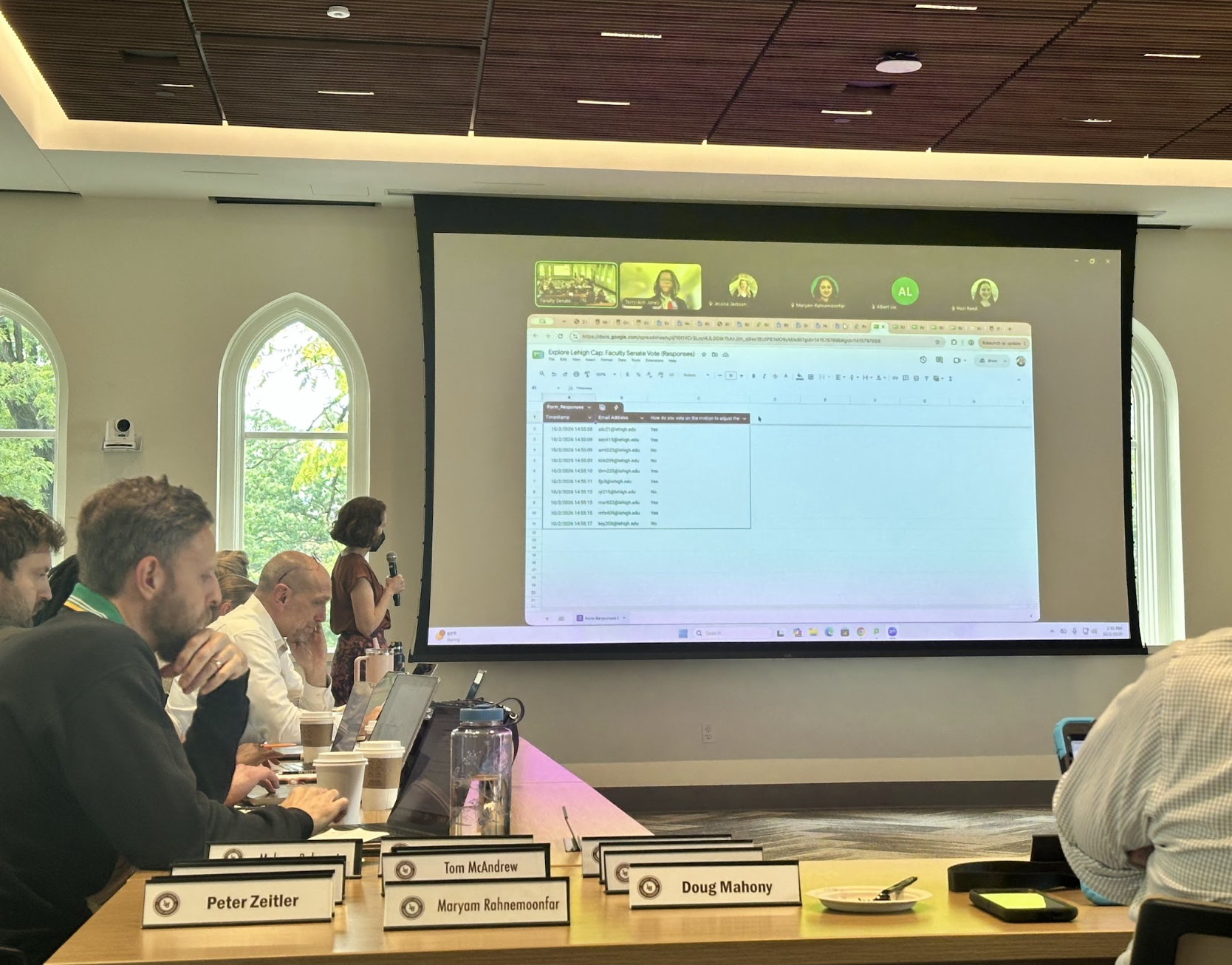
In a tie-breaker vote decided by Faculty Senate Chair Jenna Lay, the Faculty Senate voted to increase the cap of the Explore Lehigh pilot program for the 2027-2028 school year during its meeting on Friday.
The Senate’s tie in the Explore Lehigh vote led the parliamentarian to recommend Lay vote as chair, following debate over whether one senator’s vote to abstain counted as a “no” vote. Lay followed the parliamentarian’s recommendation that abstaining didn’t count as any vote, and used her vote to break the tie.
Lay said after the meeting in all her time on the Faculty Senate, she’s never seen a vote where the chair had to intervene and use both of their votes — one as a senator and one as chair.
Prior to the vote, Senate discussed the annual review process being developed for graduate students, and conducted second readings on the Arts and Libraries Faculty Committee and Normal Academic Progress, a benchmark for making academic development toward their degree.
Senate debate to raise cap for Explore Lehigh program
During the meeting, Terry-Ann Jones, deputy provost for undergraduate education, explained via Zoom why she wanted to raise the cap from 30 to 50 students for the Explore Lehigh pilot program.
Jones said the program, which was introduced in fall 2025, gives first-year students who are unsure about their major or career path, a chance to take classes in all four of Lehigh’s academic colleges during their first semester.
In spring 2025, the Senate voted on a three-year pilot for the program. Jones said there were 11 students in the first cohort and 29 this fall.
Among students in the fall 2025 cohort, 45% went on to declare a major in the college of business, and 90.91% changed their college or major from their original application.
Jones said there are two primary reasons she wants to increase the program’s capacity. One is to have more data on the program and its outcomes by the pilot’s conclusion.
Faculty Senate’s final vote on the program will take place in the spring 2028.
The second reason Jones cited was to make sure incoming students who are interested in the program have the opportunity to participate if they want. Jones said she doesn’t know if there would be 50 students interested who qualify for the program, but based on recent admissions events, she’s seen a lot of interest.
“This is entirely based on my experiences attending admissions events and just looking at the turnout at the Explore Lehigh presentations, meeting the students who are interested and talking with the parents of these students,” Jones said.
She also said she’s been discussing the idea with the associate deans of the colleges about increasing the number of students incrementally to avoid overwhelming departments.
Senator Rosi Reed, a physics professor, said during the meeting the increase to 50 felt rushed and not incremental. Jones responded they already increased the number from 11 to 29 this past year and it seemed to be going well.
Senator Dean Caivano, a political science professor, questioned the impact raising the cap would have on advising and other resources, especially because a high percentage of students from the first cohort ended up in the college of business.
“Is demand actually that diverse?” Caivano asked Jones during the meeting.
Jones said she’s also interested in where the cohort’s demand for the business program came from, and wondered if it had to do with an instructor or guests who came to the class. She said this is part of the reason she wants to have more students and more data on the program.
She added that the fall 2026 cohort seems to have a more diverse range of interests than the first.
Provost Nathan Urban said during the meeting the cap should be higher because of demand, especially coming at a time when colleges across the country are struggling with enrollment.
Senator Mike Spear, associate professor of computer science and engineering, asked Jones why the Senate needed to vote on the increase now rather than in December, when they would have a better idea of the fall 2026 cohort outcomes.
Urban said the admissions team typically sets targets around this time of year and having more time to plan for this program would be beneficial.
Before the final vote, Senator Steven Pessiki, professor of structural engineering, asked about the long-term goals for the next three to five years.
“The reason the program was started was in recognition that there are these students who need more guidance after arriving at college in terms of determining what they want to do and the college they want to be in,” Jones said. “There are a number of students who know they want to be at Lehigh and are really keen to be part of these cohorts to think about careers beyond just a major.”
Jones also said the outcomes of the pilot will determine adjustments made to the program in the future.
Reed said after the meeting students in the College of Arts and Sciences come in without a major and get to explore different interests. She said it would be more beneficial to expand all students’ ability to take classes outside of their college for the first semester rather than just Explore Lehigh students.
Annual review for graduate students concerning duration of status
In response to potential major federal guideline changes to duration of status for international students, Lehigh’s developing an annual review for graduate students who are doing research, a thesis or capstone project.
Under the new federal guidelines, international students would have a fixed amount of time to complete their undergraduate, master’s and doctoral programs.
Lay said after the meeting this could look like a doctoral student being required to finish their degree in four years when in some fields, earning a degree can take over nine years.
Sabrina Jedlicka, deputy provost of graduate education, said an annual review would make it easier for students who were applying for an extension of stay in the U.S. to have data from the university to back them up.
She said the review would benefit all graduate students by helping them understand where they’re at in their degree. She also said the reviews wouldn’t be provided directly to the federal government.
The Senate discussed the proposed annual review, which would require each graduate program to have their own process.
Jedlicka said this would look different for each program, but would include requirements for doctoral students such as course work met, qualifying exam completed, proposal completed and faculty comment, among other criteria.
She also said programs could use existing accreditation that graduate students go through as part of their degree. Programs that are course-based can use degree audits.
Senators raised concerns about student procedural rights throughout the annual review process at the meeting.
Jedlicka said the entire proposal is in accordance with the Family Educational Rights and Privacy Act guidelines, and students would have all the rights included in regards to the reviews.
One senator asked why Lehigh wasn’t waiting until regulations were officially released. Jedlicka said if they waited, they wouldn’t be able to support students as well as they could when the new guidelines are released.
“We’re doing our best to predict what an administration is going to do that often defies prediction, so we’re trying to cast a very wide net,” said Mike Burger, graduate associate dean for the College of Arts and Sciences.
Committee confusion
During the Senate meeting, faculty also reviewed a second reading of the proposed committee pertaining to the restructured arts and libraries system and its makeup. At the end of the discussion, faculty senators voted to postpone moving forward with changes to the document until the November meeting.
This year, Lehigh restructured the arts and libraries system to bring together the libraries, Zoellner Arts Center and LUAG into one division. In response, a faculty committee was established to ensure faculty representation in decision-making.
This decision arose from concerns around text removed from the second version of the document, which would’ve ensured faculty have input on the use of academic technologies at Lehigh. This would include any online learning tools, research computing and academic software.
Some senators raised concerns around faculty workload, questioning if making another committee would make things more complicated.
Greg Reihman, vice provost for arts and libraries, said the goal of this committee was to bring together multiple other faculty committees to simultaneously reduce workload and amplify faculty voices in this conversation.
Lay said the committee structure at Lehigh can be very confusing, and it’s hard to tell which groups have faculty on them.
“This is why we now have a working group on our committee structure because it is messy and we don’t even know how many committees are out there,” Lay said during the meeting.
The faculty decided to vote on the document’s language again at the November meeting, where it’ll be altered to address faculty representation for academic technologies.
This Faculty Senate meeting was the first for Student Senate President Drew Smith, ‘27, an ex-officio member of Faculty Senate. This means Smith cannot vote but can speak during meeting discussions.
Smith said it was fascinating to see the faculty engage in similar procedures and address issues relevant to leadership.
He also said he was happy the Explore Lehigh program cap was raised from 30 to 50 students.
“I have found, anecdotally, that a number of students choose to stay with a major they dislike, purely because they are too far along to change,” Smith said. “This program would be excellent in exposing those students to alternatives and reduce the number of quote unquote false positives of individuals who would have changed majors, but didn’t.”
The next Faculty Senate meeting will be on Nov. 6.
Comment Policy
Comments posted to The Brown and White website are reviewed by a moderator before being approved. Incendiary speech or harassing language, including comments targeted at individuals, may be deemed unacceptable and not published. Spam and other soliciting will also be declined.
The Brown and White also reserves the right to refuse the publication of entirely anonymous comments.