



When first-year student Chatham Gillis, ’30, enrolled in his Big Question Seminar, “Plots and Probability,” he expected a semester focused on numbers, equations and statistical analysis.
Instead, he discovered how literature and poetry could deepen his understanding of statistics, introducing him to connections between subjects he’d previously considered unrelated.
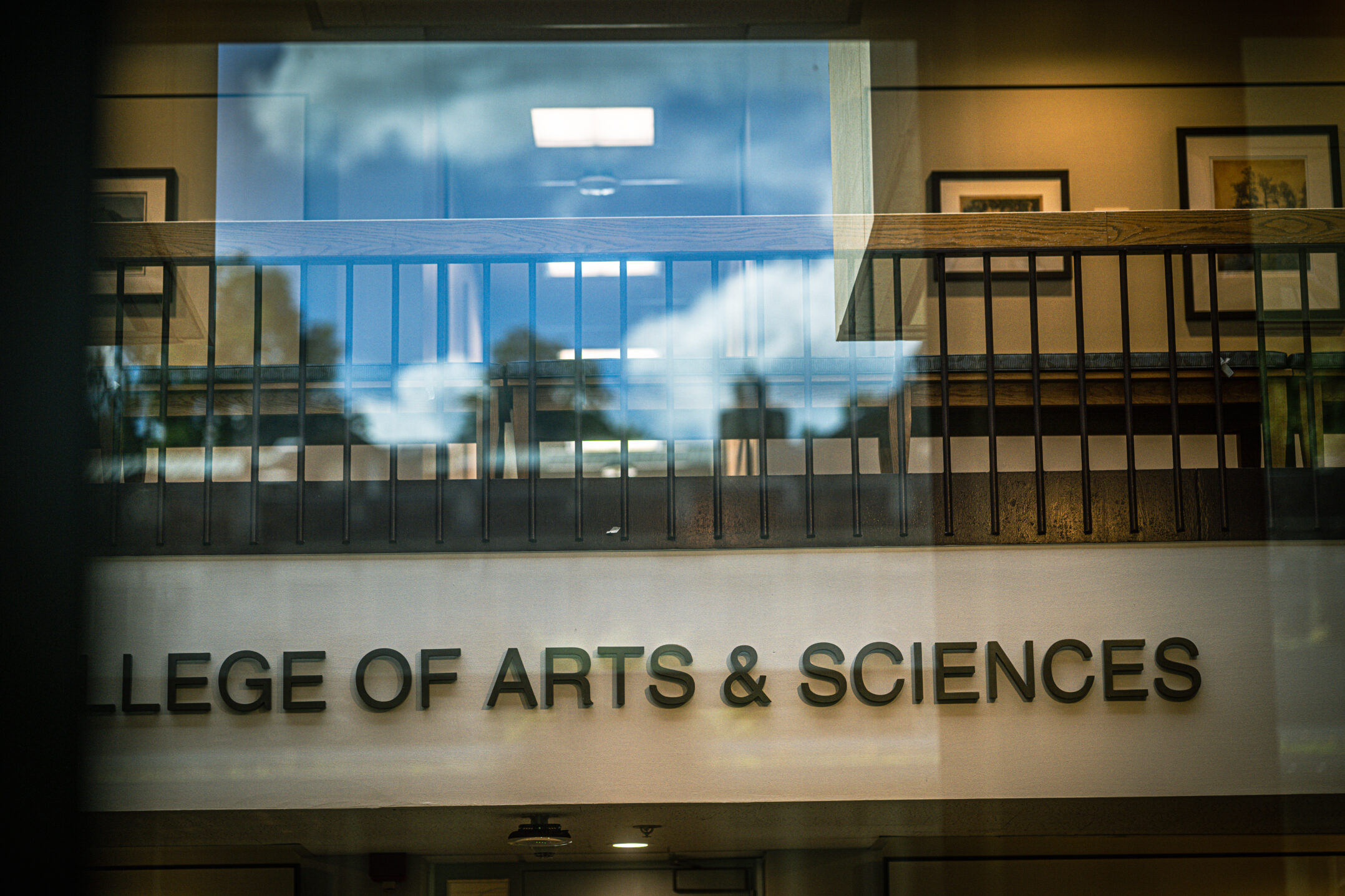
In the College of Arts and Sciences, every first-year student is introduced to interdisciplinary learning through a mandatory seminar encouraging exploration of complex, real-world questions from different academic perspectives.
Rather than immediately focusing on a specific subject, the seminars give students the opportunity to explore new topics they might not have considered and make connections beyond their intended majors.
Frank Pazzaglia, director of undergraduate academic planning, said the program aims to broaden students’ academic perspectives early in their college experience.
Pazzaglia said faculty members are invited to propose questions they find compelling to develop seminar topics. Each department is required to offer at least one Big Question Seminar, and all topics are approved by Associate Dean Kelly Austin.
Austin helped formalize the transition from first-year seminars to Big Question Seminars during the 2023-24 academic year.
“We wanted everyone in the college to experience something that was a big question that’s on the minds of the generation of students coming and starting their careers at Lehigh,” Pazzaglia said.
He also said the courses change year-to-year, as faculty members experiment with new ideas and adjust their approaches based on student feedback and their own teaching experiences.
For Gillis, an intended statistics and data science major, he said the interdisciplinary nature of the seminar not only changed how he understands his field of study, but also broadened his interest in future research opportunities.
Although he initially expected the course to focus primarily on mathematics, Gillis said assignments involving poetry, literature and experiments have helped him recognize how statistics can be applied beyond traditional mathematical settings.
“It really has changed my view on how the world uses statistics,” Gillis said.
Gillis’ experience reflects one of the Big Question Seminar program’s central goals: encouraging students to look beyond the classroom and recognize how their studies apply to real-world challenges.
Particularly, Gillis said this understanding comes through his professor’s work in biostatistics, which uses statistical methods to better understand illnesses and medical research.
“It kind of just brings to life the idea that math is everywhere,” Gillis said.
He also said his seminar has encouraged him to pursue additional statistics classes and explore opportunities involving mathematical modeling and research during the rest of his time at Lehigh.
Andrew Wallace, ‘30, an intended political science major enrolled in the seminar, “What Is Reality?”
He also said the experience encouraged him to explore unfamiliar subjects. Although Wallace said he doesn’t expect the course to change his academic trajectory, he appreciates the opportunity to broaden his horizons and explore a subject he otherwise might not have considered.
“I think it adds something that I wouldn’t normally take,” Wallace said. “So it’s kind of pushing me to be outside of my comfort zone by taking something I don’t really know anything about.”
Despite the program’s emphasis on exploring unfamiliar concepts, Pazzaglia said that not every student connects with their assigned seminar during the first weeks of school.
Some students request to switch courses after discovering the subject matter varies from expectations.
However, Pazzaglia said part of the program’s purpose is to challenge students to explore subjects they might not otherwise consider.
“One of the things you should be doing at university is broadening your horizons and getting yourself out of your comfort zone,” Pazzaglia said.
As the program continues to evolve, Pazzaglia said its long-term impact on students remains difficult to measure. While the college continues to collect feedback to better understand student experiences, much of the evidence surrounding the program’s success remains anecdotal.
Comment Policy
Comments posted to The Brown and White website are reviewed by a moderator before being approved. Incendiary speech or harassing language, including comments targeted at individuals, may be deemed unacceptable and not published. Spam and other soliciting will also be declined.
The Brown and White also reserves the right to refuse the publication of entirely anonymous comments.