



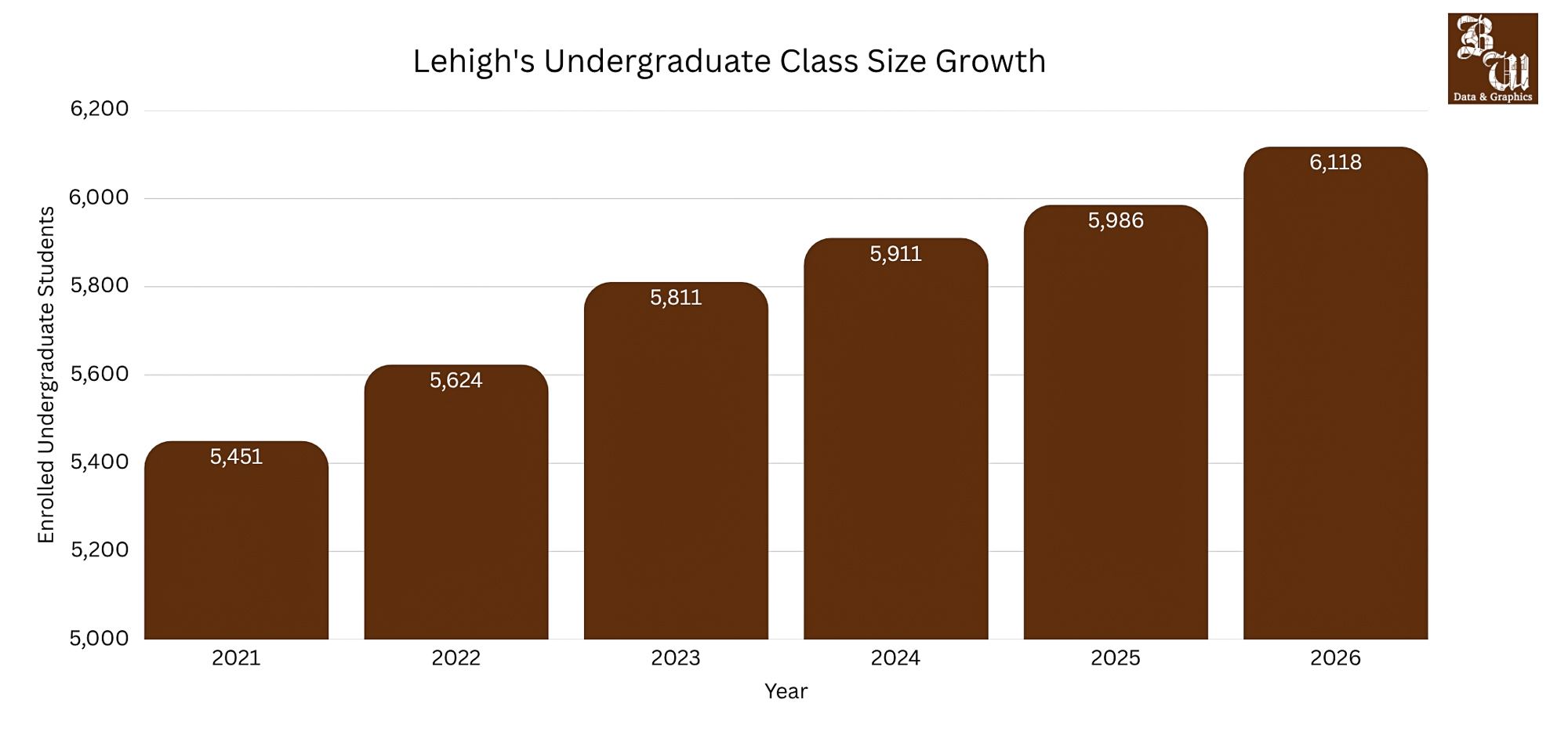
Surpassing the target enrollment for first-year students this year, Lehigh’s academic advising is preparing to accommodate continued enrollment growth in the coming years.
Emily Ford, director for coordinated advising, said despite increased enrollment this year, there were no significant changes to advising models.
“Advisers are always at the ready, and they were aware that numbers were going to increase,” Ford said.
Academic advising is managed at the college department level rather than a singular centralized university office, so the direct impact of enrollment increase varies across the four colleges.
Lehigh’s adviser-to-student ratio or total number of advisers is not publicly available.
Ford said to accommodate continued enrollment, academic advisers could be redistributed among students.
Faculty advisers balance teaching, research and other administrative duties alongside advising. Ford said continued enrollment growth may accelerate a broader shift toward hiring more professional advising staff.
Terry-Ann Jones, deputy provost for undergraduate education, said as incoming cohorts start to expand, first-generation, low-income and historically underrepresented students will continue to receive access to supportive advising. Advisers provide surveys to receive feedback from students on their services.
“We do surveys on advising, and that’s our main way of learning and understanding if there are any concerns that students are facing,” Jones said. “As we’re not there in the room with them when they’re meeting with an adviser.”
Alongside feedback surveys, she said Lehigh tracks appointments and adviser notes through an online platform called Compass. Ford said this helps determine whether students are getting adequate support.
Jones said advisers see the highest demand during registration periods. Rather than limiting faculty contact to these windows, Jones encourages students to connect with faculty throughout the academic year.
“I really want to encourage students to connect with faculty, not just to reach out when they need a pin number (for registration), but to connect with faculty for mentoring, get to know their faculty because the faculty really want to do this,” Jones said.
How colleges determine the workload with increased enrollment depends on the staffing structure. Jones said the College of Business utilizes professional staff advising, P.C Rossin College of Engineering uses a hybrid model and the College of Arts and Science relies primarily on faculty advisers.
If a department finds that increased enrollment would be overwhelming for advising, Jones said they’d reach out to the dean of the specific college for help. But so far, she said there haven’t been any concerns expressed.
Intercollege programs IDEAS, IBE, CSB and IBH have dedicated advisers for their programs. Jones said with the increased enrollment this year, there’s still adequate range to advise students.
Jones said she expects an increase in advising needs for the Explore Lehigh program which allows students to take classes across all four colleges. She said it’s targeting 50 students next year and may need to share an additional adviser with the IBH program.
As advising leadership prepares for increased enrollment size, Dan Warner, vice provost for admissions and financial aid, said he predicts Lehigh doesn’t have set plans to continue expanding incoming class targets.
“I cannot imagine that our target will be any higher,” Warner said. “I strongly suspect it’ll be slightly lower because we brought in a larger size class this year.”
Warner said over the past eight years there’s been a gradual enrollment increase, and the budget office has worked alongside the different college departments to increase resources proportionate to student volume.
For this reason, resources may not increase equally across colleges. The College of Health, which welcomed its inaugural class in 2020, is expected to see greater student enrollment and need for student resources.
To give deans enough time to adjust budgets and staffing for a larger student body, the provost and admissions office provide target enrollment numbers in the fall and updates them after the Jan. 1 college application deadline.
Final class sizes are determined based on how many students accept their admission offer. Warner said while there’s no plan for higher target enrollment next year, each college’s advising system has accommodated this fall’s larger class size.
Comment Policy
Comments posted to The Brown and White website are reviewed by a moderator before being approved. Incendiary speech or harassing language, including comments targeted at individuals, may be deemed unacceptable and not published. Spam and other soliciting will also be declined.
The Brown and White also reserves the right to refuse the publication of entirely anonymous comments.