



Candidates Hillary Clinton and Donald Trump clashed during Monday night’s first presidential debate of the 2016 election.
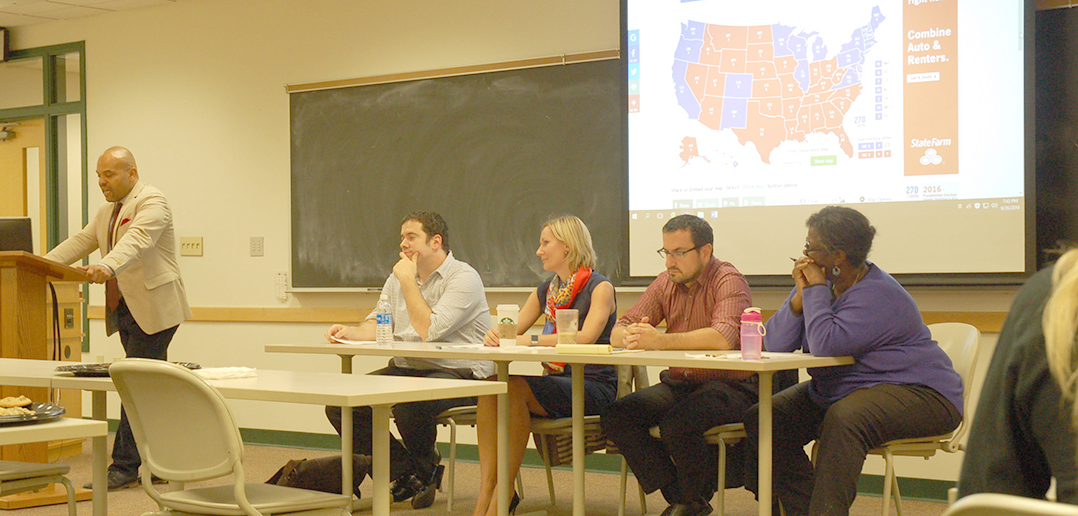
Before the debate, Lehigh’s departments of political science and international relations hosted an event in Maginnes Hall to inform students about the election and possible implications of the policies of each candidate.
“We thought it would be a good opportunity to get our faculty and students together outside of the classroom to talk about issues that are germane to what we teach in class, (and also) germane to being a good citizen,” said Saladin Ambar, the chair and associate professor of the political science department, who hosted the event.
A panel of political science and international relations professors informed both domestic and international students about the electoral system.
“The goals of the panel are to provide the students with interest, and what to watch (for) in the debate,” said Dinissa Duvanova, an assistant professor of international relations.
A main focus of the event was to bring students and faculty together so students could share their opinions and professors could provide insight in their areas of expertise. A question and answer session took place after the panel to promote student involvement.
Prior to the screening, Ambar informed students about the electoral system and how voting works in the U.S. He discussed the concepts of red states, blue states and swing states to show students which states were most important for the respective candidates.
Ambar recommended that students keep their eyes on North Carolina, Florida and Colorado because they can ultimately change which candidate could win.
A variety of professors were able to contribute different types of knowledge on the national and international levels, said Anthony DiMaggio, an assistant professor of political science. They provided clarification on how to vote, why voting is important and the actual debate itself.
“I think it’s good to be informed about what you’re watching,” Anne Henry, ’18, said. “It’s interesting to hear what the professors have (to say) and their perspectives on it.”
A large focus of the discussion was voter rationality. DiMaggio said individuals do not vote based on issues and the candidates’ policies. Instead, they consider whether they like the politician as a leader or a person.
He said people will often chose the leader they are voting for before viewing a debate and are unlikely to be persuaded.
“There doesn’t seem to be a lot of strong evidence that debates have a big impact on people’s vote,” DiMaggio said.
DiMaggio said the only time a debate could actually have an effect is when third-party candidates are allowed to participate. Voters typically do not know what these candidates stand for because of their absence from the political spotlight. Without the required 15 percent of public support, these candidates are not allowed to participate in a debate.
Duvanova’s discussion primarily focused on the economic issues faced by candidates.
She said that, from an economic standpoint, Trump and Clinton have not differentiated themselves from one another.
Duvanova explained the economic platforms of both candidates focus on job creation and opposition of the Trans-Pacific Partnership. She said voters need to look deeper into the stances of the parties to truly understand the candidates’s economic views.
Another component of understanding the election is to discuss it from a foreign perspective.
Vera Fennell, an associate professor of political science, said though the Chinese government is not a supporter of Trump, the citizens of China are fanatics for him. She said the people of China like that Trump is a successful businessman and they believe he will rule with an iron fist. She said Trump has gained a large following in China with a public opinion poll showing that 54 percent of the Chinese support Trump.
Fennell inferred that Clinton’s unpopularity in China could simply be a result of unfamiliarity with a female leader, resulting in widespread disapproval. She said there is also a sentiment in China that older women, like 68-year-old Clinton, should be focusing on raising their grandchildren rather than working.
Japan, however, is different from China. Fennell said many Japanese people are concerned about Trump and believe he will leave their country vulnerable by taking it out from beneath the U.S.’s nuclear umbrella.
She said the Japanese are inclined towards Clinton and like her because she has a strong presence and good leadership skills.
Arman Grigoryan, an assistant professor of international relations, discussed the election’s role in foreign policy. Clinton is more likely to enact the expansion of NATO and provide aid to Ukraine, he said. However, he believes Clinton would be much more level headed in the White House.
Trump represents no coherent policy, Grigoryan said, and while he claims to be ready to do business with Russia, Trump is generally unpredictable.
A follow-up event will be held after the election Nov. 9 at 4 p.m. in Maginnes 101. Ambar and other faculty members will discuss exit polls and explain why the winning candidate was victorious.
Comment Policy
Comments posted to The Brown and White website are reviewed by a moderator before being approved. Incendiary speech or harassing language, including comments targeted at individuals, may be deemed unacceptable and not published. Spam and other soliciting will also be declined.
The Brown and White also reserves the right to refuse the publication of entirely anonymous comments.