



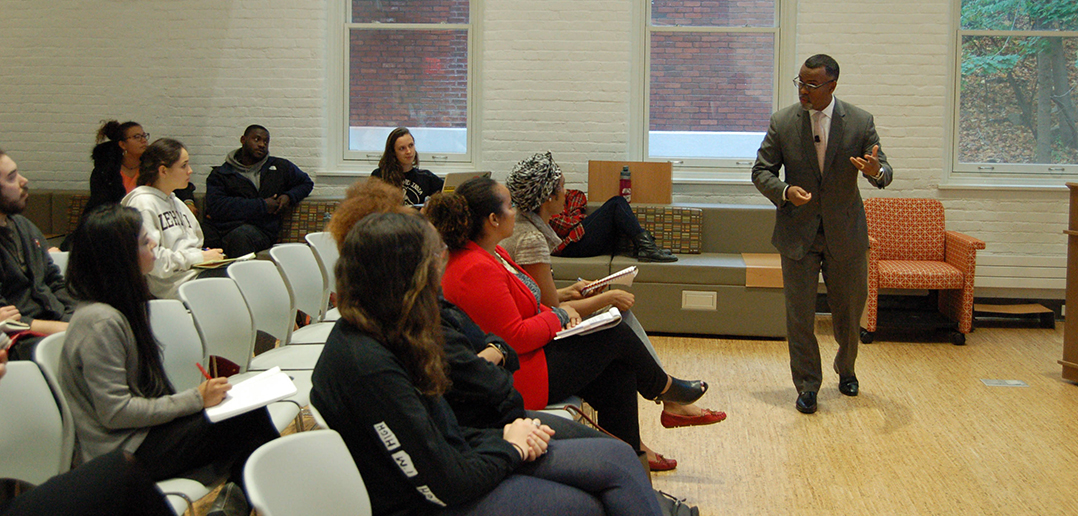
Eddie Glaude, the chair of Princeton University’s African-American studies department, remembers an incident of racism he experienced as child growing up in Mississippi.
Glaude, who had just moved with his family to a predominantly white neighborhood, was playing outside with his neighbor, a white boy. When the neighbor’s father saw the two boys playing together, he instructed his son to stop and called Glaude a racial slur. Glaude said though he was young, he still understood the incident was racism.
He spoke about the value gap and current issues in democracy Monday at the Global Commons in Williams Hall. Glaude said the value gap is prevalent in many ways, specifically in the way in which white people speak to black people.
“(Glaude) is someone who is thinking deeply about very important issues, and I know that’s what we are doing at Lehigh,” said Saladin Ambar, an associate professor and the chair of the political science department. “To have others from other institutions come and share their thoughts is always a welcomed thing.”
The event was sponsored by a variety of departments at Lehigh, including the political science, Africana studies and philosophy departments.
Glaude spoke about how the largest problem Americans face is the value gap, the idea that society values white people over black people. Because of society’s inability to admit to this, he said, its vision of democracy is distorted.
Glaude said we need to admit there is ugliness if we want to make progress.
“In order to fully acknowledge what is going on, we need to acknowledge our own problems and our conflicts with (race),” said Joey Recupero, ’20, who attended the event.
The value gap is also present in the difference between predominantly black and predominantly white neighborhoods.
Glaude said there is a difference in the size of houses, how parks are maintained and how the sewage system works. It is smaller details like these, he said, that contribute to the value gap between the two races.
Glaude said economic inequality between whites and blacks is the worst The Brown and White conducted an interview with Republican congressman Charles Dent, ’93G, whose district covers the entire Lehigh Valley, including Lehigh University it has been in a long time. There has also been a sharp increase in black poverty among children in recent years.
“There are more black children in poverty than white children,” he said, “and white children outnumber black children 3-to-1.”
Glaude said this increase in poverty may be a result of lack of access to networking opportunities. Since many jobs involve a high degree of networking, it has become harder to find a job. And since a majority of networks consist of almost all white people, it is even harder for blacks to find jobs.
This value gap has stimulated fear among the black population. Glaude said black people are afraid of making white people afraid. It is white fear that often stimulates the deaths of black lives. He said this dates back to the Black Panther Party, which was feared by the white population.
One of the major problems our democracy is facing is the two-party system. Glaude said Americans generally feel they are handed only two options for who becomes their leader.
“The two-party system is not a democracy — it is an oligarchy,” he said.
Glaude said he is critical of both Hillary Clinton and Donald Trump and believes neither is a suitable candidate to be the next president.
“Voting is essential in the pathway forward,” said James Peterson, the director of Lehigh’s Africana studies department and an associate professor of English.
Peterson said Glaude knows the importance of voting, and he focuses more on participation in democracy rather than selecting a candidate.
After his lecture, Glaude signed copies of his new book, “Democracy in Black: How Race Still Enslaves the American Soul,” which covers the value gap and the rightward shift of American politics.
Peterson said the shift toward the conservative right is extremely apparent.
“It’s a very critical text,” Peterson said. “Glaude has been critical of the Obama administration for some time now and sometimes people mistake his principle critique for ad hominem attacks.”
Glaude said the purpose of his book rests on the principle of “government of the people, by the people, for the people.”
He emphasized, however, the idea that society needs to expand who those people are, not just for white people, but for people of all races.
Comment Policy
Comments posted to The Brown and White website are reviewed by a moderator before being approved. Incendiary speech or harassing language, including comments targeted at individuals, may be deemed unacceptable and not published. Spam and other soliciting will also be declined.
The Brown and White also reserves the right to refuse the publication of entirely anonymous comments.