



The U.N.’s latest update on climate change issued some dire warnings about Earth’s future.
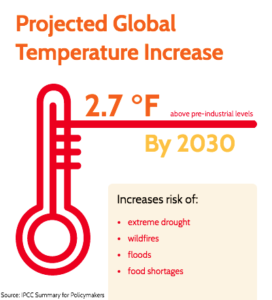
In its special report issued last month, the U.N. Intergovernmental Panel on Climate Change, or IPCC, explored the impacts of an expected global warming of 1.5 degrees Celsius, or 2.7 degrees Fahrenheit, above pre-industrial levels by 2030.
According to the report’s Summary for Policymakers, the results of this change entail severe drought, deadlier wildfires and increased flooding, as well as risks to food and water supplies.
While the temperature change might seem insignificant to some, Dork Sahagian, a professor of earth and environmental science, said its associated impacts will be detrimental.
“Don’t be fooled by using the temperature as a metric because it doesn’t sound like much at all,” Sahagian said. “But for the global average, it’s a lot. It changes everything.”
Sahagian believes the larger community of researchers studying climate change today have a deeper understanding of the related issues than ever before.
However, the main challenge these same researchers face is communicating their findings to society and policymakers in a way that is properly received. Sahagian said society isn’t concerned with metrics or the temperature. Instead, it cares about the global changes that are associated with them.
Sahagian said the United States’ indifferent attitude toward climate change is despicable compared to perspectives in other countries.
“The United States has become a laughing stock when it comes to climate change and our disregard for science in general in decision making,” he said.
According to the report’s Summary for Policy Makers, the solution to the issue relies on human behavior to avoid increases in carbon dioxide emissions. The avoidance of overshoot and reliance on future large-scale deployment of carbon dioxide removal can only be achieved if global emissions start to decline well before 2030
Vincent Munley, a professor of economics, said economists agree that a carbon tax is a preferable policy to decrease carbon dioxide emissions.
A carbon tax would impose a fee on those who burn carbon-based fuels, in an effort to provide a monetary disincentive to emitting carbon dioxide into the atmosphere.
Munley said one of the main effects of a carbon tax would be a rise in the price of electricity.
“When you put a tax on carbon, the price of electricity will go up, resulting in firms adjusting their production processes to use less energy than they did before,” he said. “The carbon tax uses the market mechanism of people making choices — operators of firms, operators of agricultural processes and the general consumer population — and reacting to this change in prices to change their behavior.”
Munley said food and agricultural producers will have to use more energy to produce certain foods, which would result in higher prices for them. In turn, consumers will be nudged to make dietary choices to favor foods that are less energy-intensive to produce.
Societal and cultural changes would also occur. Munley said a carbon tax would increase the price of gasoline, which could lead consumers to drive more fuel-efficient cars and adjust their lifestyles to diminish the emission of harmful gases.
“People acting in their own self-interest becomes a solution,” he said.
To achieve that solution, many believe that policymakers and the public need to act fast.
Michael Ioannou, ’19, a double major in economics and psychology, believes part of the problem lies in the public and policymaker’s slow pace in decision-making regarding climate change.
“I think all of the problems now are only going to be exacerbated by climate change in the next couple decades,” he said. “America, personally, I think is already being affected and it’s only going to continue to get worse.”
Sahagian said this report is not to be considered as the latest installment of the main IPCC Assessment Reports. Rather, this is a special report to serve in the interim while researchers work to develop the sixth IPCC Assessment Report.
The last report was finalized in 2014 and the report prior was published in 2007. The 2007 report made headlines at a time when former-Vice President Al Gore’s campaign to educate the world on climate change won him the Nobel Peace Prize.
But Sahagian doesn’t think this upcoming report will have the same impact as the 2007 edition.
“The hoopla was already all done by 2008,” he said, “So, I do not expect much public response in terms of policy, economic alterations, or behavioral modifications on the basis of the upcoming sixth assessment report.”
3 Comments
Recently there was a lively discussion on cable TV by Dr. Patrick Michaels who is a bona fide expert on the subject.
See: https://cdn.cato.org/archive-2018/michaels-fox-10-21-18.mp4
Michaels claims that virtually all of the computer models championed by the IPCC are wrong and fail to agree with the historical empirical data of what has actually been happening.
He points out that there is only one model out there that agrees with the empirical data.
It is one devised by the Russians.
This recent article discusses the problem.
https://www.cato.org/publications/commentary/thirty-years-how-well-do-global-warming-predictions-stand
It would be interesting for Lehigh to invite Dr. Michaels to come to and have a debate with Prof. Sahagian on the subject.
Dr. Michaels contact information can be found at:
https://www.cato.org/people/patrick-michaels
The new studies do include severe drought, deadlier wildfires and increased flooding, as well as risks to food and water supplies. What is missing they also say these things will happen simultaneously, together.
What no mention of rising sea levels? Will Florida be submerged. Will the Jersey shore become significantly closer to Lehigh?
Will natural processes overpower humanity’s ability to control them. Should we prioritize planing for coming planetary changes rather than solely concentrating on trying to stop potentially harmful changes?
Comment Policy
Comments posted to The Brown and White website are reviewed by a moderator before being approved. Incendiary speech or harassing language, including comments targeted at individuals, may be deemed unacceptable and not published. Spam and other soliciting will also be declined.
The Brown and White also reserves the right to refuse the publication of entirely anonymous comments.