



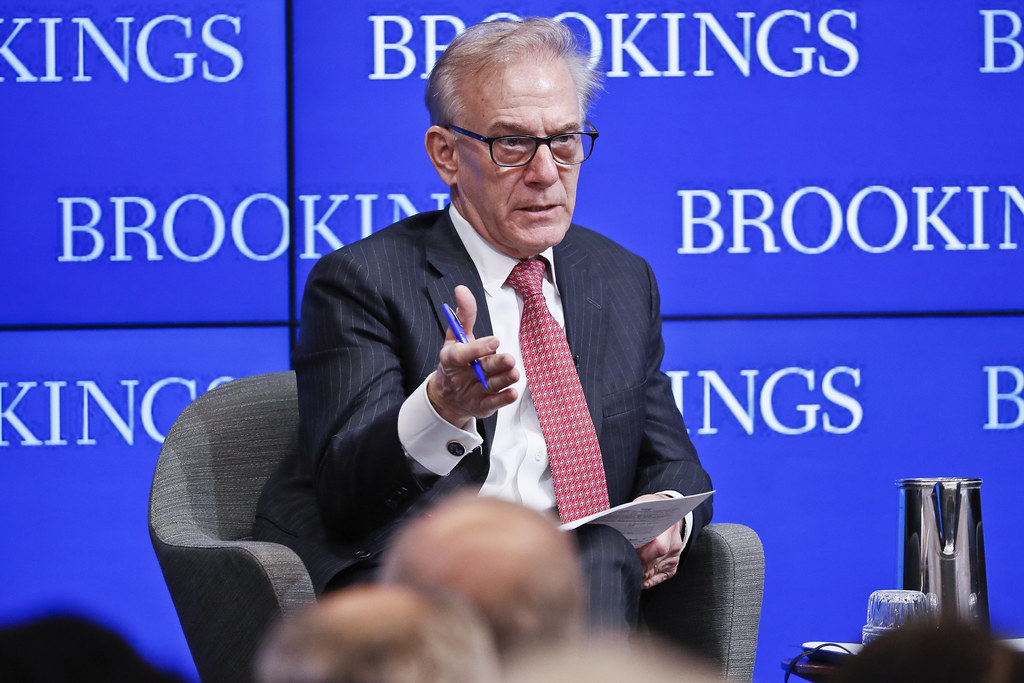
David Ignatius, foreign affairs columnist at The Washington Post, delivered the 2021 Kenner Lecture on Cultural Understanding over Zoom on Tuesday, Feb. 9.
His lecture, titled “New World Disorder: Snapshots From A Journalist’s Notebook,” depicted defining moments from Ignatius’ career as a journalist and novelist.
The lecture was formatted into ten “verbal snapshots” of disorder, the first snapshot taking place in Bethlehem, Pennsylvania. Ignatius began his career in 1976 at the Wall Street Journal where he covered Pennsylvania’s steel industry.
Ignatius said in those years he watched the beginning of the decline of one of America’s greatest industries.
“That is why the first snapshot of disorder is right here in the Rust Belt,” Ignatius said.
Other influential snapshots included April 18, 1983, in Beirut, Lebanon where Ignatius was covering the Middle East with the Wall Street Journal. Ignatius recalled ending an interview at the American Embassy at 12:30 p.m. and returning to his hotel, only for a terrorist truck bomb to attack the Embassy less than thirty minutes after his departure.
“(It was) the loudest explosion I had ever heard in Beirut,” Ignatius said. “Which is saying something.”
Ignatius shared personal reflections on key dates, ranging from the fall of communism to the invasion of Iraq in 2003. A more recent snapshot was the 2016 election.
“I remember my wife going up to bed after it was clear the election results were in,” Ignatius recalled. “She came down at 3 o’clock, I was still watching TV, deeply upset. She turned to me and said, ‘David, you have to do your job.’ That was an injunction that I never forgot.”
Ignatius touched on topics such as high and low points from the “Trump era,” as well as the “chaos” in Washington D.C. over the past year.
The latter portion of the lecture focused on the role of journalists and the modern narrative toward the press.
“Every day around the world there are journalists who risk their lives literally for the most basic job of a journalist, which is to report events,tell the truth and not be intimidated by governments,” Ignatius said.
Ignatius included a nod to his former Washington Post colleague Jamal Khashoggi who “paid the ultimate price,” for accountability and truth.
Ignatius closed the lecture portion of the evening on an uplifting note.
His final snapshot was about his 100-year-old father, Paul, who Ignatius noted was born on Veterans Day in 1920.
“He came to Washington D.C. when I was a boy in 1961 to work for President Kennedy in the Pentagon and ended up becoming secretary of the US Navy,” Ignatius said. “The USS Paul Ignatius was named after him.”
Ignatuis said much of the difficulty his father faced throughout COVID-19 was just “how he was going to get through the days.”
Ignatius suggested that his father start writing essays on various aspects of his life. Over the duration of COVID-19, Paul Ignatius wrote a book’s worth of essays that his children bound and printed, titled “Coping With Covid.”
Ignatius said focusing on what he loves and what matters was the secret of how his father got through such a challenging year.
In the second portion of the event, Ignatius responded to questions on various topics including the vulnerability that the US faces as a nation due to increased dependence on cyberspace and digital tools. He also reinforced the importance of an unbiased press in a time where journalists are pegged as the enemies of the people.
“I was brought up to think our job was to challenge people’s misconceptions, not reinforce them,” he said.
In closing, Ignatius drove home the need to support good journalism financially, in order for it to remain a key informant of the public.
“In the end, we get the news media that we deserve,” he said. “Meaning that unless we support quality news organizations through subscriptions or contributions, they’re not going to be around. We will end up with the news media that we deserve, through our actions in the marketplace.”
Comment Policy
Comments posted to The Brown and White website are reviewed by a moderator before being approved. Incendiary speech or harassing language, including comments targeted at individuals, may be deemed unacceptable and not published. Spam and other soliciting will also be declined.
The Brown and White also reserves the right to refuse the publication of entirely anonymous comments.