



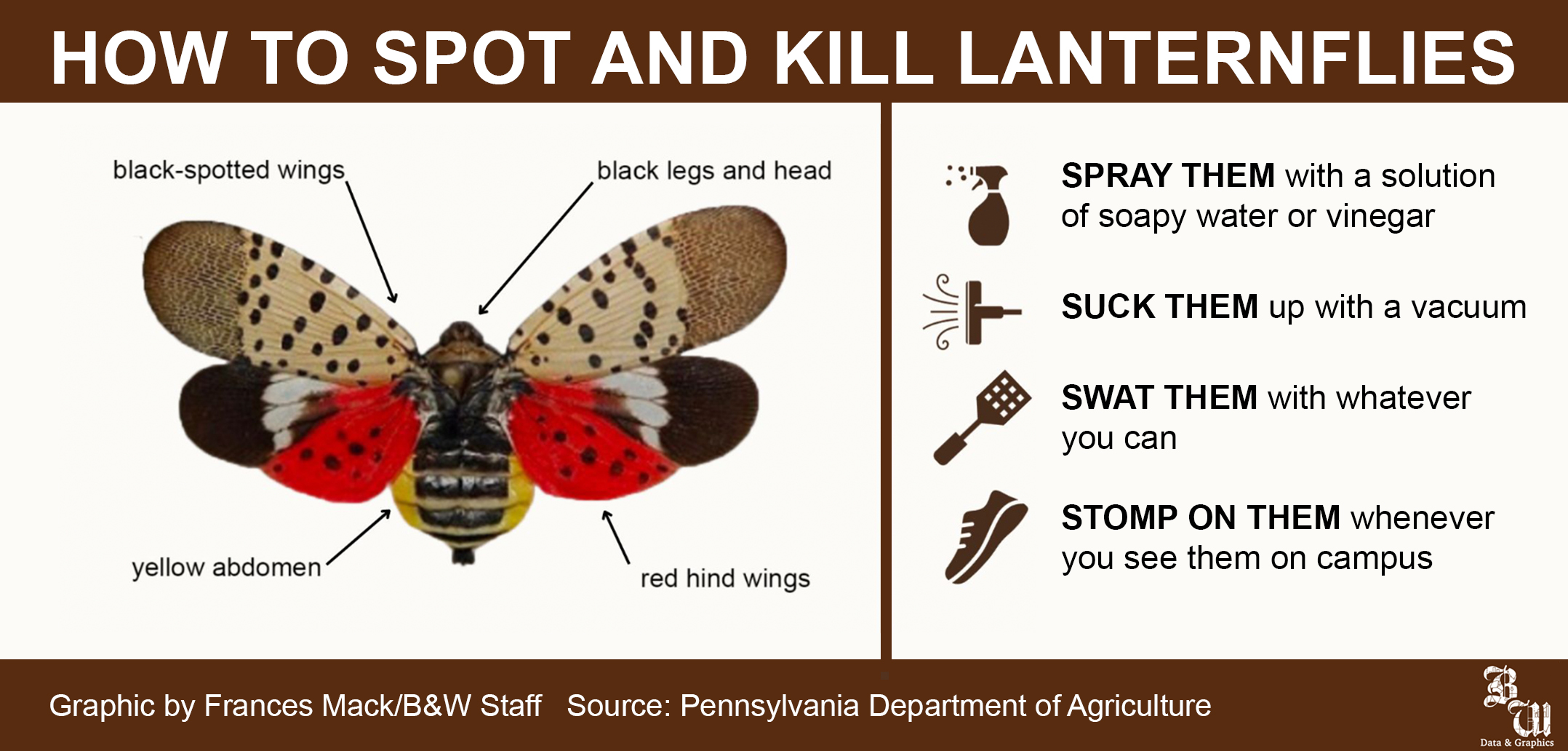
The spotted lanternfly (Lycorma delicatula) has a striking appearance. With vibrant red wings and unique black spots, this invasive species deceives some people into thinking they are harmless.
But, the protocol when interacting with this species is to kill them.
The “If You See It, Stomp It” campaign is central to the government’s response. This public awareness initiative encourages individuals to combat the invasion of spotted lanternflies.
According to National Park Service, the invasive species was first discovered in Berks County, Pennsylvania, 42 miles from Lehigh’s campus, in 2014. Since then, the population of these pests has created a growing concern among farmers, environmentalists and government agencies.
According to the Pennsylvania Department of Agriculture, the spotted lanternfly causes “serious damage including oozing sap, wilting, leaf curling and dieback in trees, vines, crops, and many other types of plants.”
The department says a sugary substance known as Honeydew leads to the buildup of “black sooty mold” that can further harm plant health and reduce crop yields, compounding the economic impact on farmers.
Margaret McLaughlin, ‘24, who is studying earth and environmental science and acts as a Campus Sustainability Impact Fellow, said the lanternfly issue serves as a reminder that the solution to invasive species is not introducing another species.
“The lanternflies use the Tree of Heaven, another invasive species, as their food source, which is why they are so prevalent around Pennsylvania,” McLaughlin said. “Although lanternflies were not purposefully introduced to combat the spread of the invasive tree, (this) can still be used to caution others not to use an introduced species to combat another introduced species outside of their natural habitats and regions.”
Rachelle Ostroff, ‘25, president of the Lehigh Conservation Club, said lanternflies are not supposed to be in the U.S. and there are other negative impacts these bugs leave behind.
“Not only is it harmful to the environment, but (it) also has an economic impact,” Ostroff said.
She said industries that use certain plants for their products are being impacted by the lanternflies as they have become a threat to agriculture.
Sophia Kianni is the founder of Climate Cardinals, an international nonprofit organization that works to translate climate change resources into hundreds of languages. She also represents the United States as the youngest climate adviser to the United Nations Secretary-General, Antonio Guterres. Kianni said every threat in our environment, whether big or small, demands our attention and action, and we should work tirelessly to safeguard our planet’s delicate balance.
“Lanternflies and invasive species, like climate change, are relentless invaders of our fragile ecosystem,” Kianni said. “Just as we need to unite to combat the rising temperatures and extreme weather events, we must also stand together to protect our planet from these silent destroyers.”
The Pennsylvania Department of Agriculture implemented quarantine zones, which limit the movement of goods from affected areas to new areas, hopefully preventing contamination.
According to CBS News, these measures are impacting trade and commerce as farmers are forced to spend more on pest control measures to protect their crops, increasing production costs.
Kaitlyn Powel, ‘25, said as a Pennsylvania resident, she has seen the frequency of spotted lanternfly sightings lessen in the last couple of years but the issue has historically affected and continues to affect the Lehigh Valley and Northeast.
“Living on such a beautiful campus, we should care about the health of the trees and forests around us,” Powel said.
Ostroff said the Lehigh Conservation Club organized a fundraiser to raise money for the Pennsylvania Environmental Council. She hopes by doing this, more initiatives will be in place to reduce the population of this invasive bug.
Adelaide Schiller, ‘25, said she has recruited members in her sorority community to reduce the invasion of lanternflies. Though her fellow Eco-Reps haven’t organized anything yet to address this issue, she organized a “squash walk” for her sorority.
“We walked to the lanternfly hot spots on campus and killed them while I talked about how to identify the bugs, why they’re bad for our environment and the best way to kill them,” Schiller said.
According to the Pennsylvania Spotted Lanternfly Program, there is a five-pronged effort underway to slow the spread, and individual efforts play a significant role. Reporting sightings and participating in community efforts to control the lanternflies has the potential to collectively make a difference in the prevalence of the spotted lanternfly in the local and greater community.
Comment Policy
Comments posted to The Brown and White website are reviewed by a moderator before being approved. Incendiary speech or harassing language, including comments targeted at individuals, may be deemed unacceptable and not published. Spam and other soliciting will also be declined.
The Brown and White also reserves the right to refuse the publication of entirely anonymous comments.