



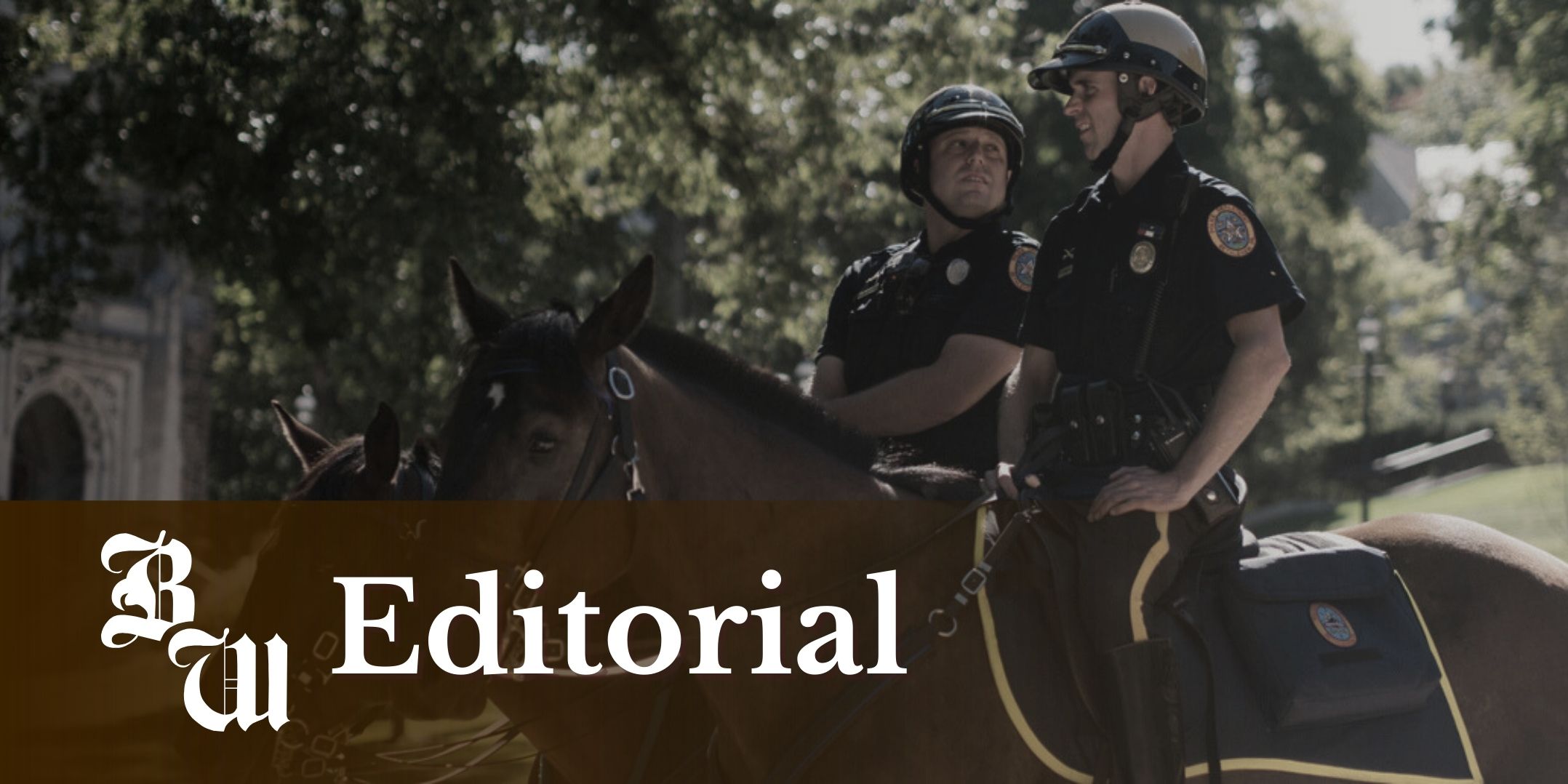
If you’re arresting people, you’re a governing entity. Right?
Law enforcement and armed forces are most commonly associated with agencies within some portion of government. Whether it be on a small local level or a large federal level, there’s reason to believe that a system of checks and balances is in place.
After all, that’s what our democracy is founded on: the balance of power between the branches of government. But things are notoriously messier on the state level.
Some types of law enforcement include local police, state troopers and deputy sheriffs.
As such, Right-to-Know laws apply to these agencies because government records are presumed to be public.
“Under the Right-to-Know Law, all records are presumed to be public records unless disclosure is barred by: (1) state or federal law or regulation; (2) judicial order; (3) privilege, e.g., attorney-client or doctor-patient; or (4) one of the exceptions in Section 708 of the Right-to-Know Law,” according to The Office of Open Records.
One major entity exempt from this are campus police departments. That includes the Lehigh University Police Department.
If Lehigh police can detain people and carry weapons, is that not a private military force?
Whether or not they serve a fulfilling and just purpose is not the subject of our discussion. Instead, we’re interested in exploring the gray area that surrounds their existence and why a lack of transparency is problematic.
At a micro level, privy solely to the experience at our own college, Lehigh police chief Jason Schiffer is seen as a sympathetic ally for equitable policing practices. He’s active in our community, friendly with The Brown and White and helps other organizations.
As a person, he seems like a nice man.
But Schiffer’s likeability shouldn’t shield us from what unchecked privileges Lehigh police might possess.
Historically, campus police departments have drawn very little attention from a scholarly standpoint, despite their prevailing presence in the United States.
In 1894, Yale University hired officers to establish the country’s first private campus police force. Since then, there’s been a growth and modernization of the on-campus law enforcement agencies we see today.
Increased attention to campus crimes, especially the 1986 murder of Jeanne Clery at Lehigh, prompted the creation of the Clery Act. It requires institutions that participate in federal student aid programs to publicly release an annual security report, maintain a public log of crimes reported to campus police and issue timely warnings of crimes.
But this isn’t enough.
According to the Bureau of Justice Statistics, as of 2012, about 95% of four-year schools with 2,500 or more students have a campus law enforcement agency.
What is the difference between a municipality and a university operating an armed police force? If they’re patrolling streets, then why is the public unknowing of the happenings of their operation?
We should point out that the idea for this editorial was not born out of a major controversy or scandal. We are not as much concerned with the way Lehigh police use its power as we are with the principle of it holding this power in the first place.
Still, with the department given the legal leeway to withhold its records, any scandals that might be out there are not so easily discoverable in the first place.
Fundamentally, why do we not apply the same level of scrutiny toward campus police as we do to regular police?
Pennsylvanian universities, particularly those in and around Philadelphia, are some of the most highly policied campuses.
The University of Pennsylvania has 121 full-time sworn officers, the largest private force in the state. Temple University, although public, has upwards of 130 officers.
Should schools be emboldened to be in the business of policing? Does the comfort we feel from their presence stem from the imagined proposition that higher education is tucked away between a fraught, urban landscape?
And how must we consider the role of the history of racism in both policing and higher education?
If two entities that have both historically mistreated black people come together in an organization with little to no outside oversight, we must at least be attentive to the possibility of injustice.
The intersections between race, policing and higher education are too complex to be effectively synthesized at the tail end of this editorial.
But calling this relationship to attention serves to highlight the importance of transparency and accountability in any police force, whether that be a governing entity or a private militia.
2 Comments
How long has Lehigh University had a Police Mounted Unit?
This reads like an agenda searching for a problem, but at least it seems to be truthful.
Comment Policy
Comments posted to The Brown and White website are reviewed by a moderator before being approved. Incendiary speech or harassing language, including comments targeted at individuals, may be deemed unacceptable and not published. Spam and other soliciting will also be declined.
The Brown and White also reserves the right to refuse the publication of entirely anonymous comments.