



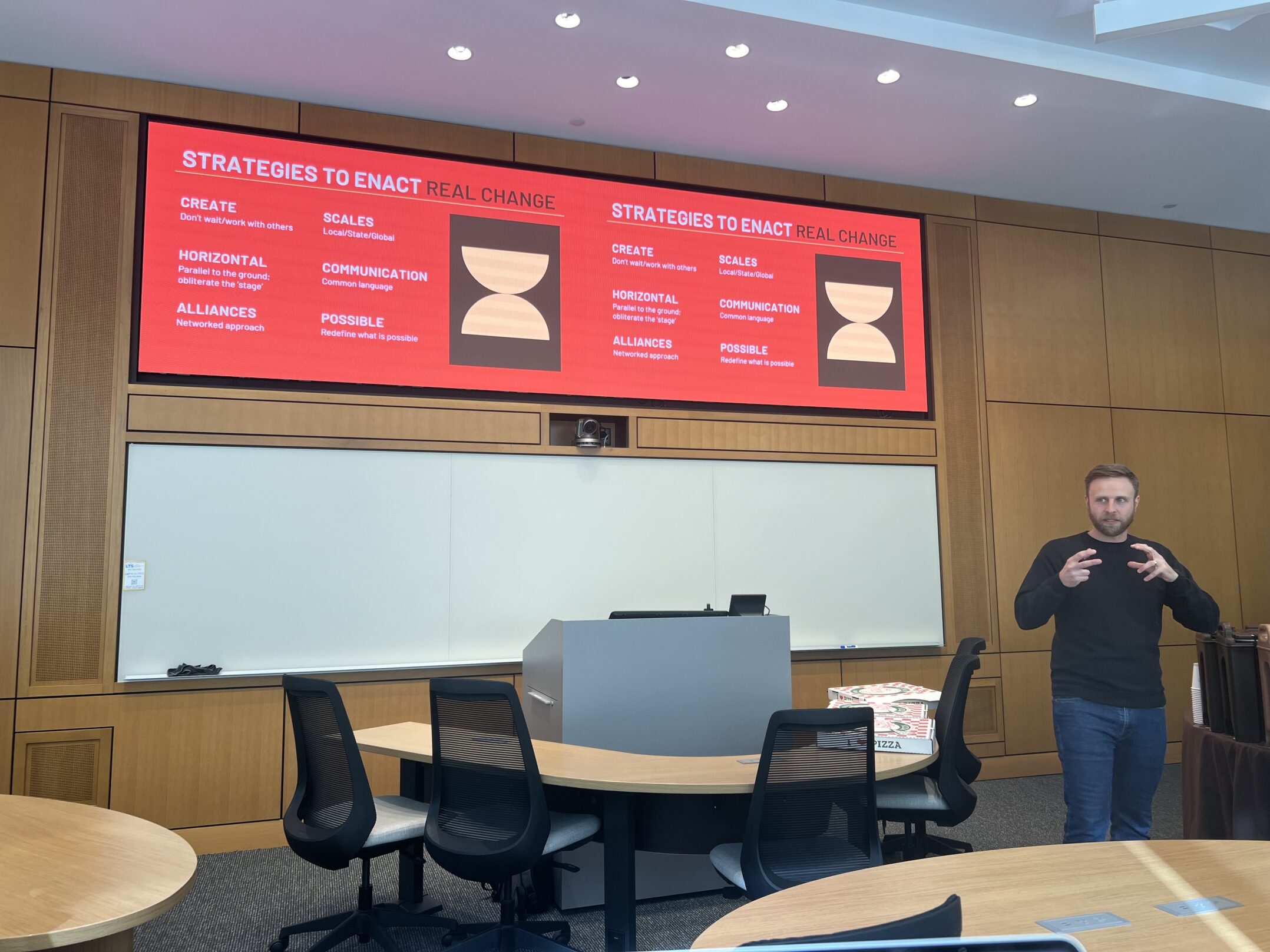
Dean Caivano, who attended Lehigh for his master’s degree, returned to campus this semester to join the political science department as an assistant professor.
With a passion for the complexities of democratic systems and a desire to inspire students and community members to engage in politics, he hosted a presentation on Civic Engagement Day about whether the U.S. government is a democracy or hypocrisy.
What inspired this specific topic, and why did you decide to hold the event on Civic Engagement Day?
Much of my research and much of my personal interest is actually informed and shaped by my students. And so as I mentioned (in) my talk, I think collaborating, listening and engaging with students is not just a valuable pedagogical exercise, but it also is a valuable communal effort when we can create a space where students and professors can exchange ideas and strategize.
So this framing of democracy or hypocrisy is something that I have been thinking about and researching and talking with students about for close to a decade now. And I think there’s a lot of upshot and thinking through that binary and challenging that binary, and seeing what potentials can emerge from that space. And I think, of course, we’re learning (during a) time that is incredibly politicized, incredibly partisan.
I think students (and) myself, feel a great sense of not just responsibility, but also anxiety and fear and trepidation about not just the outcome of the election, but the aftermath and what the future looks like. So talking about democracy in relation to hypocrisy encourages us to recognize that civic engagement is not an infrequent activity. It’s something that we have to be vigilant, and we have to engage with, and we have to find new ways to sustain our communities. And so I thought civic engagement day — a day where we’re going to spend so much time and energy thinking about voting, talking about voting, actually voting. What else is there for us? What other spaces are afforded to us? And, hopefully, create that dialog that if you’re feeling disheartened or frustrated and hard to help you’re not alone. There can be more, and there will be more, but it’s up to us
Can you explain the statistic that you brought up right at the beginning of your presentation — that 95% of students believe we don’t live in a democracy — and how you feel about the results?
It’s a survey question that I provide to my students in every one of my classes. I’m actually shocked at the overwhelming response towards democracy. I have taught at research institutions like Lehigh. I taught at community colleges, adult education programs. I’ve also taught in state prisons. And what we’re seeing is that across those spaces with diverse, racial, ethnic, class, gender differences, there is still almost a uniform agreement, almost a consensus that these ideals of democracy are not being realized. And for me, that’s remarkable. It’s remarkable that when we’re considering all the differences among individuals, students, voters, there is finally something we agree upon. But the thing that we agree upon is that the democracy we live in is flawed and deeply, deeply flawed.
Now there are some really interesting repercussions of this. For those that think we do live in a hypocrisy, there may be an array of methods to sort of ameliorate that, to fix that, and that’s where things can get even more complicated when thinking about how someone on the far right would address the hypocrisy or democracy, or someone who identifies as a progressive. What is their solution? What is their approach to rectify the hypocritical nature of America? And it’s the playing out of politics that becomes all the more interesting and all the more engaging when we look at it from that lens. I think we learn something really valuable when we see frustrated voters, upset voters, powerless anti-voters, and we start to see why. Why? Why do they no longer believe in the system? Why are public levels of confidence at all-time historic lows for the Supreme Court, for the presidency, for Congress, and what does that say about something much larger beyond the individual voter. What does it say about the system that we are in many ways hostage to, but yet we feel like we have no control over.
What do you think Lehigh has done to improve discussion of these topics?
This is my first semester here as a professor. It’s great to be back because I earned my Master’s degree here over a decade ago. So I certainly have noticed some substance differences from the old regime when I was here under President Alice Gast to our current president. I am incredibly encouraged by the plethora of spaces and avenues for student engagement here presently, I think the student population of Lehigh today is far more critical, not only of the issues that are confronting American society at large but also some of the underlying issues that continue to plague Lehigh University.
This is a university that is the result and it’s a product of a historically exclusionary system — higher education. It is also a university that specifically serves a very particular demographic, but in the serving of that demographic, I think there is an incredible amount of potential to translate those preexisting forms of social capital into significant change. I certainly recognize that I’m generalizing the student population here, but I think it’s a pretty safe generalization to talk about, sort of the advocacy of many of the students here at Lehigh.
What I’m recognizing is so encouraging as not just a political science professor but also as a member of the community and as a resident of South Bethlehem, is that there seems to be an insatiable thirst to translate those social standings and that sense of social capital into a force of good, into a transformation of our campus, of our community, of our state and of our country. This no longer feels like a docile, passive cohort of students. It seems and feels very much like the percolation of a student population that is recognizing that the future perhaps looks very gloomy and very pessimistic, and I think there’s a best interest in changing that.
If you could give students, one piece of advice in this exact moment, what would it be?
I follow this saying by the Talking Heads from the song “Once in a Lifetime” that repeats “same as it ever was.” This idea of the same as it ever was suggests that we are constantly reproducing new views and new ways that create the illusion of freedom and equality, yet we’re coming up with more nefarious trappings (and) dangerous ways. My one bit of advice is that even if it’s the same as it ever was that doesn’t mean it’s the same as it always will be.
Comment Policy
Comments posted to The Brown and White website are reviewed by a moderator before being approved. Incendiary speech or harassing language, including comments targeted at individuals, may be deemed unacceptable and not published. Spam and other soliciting will also be declined.
The Brown and White also reserves the right to refuse the publication of entirely anonymous comments.