



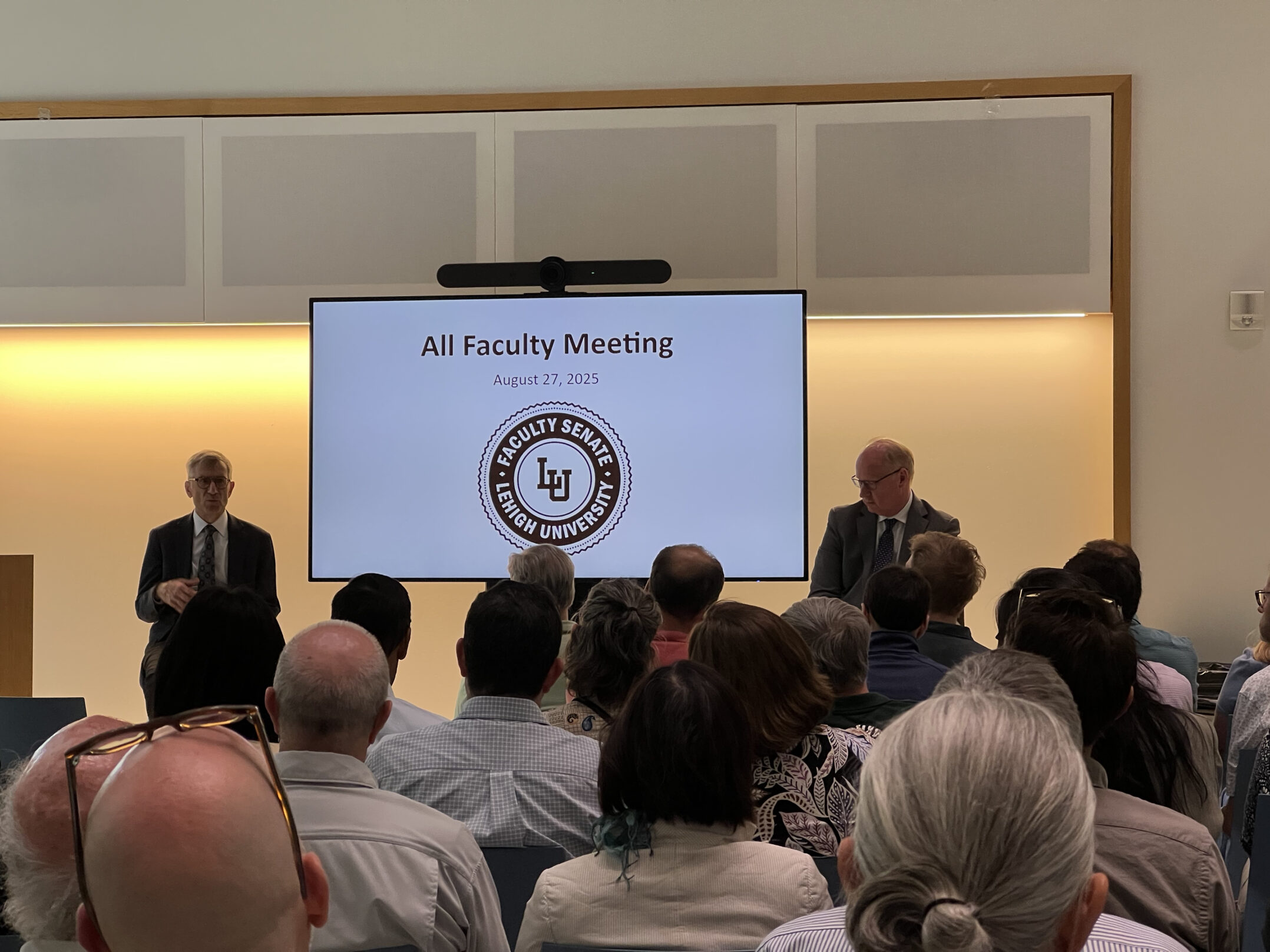
Lehigh’s Faculty Senate hosted an all-faculty meeting on Wednesday following requests from faculty members to discuss the university’s stance on federal government intervention.
Because the meeting was held in response to faculty demand, it did not fulfill the Faculty Senate’s annual required all-faculty meeting, but was seen as an add-on.
The meeting was facilitated by President Joseph Helble and Provost Nathan Urban, who both spoke about the university’s federal funding and other institutional factors affected by government executive orders.
Helble opened the meeting by addressing concerns about foreign undergraduate students being unable to keep visas.
In April, “a few” international Lehigh-sponsored student visas were revoked, reportedly not in relation to student participation in protests or civic engagement.
However, Helble said Lehigh has not seen major visa issues at the undergraduate level. As of Wednesday, he said two undergraduate international students were unable to get visas while all other students who needed one received one.
Although he said undergraduate visas haven’t been too greatly impacted at Lehigh, Helble said the federal government’s intervention has certainly affected academic institutions.
“There has been a new level of government intervention in university operations over the course of the past six months that is unlike anything any of us have seen in memory,” Helble said. “The federal government has, of course, long played a role in college and university higher education — supporting financial aid and providing some support for research — but they have always respected and remained at arm’s length from operational freedom.”
Economics professor Frank Gunter said Helble spoke poorly of the government being involved in higher education, but said he believes there can be an appropriate level of federal involvement.
“It seems that Columbia and Harvard — they institutionalized antisemitism, and it seems appropriate for the government to get involved in that,” Gunter said. “So should we say that in some cases (government intervention) is inappropriate, but some cases it’s appropriate?”
In response, Helble said a broad characterization of antisemitism across the higher education spectrum presents a picture he doesn’t believe is completely accurate.
He said the federal government can ask questions, host hearings and hold universities accountable when incidents may happen on campus.
However, Helble questioned whether the right way to respond to these incidents was to immediately freeze funding upwards of $500 million.
He mentioned specifically how some universities were fined or had research funding frozen over the summer due to alleged unchecked antisemitism, including Harvard University and Columbia University.
In regard to Lehigh’s finances, Helble said although the university has been moving cautiously with hiring since February after federal funds were being frozen, staffing has not been stopped or reduced. He also said the full planned merit pool has been fulfilled for the 2025-26 academic year.
He said Lehigh has, however, had some of its grants canceled through governmental changes.
“We lost about $1.3 million in funding, direct and indirect,” Helble said. “It had been higher than that, but some positive news is that we had two grants reinstated.”
He did not elaborate as to which grants had been reinstated.
One of the concerns Helble discussed was whether professors can continue teaching how they wish, or if they would have to change their methodologies in accordance to what the government dictates. This statement was met attentively with many head nods from the faculty.
However, Helble said there is no curtailment of a professor’s ability to continue engaging and teaching students in whatever manner they want.
Urban then discussed faculty concerns about how a potential cut in future funding would affect expectations for tenure promotion.
Urban said the current plan is to reinstate a tenure promotion process similar to what was enacted during the coronavirus pandemic.
The process allows faculty members to explain how external environmental factors out of their control may have impacted their ability to perform certain kinds of research.
Urban said these factors can include funding cuts or regulatory changes.
Urban said even before funding reductions were implemented on a governmental level, Lehigh was looking to improve how intellectual property, or products of faculty and student research, is handled and ensuring it has an impact.
“If that impact is achieved through a commercialization channel, we want to be more supportive both in terms of infrastructure and also in terms of policy things around promotion,” Urban said.
Helble also said that while Lehigh is not among the national leaders in faculty and student intellectual property, the university is taking steps to address and improve upon that.
The next Faculty Senate meeting will be held on Sept. 5, and the next all-faculty meeting is expected to take place in February 2026. More information can be found on the Faculty Senate website.
Comment Policy
Comments posted to The Brown and White website are reviewed by a moderator before being approved. Incendiary speech or harassing language, including comments targeted at individuals, may be deemed unacceptable and not published. Spam and other soliciting will also be declined.
The Brown and White also reserves the right to refuse the publication of entirely anonymous comments.