



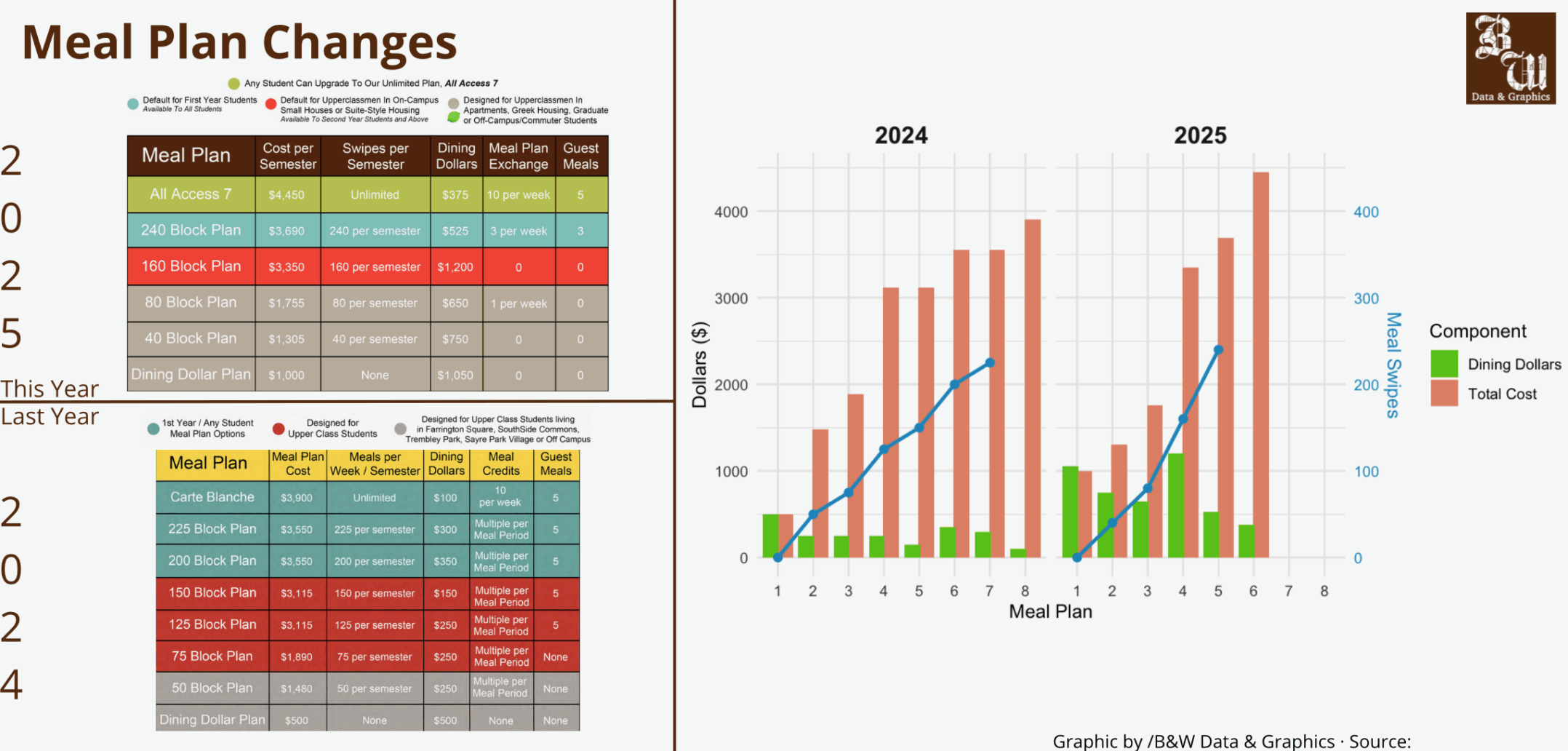
Lehigh Dining has modified meal plans and dining options for the 2025-26 academic year, prompting mixed reactions from the student body.
The number of meal plans available has been reduced from eight to six. Meal swipes are also no longer able to be exchanged for dining dollars at retail locations and can only be used at dining halls. The new meal plans have increased the included number of dining dollars to reflect this change.
Last spring, meal swipes had a $7 equivalency at retail dining locations. Lehigh Dining has swapped out this program with “meal exchanges,” where students can get several items under one “exchange.”
According to Lehigh Dining, the current default meal plan for first-year students consists of 240 meal swipes and $525 dining dollars, costing $3,690 per semester. The cost of the first-year meal plan in fall 2024 was $3,550 per semester.
The plans available range in different amounts of swipes or dining dollars, and costs range from $1,000 to $4,450 per semester. In fall 2024, the cost of meal plans ranged from $500 to $3,900 per semester.
Charlie Keenan, ‘28, is currently on the 40 block plan and lives on campus with a kitchen. She said she isn’t sure if she enjoys the new meal plan system this year.
“I liked what we had last year, where if I wanted to spend $7 equivalent of a meal swipe, I could,” Keenan said. “It’s how I went through a lot of my meal swipes last semester.”
Keenan has lived with celiac disease since age 7. She said she was very cautious about picking a school that had a lot of options and somewhere she would be able to eat safely.
Audrey Pankauskas, ‘28, said she has really enjoyed her dining experience at Lehigh so far.
She frequently went to Rathbone Dining Hall and Hawk’s Nest last year, but now that she lives at Singleton, Hitch and Maida Houses she said she doesn’t go as often.
Pankauskas said the option of reaching out to Lehigh Dining for accommodations like getting access to Brodhead Dining Hall isn’t talked about enough.
Pankauskas is currently on the 160 block plan, with 160 swipes per semester and $1,200 dining dollars.
She said she’s worried about running out of dining dollars, because her meals usually cost at least $13.
Last year, she said it was nice to be able to pay with both dining dollars and meal swipes, but even then it wasn’t that much food for one swipe.
“I’m not going to go to the big dining halls as much as I did last year,” Pankauskas said. “Especially with classes, it’s just a completely different schedule and it’s easier to pick things up. Everything is dining dollars.”
David Joseph, the executive director of auxiliary services, said the inspiration behind the changes in meal plans and available retail locations came from research and a conversation with senior administration, asking Lehigh Dining to make “transformational” changes.
Joseph said Lehigh Dining worked with the consulting group Envision Strategies to better understand the dining habits of students today. They also compared Lehigh’s dining with “similar” schools such as Bucknell University and Lafayette College.
The consulting group also looked at trends across the country and Lehigh Dining spoke to student groups on campus, including the Muslim Student Association and the Student Senate.
Last spring, Lehigh Dining announced the closure of multiple retail dining options, including Williams’ International Cafe, Lucy’s Cafe, Hillside Cafe and Chick’N’Bap, which was located in Hawks Nest.
“That was all from looking, strategically, at sizing your campus,” Joseph said. “There were too many retail operations.”
Joseph said, based on research, there was a demonstrated need for Kosher and Halal dining, kiosk-based ordering and an Amazon To-Go store based on research.
He also said, along with these adjustments, he believes Lehigh has taken the dining program up a couple notches over the last couple years.
Joseph also said one factor considered for a successful university dining plan is having students who are not required to be enrolled in a meal plan still opt in to a plan. He said these students are considered “voluntary.”
“That’s saying something about your program – people want to use it,” Joseph said. “It may be confusing and it may be frustrating at times, but they’re interested in either eating nutritious or healthy and having a lot of options.”
Resident District Manager Kristin Piazza said pricing increases come from making sure Lehigh Dining employees are being fairly paid while covering the costs of food that have increased with inflation.
Joseph said supply chains have changed pretty drastically since COVID, which also contributed to pricing increases.
“Dining is a touch point for kids. Every single day they got to be eating something, right?” Joseph said. “And so we try to create not just good food, not just a variety of food, but an environment where everybody can feel like they belong and are part of the campus community. That sense of belonging is really important to the senior administration, and I know they look to dining to help create and maintain that.”
Comment Policy
Comments posted to The Brown and White website are reviewed by a moderator before being approved. Incendiary speech or harassing language, including comments targeted at individuals, may be deemed unacceptable and not published. Spam and other soliciting will also be declined.
The Brown and White also reserves the right to refuse the publication of entirely anonymous comments.