



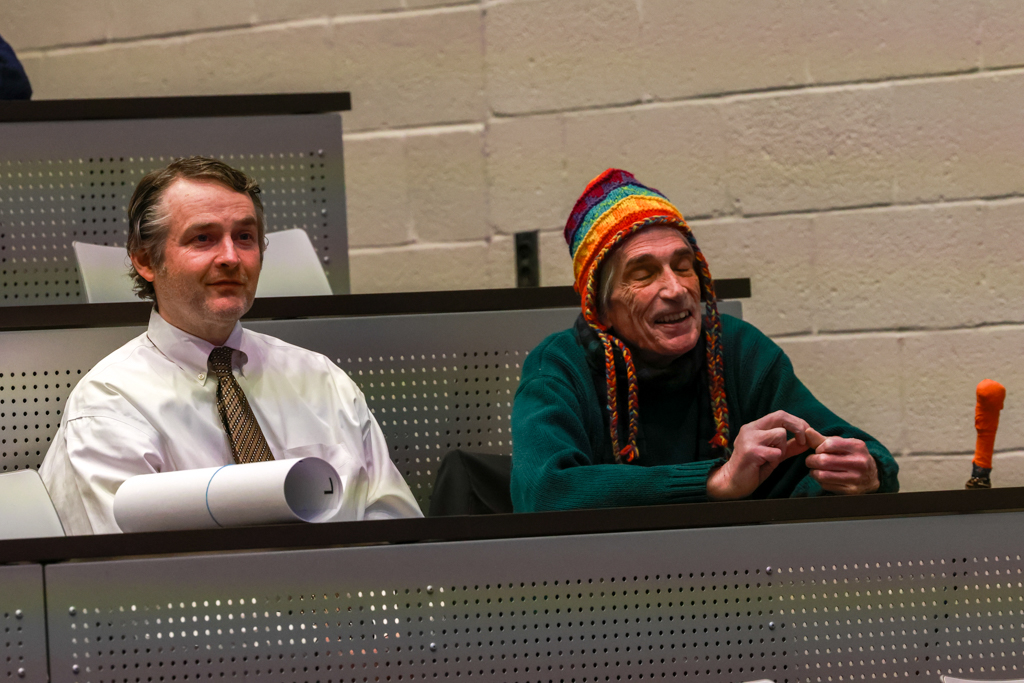
On Tuesday evening, more than 70 people gathered for the 45th annual Tresolini Lecture in Law, delivered by Rachel Scott, an award-winning senior political correspondent for ABC News.
Scott reports from Capitol Hill for all ABC News platforms, including “Good Morning America,” “World News Tonight with David Muir,” “Nightline,” “This Week with George Stephanopoulos,” “20/20,” ABC News Live, ABC News Digital and ABC Audio.
She’s covered some of the most consequential political moments in recent years, reporting live from Butler, Pennsylvania, in the immediate aftermath of the attempted assassination of President Donald Trump, anchoring ABC’s coverage when former President Joe Biden withdrew from the 2024 presidential election and reporting from inside the federal courtroom during Trump’s felony trial.
On her first day as the incoming congressional correspondent for ABC News, Scott received her first assignment: covering Jan. 6, 2021, when thousands of people stormed the U.S. Capitol. About 250 of them were convicted of a crime by a judge or jury, according to PBS News.
“Breaking news, sometimes, doesn’t interrupt your day; sometimes it appears like an ordinary day,” she said. “Sometimes it’s disguised as just another day on the calendar, and sometimes it doesn’t really announce itself. Other times it’s disguised as your very first day.”
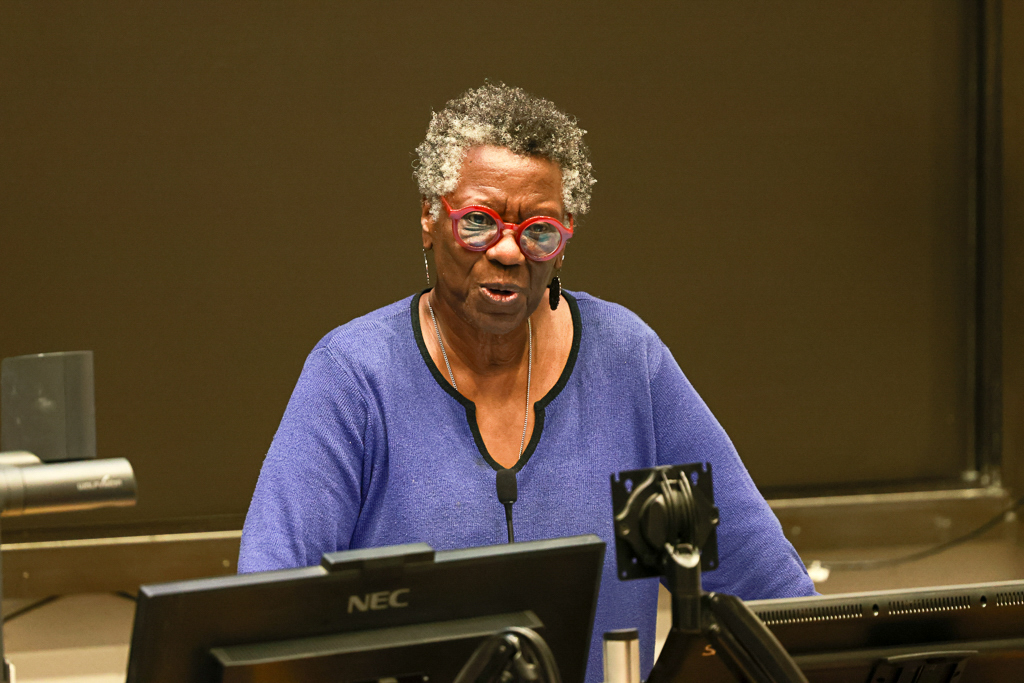
She said she hardly knew her way around Capitol Hill when she received a call from her executive producer informing her that George Stephanopoulos, an American television host, political commentator and former Democratic advisor, was preparing to break into ABC News Programming to report that the Capitol had been breached.
Much of how she navigates the Capitol today, she said, is tied to what she saw and experienced that day. She was almost tackled twice, called racial slurs and had Trump supporters yell at her team that they were “fake news.”
After the attack, the National Guard remained at the Capitol for 130 days.
“And here we are, five years later after the January 6 riot, and the lawmakers who stood together shoulder to shoulder through that violence still can’t really agree on the event that happened that day,” she said. “There are shouting matches in the hallways on Capitol Hill. You have lawmakers who refuse to talk or speak or even work with one another. There are some days where we wonder: Where exactly is all the bipartisanship anymore?”
Still, she said one thing stood out from covering the riot: how close democracy felt. It wasn’t an abstract idea learned in a history or political science course, she said, but a reminder of how fragile and sacred it is.
The lesson stayed with her as she traveled on Biden’s first foreign trip to Geneva, Switzerland for a high-stakes summit with Russian President Vladimir Putin — an assignment she didn’t expect.
“(Putin) decided to take a few questions from the American press, and he called on me,” Scott said. “So I decided to ask him about political dissent in his country, about Alexei Nevalny, the opposition leader, and why (Putin) did not want free and fair elections in his own country.”
She ended her exchange by asking, “What are you so afraid of?” She also asked whether, with political rivals dead, in prison or poisoned, he believed that sent a message that he didn’t want a fair political fight.
While late-night talk shows joked about the exchange, the question brought hope.
She said she received letters from around the world, including from an Irish woman named Siobhan, who wrote that if Scott thought her message to Putin wasn’t reaching the masses, she was proof that it was.
Scott said a journalist living in Russia would never be able to ask Putin such a question, and, if they did, would face severe consequences — as Navalny, the imprisoned Russian opposition leader and anti-corruption activist, did before he was poisoned and later died in 2024.
Although the world saw an American journalist confronting one of the most dangerous leaders of the time, Scott said she questioned whether she deserved to be there — whether she should’ve raised her hand or sat in the front row — appearing as the youngest reporter in the room.
She also said although the question she asked Putin appeared in many headlines, it was about much more than just one leader.
“What happens to this idea of an institution, when journalists can no longer ask uncomfortable questions?” she said. “When journalists are not able to challenge power without fear, when questions are discouraged, when questions are controlled, when questions are punished, and that’s when accountability really begins to fade.”
Geneva wasn’t the last time Scott would press Putin. A few months later, Putin was back on American soil for the first time in 10 years. When Trump landed, officials gathered along a red carpet as the two leaders shook hands.
“When President Putin and President Trump got to the end of the red carpet, I shouted out, ‘Will you commit to stop killing Ukrainian civilians?’” Scott said.
Putin appeared to shrug at the question, she said.
Once home, she said she was flooded with messages, including one from a Ukrainian woman who thanked her for giving Ukrainians a voice and shared that Russian forces had killed her brother.
“I never knew that just a single shouted question could have so much power, and it didn’t have power because it changed policy,” Scott said. “It didn’t have power because it suddenly ended the war between Russia and Ukraine. It didn’t have power because it saved lives. But it had power because it made people feel heard. It made people feel understood.”
It made Ukrainians who would never have a face-to-face interaction with Putin feel that someone was pushing for answers on their behalf — a responsibility she said she doesn’t take lightly.
Scott said the idea of being prepared when history breaks was never tested more than the 19 days of the 2024 presidential campaign, where she covered Trump’s third bid for the White House. She was in Butler, Pennsylvania, when an assissination attempt occurred.
“I remember the sound first, not so much the speech, but a sound that, quite frankly, didn’t belong anywhere in American politics,” Scott said. “It was the sound of gunfire.”
She said her team couldn’t immediately report that it was gunfire or that Trump had been grazed by a bullet, even though it appeared he was bleeding. She said she waits for confirmed facts, especially in an era when misleading information spreads rapidly on social media.
Her job, she said, is to tell people what she sees and hears — and nothing more.
She faced a similar moment when she learned Biden was dropping out of the presidential race and once again found herself filling in on the evening news to break major developments.
Even during what she thought would be a celebratory weekend for her engagement, she received a call asking whether she wanted to interview Trump at the National Association of Black Journalist conference. She said the organization was divided over inviting him, given his past comments about former President Barack Obama and his criticisms of Black journalists.
“We couldn’t let this opportunity go to waste, and there were tons of questions to ask him,” Scott said. “The whole campaign had changed for (Trump), and behind the scenes, as much as they projected confidence, I knew from my reporting and my sources that they were scrambling.”
On Capitol Hill, she said she heard Republican lawmakers describe former Vice President Kamala Harris as a diversity, equity and inclusion hire, implying she held the position because she’s a Black woman.
When Scott asked Trump whether he agreed at the conference, he said Harris had been promoting herself as Indian and that he didn’t know she was Black until a number of years ago, when she “happened to turn Black.”
Although she had to repeat her question multiple times before receiving a direct answer, Scott said she appreciated that Trump took questions and gave the association significant time. The experience reminded her of journalists in Russia who can’t freely ask leaders difficult questions.
She concluded her lecture by emphasizing democracy isn’t guaranteed but must be practiced. She said it’s not just about standing with a microphone and chasing down lawmakers or asking questions to the president.
“Democracy is something that not only lives in tough questions, but it also lives in this idea of accountability,” she said. “It lives in this idea of believing in upholding the principles. It lives in the idea of serving the American people.”
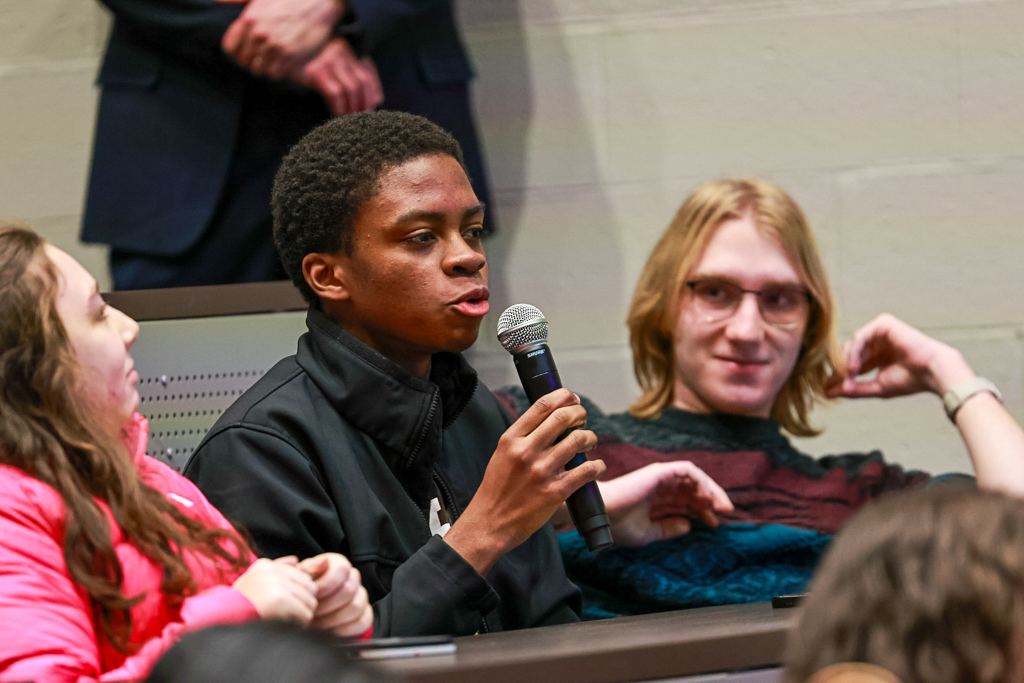
Rory Butler, ‘28, a political science major, said he felt pressured by friends to attend the lecture but was glad he did.
“I’ve been really burnt out by American politics in particular recently, and not to sound overromantic, but (Scott’s) piece was incredibly inspiring and makes me want to get back into (politics),” he said. “I’ve lived (for) American politics since I was in middle school, and then at a certain point after the 2024 election, that just all left me.”
He said journalists like Scott can help keep the country moving forward and show that there’s more good in the world than evil. He also appreciated her multimodal presentation style, which felt less like a traditional lecture and more like a fast-paced reflection of her career.
Brian Fife, the chair of the political science department, said his goal when selecting this year’s speaker was to bring someone who could connect with young people and offer a relatable perspective.
A strong supporter of objective reporting — journalism that focuses on verified facts without bias — Fife said he believes Scott exemplifies that approach. He added that her work, and that of her colleagues, is especially critical in a polarized and less civil political climate.
“(Holding people in power) is extremely important, with all the intimidation that’s really been exerted against journalists in the contemporary era,” Fife said. “When you ask a question that’s important and you’re berated for it, that’s a message. That’s an attempt to deflect the question because the person doesn’t want to answer it and presumably be held accountable as a consequence.”
Comment Policy
Comments posted to The Brown and White website are reviewed by a moderator before being approved. Incendiary speech or harassing language, including comments targeted at individuals, may be deemed unacceptable and not published. Spam and other soliciting will also be declined.
The Brown and White also reserves the right to refuse the publication of entirely anonymous comments.