



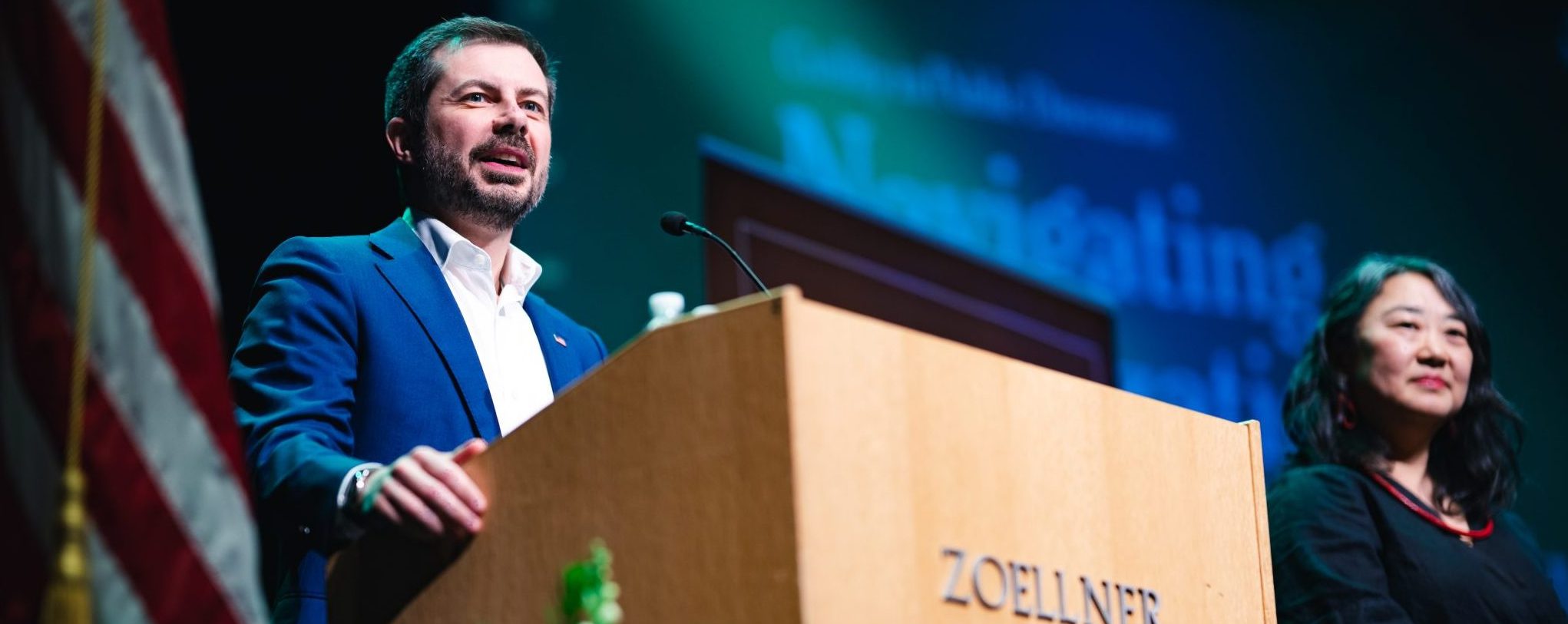
Former U.S. Secretary of Transportation Pete Buttigieg delivered Lehigh’s annual Kenner Lecture on Tuesday night, addressing political polarization, uncertainty in government and the importance of staying politically engaged.
The Kenner Lecture, now in its 29th year, is an endowed lecture series on Cultural Understanding and Tolerance hosted by the College of Arts and Sciences. Speakers share perspectives on the current political and cultural climate, often addressing polarization and the fragility of democracy.
Robert Flowers, dean of the College of Arts and Sciences, opened the event by introducing Buttigieg and outlining his political career, including his tenure as mayor of South Bend, Indiana, and his most recent role as U.S. secretary of transportation.
Buttigieg noted his previous visit to the Lehigh Valley came while announcing transportation funding and infrastructure grants for Lehigh Valley International Airport, part of roughly 700,000 projects funded through the Department of Transportation.
He said leaving the Cabinet was an abrupt transition — suddenly without a government phone, computer or security detail — though his responsibilities as a parent remained unchanged.
Buttigieg said raising his son and daughter reminds him there’s more to life than politics, while also highlighting the stakes of the country’s political climate.
Throughout the lecture, Buttigieg emphasized the need to build a political future better than both the present and the past.
“Our nation is at war launched by a president who did not feel an obligation to build a case for doing so to the American people or Congress and now American blood and treasure is being spilled abroad without a clear picture of what our mission would look like, which is, of course, something we’ve seen before,” Buttigieg said. “And then here at home, we have seen demands from Washington that civil society conform to the whims of the White House or else be punished.”
He pointed to pressure on law firms, universities, student newspapers and late-night comedy shows, as well as Immigration and Customs Enforcement detentions and recent events in Minneapolis, Minnesota, as developments Americans across the political spectrum should be concerned about.
“Equality is very much a kitchen table issue at our house and when we talk and think in terms of everyday life, rather than the rage bait and the political intrigue and the political drama that dominate our moment, we come up with a vocabulary that makes it possible to connect with one another in authentic deliberation and real debate,” Buttigieg said.
Looking ahead, Buttigieg said improving the country’s future requires redistributing wealth and power so everyday Americans can afford essentials such as groceries, housing, education, childcare and health care.
He said Americans must seek perspectives beyond their political bubbles. For him, that includes visiting the Fox News website and engaging with viewpoints he doesn’t expect to agree with.
Buttigieg acknowledged the challenge posed by polarizing media feeds and encouraged Americans to focus on a core democratic principle – political equality, economic opportunity and personal liberty. Drawing on his experience serving in Afghanistan, he said the country would be healthier with a political system centered on protecting everyday freedoms.
At what he said is a decisive time for the country, Buttigieg urged Americans not to disengage from politics.
“The people that inspire us from before should call us to recognize we’re in one of those moments that requires more rather than less engagement,” Buttigieg said. “Probably the wisest thing I’ve ever heard said about hope is that hope is the consequence of action more than its cause.”
Following the lecture, Buttigieg participated in a moderated question and answer session with Ziad Munson, chair of the department of sociology and anthropology.
Munson began by asking how Americans can find common ground in an increasingly polarized society.
“I think it is very important to recognize that none of this is symmetrical, and to resist false equivalences,” Buttigieg said.
Buttigieg reflected on debates he had with conservative and libertarian friends during college about issues such as background checks and environmental regulation. He said those arguments helped shape his understanding of political disagreement.
He also pointed to two defining events during his college years — the Sept. 11 attacks and the invasion of Iraq.
“The stakes seemed apocalyptic, but also to the people who buy political persuasion, the ultimate supervillain in American politics was Dick Cheney,” he said. “Dick Cheney and I were on the same side in the last election. It’s crazy that actually happened.”
Buttigieg said unlikely political alignment reflects a moment when Americans can form new coalitions based on shared democratic principles.
He said humility will be important in the current political moment, emphasizing that a person’s political beliefs or voting choices don’t define whether they’re good or bad. He said people are capable of both good and harmful actions regardless of their politics.
Munson also asked how anger can play a role in civil political dialogue.
“I do worry that some people in our current political moment assume that the only way to respond is performative anger,” he said. “We know there are many things seriously wrong in this country. We cannot accept them, and we have to bring our disposition, whatever that is, whatever it truly is, into that dialogue, into that debate.”
Munson later raised questions about the recent killings of Alex Pretti and Renée Good in Minneapolis.
“I’m a proud native of Minnesota, and so I have watched with particular pain as federal authorities have shot and killed both bystanders and protesters (and) have searched and seized property with warrants,” Munson said.
He asked what role state and local governments can play in holding federal authorities accountable for potential civil rights violations.
“Federal law is what tends to dominate in these cases, and I would argue, in many ways, the problem isn’t the law,” Buttigieg said. “The problem is that the federal government is getting away with ignoring the law.”
Buttigieg said the federal government must become stronger in protecting rights and more restrained in other areas.
Munson then asked about political leaders offering explanations for government actions that may not be made in good faith.
“First of all, to state the very, very blindingly obvious, it’s unacceptable to lie to the people about something important,” Buttigieg said.
He added that while accountability from leaders is important, the strongest safeguard ultimately comes from the public. He said political leaders can act with few consequences when voters back them, but public opposition can quickly limit what government officials are able to do. Strengthening civic engagement, he said, will be critical to protecting the integrity of the 2026 and 2028 elections.
Munson concluded the discussion by asking what steps Americans can take to help restore Congress as a functioning legislative branch. Buttigieg said fixing Congress should be a top priority.
“You can do anything on a bipartisan basis, we got a lot of good things done, but no one can look at the U.S. Congress today and think that we’re looking at the most functional representative body,” he said.
Jack Ciavolella, the vice president of Lehigh College Democrats, said events like the Kenner Lecture give students the chance to engage with complex political issues through structured discussion.
“It helps too that Lehigh Valley is one of the most purple areas in the nation so people focus on us and campaigns will always be clamouring to get students to help them,” Ciavolella said. “The opportunities for (students) to get involved here are some of the best in the nation.”
Julie Wright, ‘25, ‘26G, said she attended the lecture because Buttigieg was one of the first politicians she followed when she developed an interest in politics at 14.
She said she agreed with Buttigieg’s argument that political polarization in the U.S. isn’t evenly distributed across parties, adding that framing polarization as equal on both sides overlooks the rise of the radical right.
She also said hearing Buttigieg speak about hope during a politically difficult time resonated with her.
“There always has to be some kind of hope,” Wright said. “I do believe in hope for the future, and it’s always good to hear different people that you really look up to talk about that. I think that this year has been so difficult for so many people, politically, myself included, but by no means do I think that the Trump administration has a final say on American politics.”
Comment Policy
Comments posted to The Brown and White website are reviewed by a moderator before being approved. Incendiary speech or harassing language, including comments targeted at individuals, may be deemed unacceptable and not published. Spam and other soliciting will also be declined.
The Brown and White also reserves the right to refuse the publication of entirely anonymous comments.