



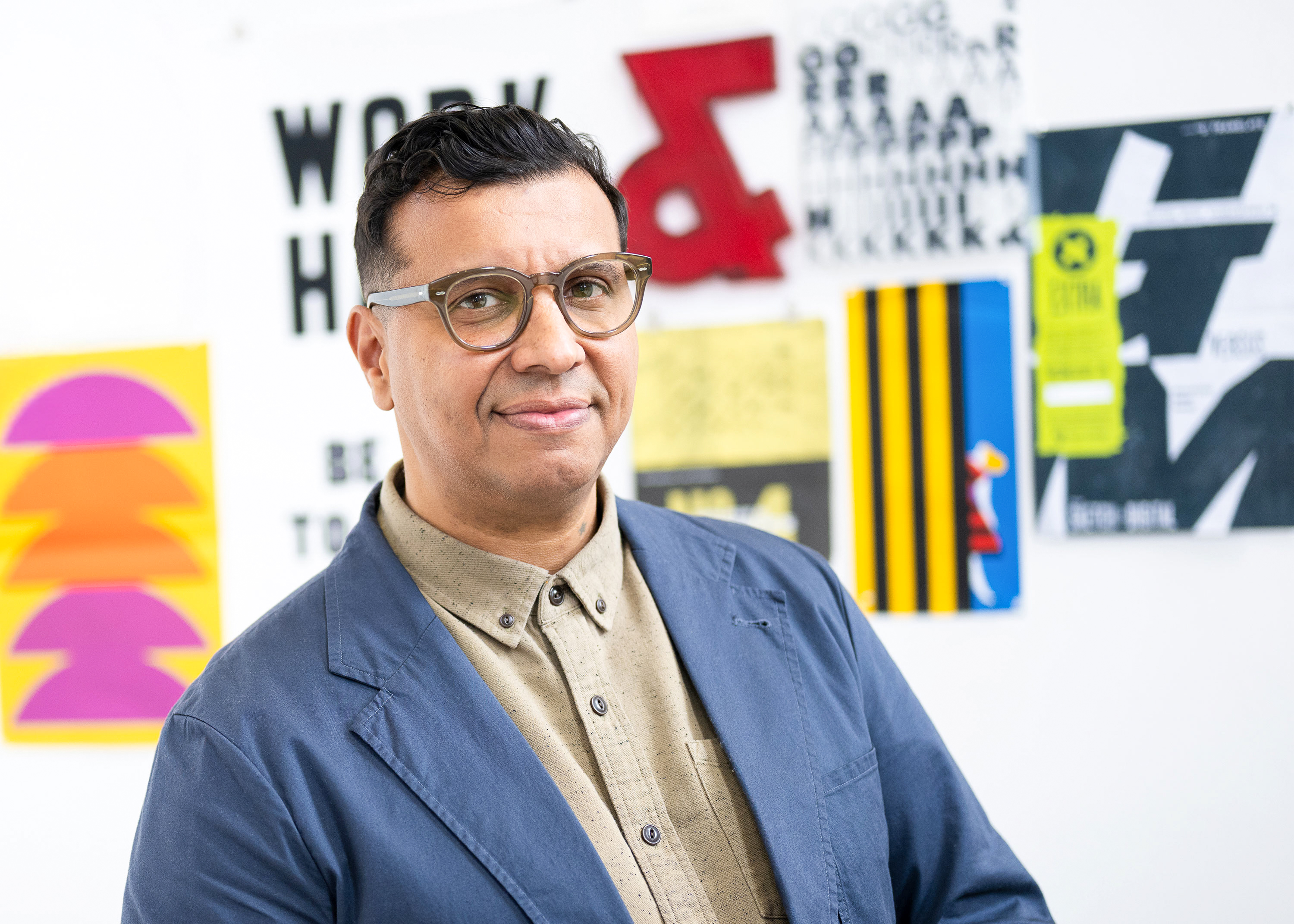
Maurizio Masi sat stubbornly on the cracked leather couch of a Jersey City tattoo parlor that doubled as a coffee shop.
He pleaded with the tattoo artist, a woman with an eye for detail — and, Masi hoped, a steady hand. She was reluctant to take on the design he carried with him. It wasn’t a dragon or a skull.
Instead, it was a crisp typographic diagram — a font he’d unearthed at the library near the office of his dull day job as a corporate graphic designer.
To anyone else, the jumble of lines and letters looked more like homework than body art. But to Masi, now an assistant professor of design at Lehigh, the typeface was Clarendon — a humanist slab-serif designed in the 19th century by Robert Besley — with the letters “Alp,” short for alphabet, as proof of obsession.
Eventually, he convinced her. Needle buzzing, she etched the strong typeface into his arm. Each mark became a permanent reminder of the discipline that’d captured his imagination. After all, Masi had been studying this typography for two years, and he now shares these designs with his students.
Today, Masi admits he often keeps the tattoo covered while teaching, like an old secret tucked beneath a shirt sleeve.
He believes it makes him look more professional, but after all those years and inked-up arms, does one typographic tattoo make a difference?
The ink has faded with time, but that’s part of its beauty: it’s worn in, not worn out.
From Queens to curiosity
Before creation comes inspiration. That inspiration began in Queens, New York, where Masi grew up as the son of immigrants.
His father, originally from Italy, was a chef who dreamed of cooking in New York City’s competitive restaurant scene. His mother, who came from Venezuela, worked as a nurse for more than 30 years.
“(My parents) wanted (my brother and I) to have the opportunities they never did,” Masi said.
At a young age, Masi found sanctuary in one of Brooklyn’s most famous boxing gyms: Gleason’s Gym.
He said self-defense felt essential growing up in New York, but boxing became more than that. The discipline, rhythm and typographic posters plastered on the gym walls all contributed to Masi’s creative eye. Historical boxing and wrestling posters, with their bold typeface and raw imagery, would later influence his design work.
Masi said boxing and design both require precision and resilience. Just as a boxer earns bruises in pursuit of mastery, a designer accumulates failures, firings and faded lines before the work begins to sharpen.
Learning the craft
Masi began his design education at Art and Design High School in New York City, and later attended the Fashion Institute of Technology, where he studied illustration, product design and graphic design.
His education deepened when he left home to study at Nottingham Trent University in England. There, he discovered a different philosophy.
“The structure of graphic design is structureless,” Masi said. “So it was a shock to spend six or seven months researching before you began designing.”
That slower, more investigative approach resonated with him. Still, the transition to professional life wasn’t smooth.
“I got fired a lot, at a couple of places,” Masi said.
Eventually, Masi found his stride in editorial design in 1998.
He worked for trade and consumer magazines, including Hearst publications, where he faced relentless three-week production cycles. Each issue demanded collaboration, quick problem-solving and originality under pressure. The work was grueling, and it honed Masi’s instincts. He learned that design wasn’t just about creating something beautiful, but also about telling a story.
“It required soft skills and lots of technical expertise,” Masi said.
From studio to classroom
Masi eventually transitioned from practitioner to an educator, first teaching at the City University of New York. Working with students, he saw how design education could serve as a ladder, much as it had for him.
Later, at Lehigh, Masi helped rethink the design curriculum, blending graphic and product design to better prepare students for real-world careers.
Professor of art, architecture and design, Wesley Heiss, vividly recalls Masi’s faculty job interview. Masi presented a design, then zoomed out to show there were 100 versions of it — and then zoomed out again to show 1,000 — leaving Heiss both speechless and impressed.
“I love how obsessive (Masi) is,” Heiss said “I think that’s what you have to be to be good.”
Like the tattoo under his sleeve, Masi’s teaching hides layers of meaning beneath a clean surface. Students may see structure and rigor, but underneath lies decades of experience.
Last spring, Masi taught a Fusion elective course that blended research, studio time and professional client work to give students real-world experience. The class pushed students to think about design not only as an academic exercise, but as a collaborative process shaped by legal and business considerations. Students were given the opportunity to design a new logo for Lehigh University’s Art Gallery to commemorate its 100th anniversary.
Masi reinforced these lessons during a class visit to the Metropolitan Museum of Art, where students met the head of design, Alicia Cheng
Cheng gave the class a tour of her studio. Masi emphasized the importance of diversity and representation in design education, pointing to Cheng’s female-owned studio and diverse team.
One student, Jenna Lamberth, ‘28, recalled how Masi’s stories about high-pressure jobs made class both engaging and instructive.
“He gives us lessons that aren’t usually taught,” Lamberth said.
Masi pushes students to create complex designs and refine even their strongest work. The goal isn’t simply to complete assignments, but to dig deeper into research, curiosity and experimentation.
Good design becomes great design, and classroom exercises become habits that last long after graduation. Like ink embedded under skin, his lessons leave marks that don’t fade.
“I have the luxury of walking down the street in New York City and somebody tapping me on the shoulder, (and) they say, ‘You taught me 10 years ago, I’m working at NBCUniversal, I’m a creative director, you showed me Neville Brody’s work and I’m never the same after that,’” Masi said.
At Lehigh, Masi continues working to modernize the design program, weaving in interdisciplinary collaboration and emphasizing diversity in the field.
Masi knows design education isn’t just about teaching software or technique — it’s about encouraging curiosity, resilience and critical thinking.
“We need to instill curiosity and make sure that you follow a journey, and take that journey,” he said.
Nearly three decades into his career, the tattoo is faded and worn. Like his teaching, that’s the point. Beauty for Masi, isn’t about keeping something pristine. It’s about letting it wear in, deepen and become a part of who he is — a designer, educator and typography-obsessed kid from Queens.
1 Comment
Professor Masi’s teachings forever changed my work ethic, process, and my life. Lehigh is so lucky to have him here.
Comment Policy
Comments posted to The Brown and White website are reviewed by a moderator before being approved. Incendiary speech or harassing language, including comments targeted at individuals, may be deemed unacceptable and not published. Spam and other soliciting will also be declined.
The Brown and White also reserves the right to refuse the publication of entirely anonymous comments.