



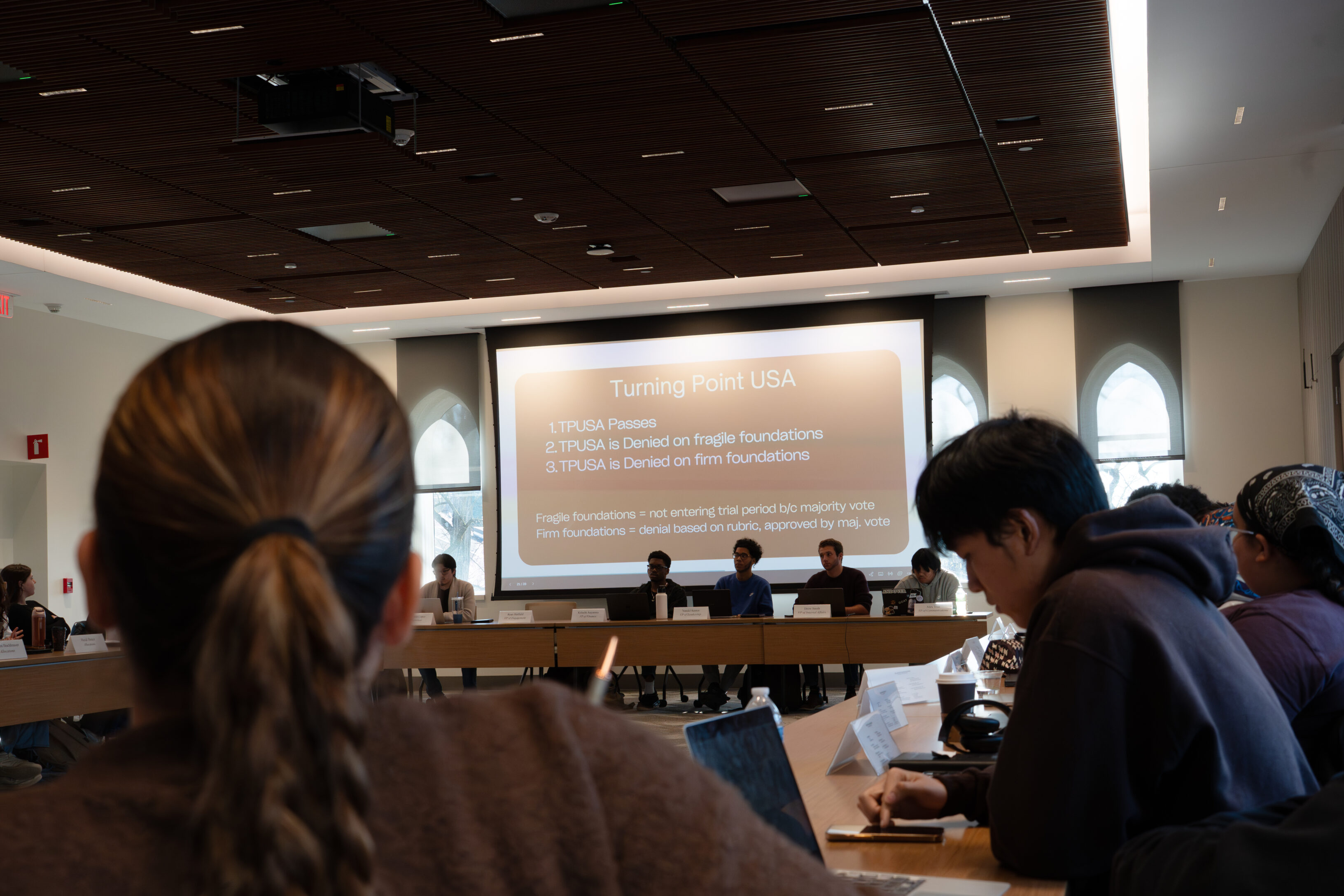
The Student Senate gathered Tuesday evening in the University Center boardroom for its weekly meeting, where senators discussed internal positions and the future of a proposed Turning Point USA chapter.
The meeting began with elections and nominations for Senate leadership roles. A senator was confirmed as parliamentarian, and senators in attendance voted in an election for senate secretary.
The senate had been expected to vote on whether to approve a trial process for a TPUSA chapter following recent debate, but the vote didn’t take place.
Ryan Hatfield, ‘26, chair of the club affairs committee, opened discussion by giving the club approval process. He outlined the six-week trial period that approved clubs must complete after receiving senate approval and addressed the TPUSA chapter’s status.
Hatfield said many senators chose to vote against the club affairs committee’s recommendation during the March 3 vote, when the senate ultimately denied approval of a trial process for TPUSA.
He said senators should place greater emphasis on evaluating clubs based on the rubric rather than focusing solely on a club’s “content.”
“The precedent for sidelining the rubric for a content-based denial is — I would argue — remarkably dangerous,” Hatfield said.
He said the only section of the rubric in which TPUSA lost a significant number of points was “benefit to the community,” adding that the club still earned enough points to pass the committee’s preliminary review.
He outlined what he described as three possible paths forward: approval by a majority senate vote, denial on “firm” foundations or denial on “fragile” foundations.
Hatfield said “firm” denial would be based on the rubric, while a “fragile” denial would occur if the senate rejected a club despite a rubric-backed recommendation from the committee.
Following Hatfield’s presentation, several senators called for greater clarity in the rubric process and improved communication between the executive board and non-executive members.
Braylon Ware, ‘27, a member of the committee for diversity and inclusion, said if a club passes through trial periods while marginalized students feel uncomfortable, then “something isn’t right.”
“If the point being (made is) that we’re supposed to fall in line with whatever club affairs decides, what is the point of full senate?” Ware said.
Mariana Roldán, ‘28, chair of the diversity and inclusion committee, said she was disheartened by what she described as a lack of communication from the executive board.
She also said more time should’ve been allocated for open discussion.
Mandisa Kollie ‘28, also a member of the committee, proposed moving the TPUSA re-vote to next week to allow for more discussion. She and other senators said the re-vote should be placed first on the agenda.
A majority of senators voted to postpone the vote until the next meeting, and the motion passed.
Several senators also expressed confusion about the motion that initiated the re-vote.
Drew Smith, ‘27, vice president of internal affairs and president-elect of the senate, said the motion was brought forward by at least one senator who had originally voted with the majority to deny TPUSA. The identities of those senators were kept anonymous at their request to the executive board. Because the vote didn’t occur, their identities remained undisclosed, leaving non-executive senators unaware of who prompted the re-vote.
Kollie and others questioned why those senators hadn’t publicly identified themselves or explained their decision to bring the motion forward.
“When the re-vote was first brought to us last week, we asked for more information — It was not given to us,” Roldán said. “I asked for a more clear explanation as to why this was happening, and I was not given any new information that wasn’t already said previously. I feel there is no communication, and if this is what (the senate executive board) is going to continue, if this style of communication is going to continue, then no change is going to be made, and we’re going to be stuck in the same old patterns.”
Hatfield also addressed internal pressures within the senate and introduced a motion for anonymous voting by ballot to reduce fear and intimidation during the voting process.
Several senators pushed back against the idea, arguing that, as elected representatives, they should be prepared to vote publicly.
“I think if you feel scared to vote on an issue, then you shouldn’t be voting on it,” Ware said. “You were elected to vote publicly for what students want, and you’re representing them.
The meeting concluded at 6:11 p.m. The full senate re-vote on the TPUSA chapter’s trial process is scheduled for April 14 at 4:30 p.m. in the Clayton University Center boardroom.
Comment Policy
Comments posted to The Brown and White website are reviewed by a moderator before being approved. Incendiary speech or harassing language, including comments targeted at individuals, may be deemed unacceptable and not published. Spam and other soliciting will also be declined.
The Brown and White also reserves the right to refuse the publication of entirely anonymous comments.