



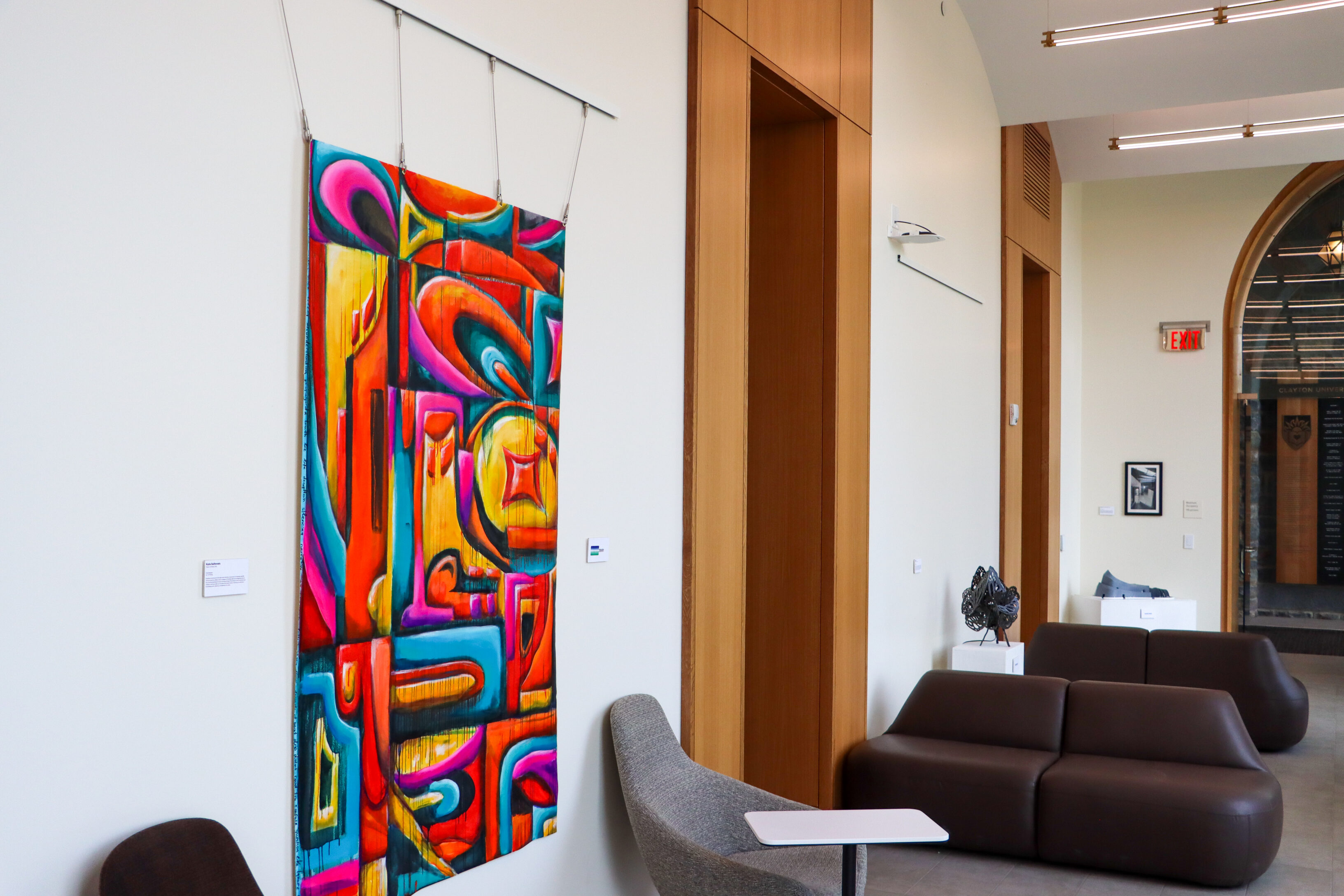
“The Greatest Works”, an art exhibition curated by Octavio Mendoza, ‘26, is showcasing student artwork in the Clayton University Center to spark conversation and intellectual curiosity.
The exhibition features a collection of student work from art, design and architecture courses, highlighting sculpture, object designs, 3D-printed architectural models, photography and paintings.
Pieces on display include both functional and conceptual works, such as hand-crafted objects, studio-based architectural projects, landscape and astrophotography, and expressive mixed-media pieces.
The exhibition aims to bring student work from studio courses into a public campus space.
Mendoza said “The Greatest Works” began with an idea from his professor, Deidre Murphy, Lehigh’s painting professor, who wanted to fill space in the University Center with artwork.
Murphy tasked Mendoza with curating the spring exhibition, and he collaborated with graphic design majors Sally Ma, ‘26, and Brian Lee, ‘26, to organize the show, noting their contributions significantly improved the exhibition’s overall presentation.
Though it was his first time directing and coordinating an art exhibition, Mendoza said he developed skills such as problem-solving and creativity.
“It is about validating our own art,” he said. “Oftentimes, when we make things, it’s because we want validation and to have others say, ‘this is great.’ It’s taking ownership and knowing that it is good.”
The exhibition also features one of Mendoza’s own projects: a croquet mallet. He said he’d never taken a woodworking class before coming to Lehigh and viewed the project as an opportunity to learn a new skill and create something meaningful.
Mendoza said prompts in Mountaintop classes are often open to interpretation, which led him to create the mallet.
“I saw a lot of these older individuals playing (croquet), and I thought it was interesting that people at that age were still aggressive and involved in it, so I wanted to enhance and bring out that visceral sense of ‘this is what it means to really be passionate and determined about a game,’” he said.
Representing the architecture program, Kimi Irie, ‘27, submitted a project from his class in which students were prompted to design a Louis Kahn-inspired theater.
Large in scale and 3D-printed, Irie’s group drew inspiration from nature, mimicking the geometries and wings of a thorn bug.
Irie said one of the biggest challenges was incorporating complex geometries, including curved forms rather than simple straight walls.
His group’s model wasn’t a traditional theater but instead emphasized the meaning of an institution and how it can influence architectural spaces.
“I hope people can feel the appreciation of architectural spaces that they encounter in everyday life,” Irie said. “Every building has a reason and a lot of thought behind its design. If people could start picking up on some of those hints and appreciate what architects, designers and engineers all do to come together and accomplish these amazing buildings.”
Kate Saltovets, ‘26, submitted a graffiti-inspired oil painting influenced by her Ukrainian background and interest in politics.
She said she began her studio minor during her junior year and initially painted in muted tones, shaped by her upbringing and the war in Ukraine.
After moving to the U.S., Saltovets said she felt guilty embracing brighter colors while conflict continued at home.
During a painting class, she challenged herself to experiment with more vibrant expression. She said she began splashing bright colors onto the canvas, which felt liberating.
Through that process, she developed an interest in graffiti and its combination of language, imagery and community expression.
“For me, this is sort of analogous to how a lot of unprivileged communities, and for me personally, how the Ukrainian story is often misrepresented in the media and deconstructed,” Saltovets said.
She said she hopes viewers will question what they see, both in her artwork and in broader media portrayals of underrepresented communities.
Mendoza said the exhibition aims to expand in the future. While only nine students were initially selected, he hopes to include more work from art and design students across campus.
Saltovets also emphasized the importance of bringing artwork to the Asa Packer Campus.
“There are so many exhibitions happening at Mountaintop, but a lot of the students don’t get to see it because they don’t have classes up there,” she said.
Comment Policy
Comments posted to The Brown and White website are reviewed by a moderator before being approved. Incendiary speech or harassing language, including comments targeted at individuals, may be deemed unacceptable and not published. Spam and other soliciting will also be declined.
The Brown and White also reserves the right to refuse the publication of entirely anonymous comments.