



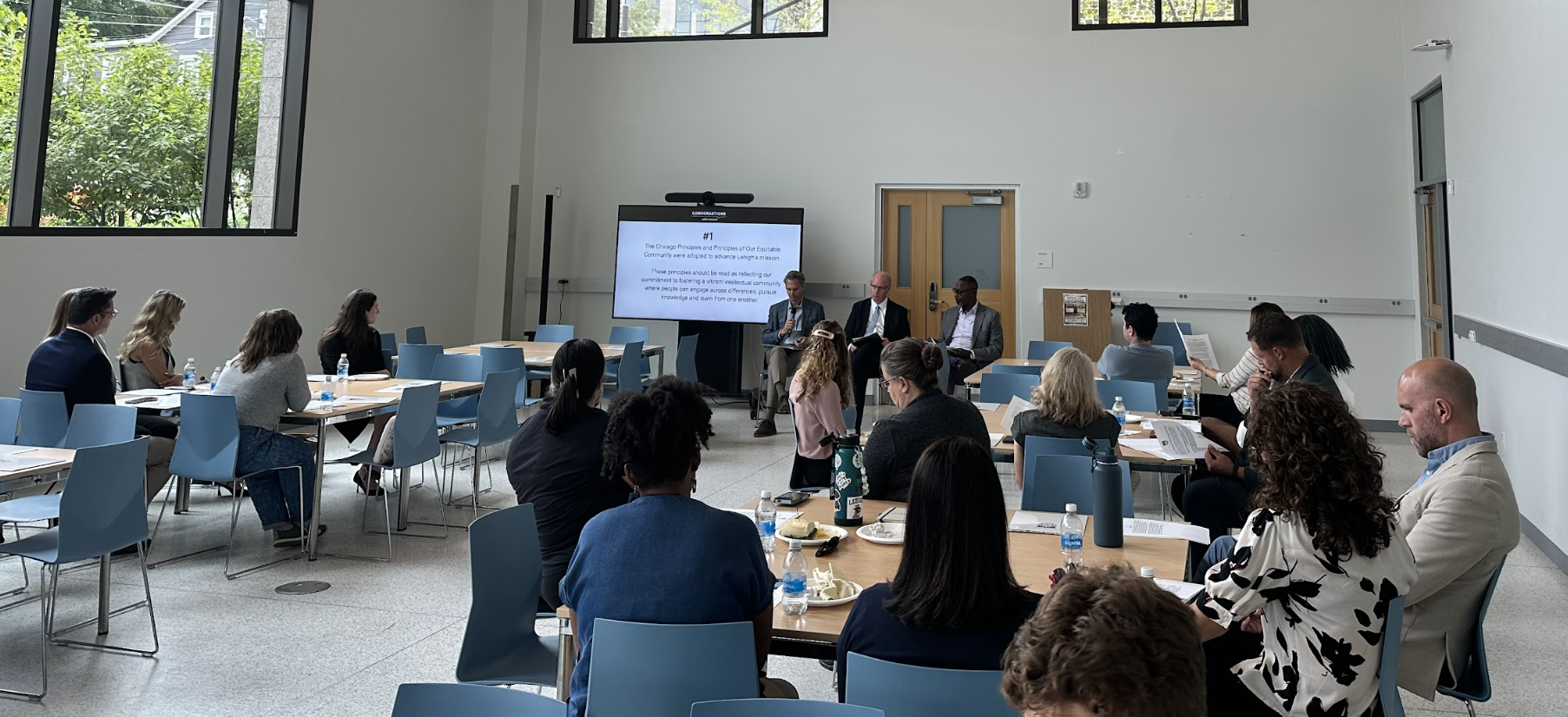
About 30 faculty members, students and community members gathered in HST for the first of three Conversations with Counsel events this semester. These discussions are led by Lehigh’s General Counsel Office on how the university’s free speech and community principles apply to questions of discrimination, safety and expression.
The event focused on the relationship between the Chicago Principles, which Lehigh adopted in October 2025 alongside 100 other academic institutions. The event also included discussion of Lehigh’s Principles of Equitable Community, which the university endorsed in 2011.
The Principles of Equitable Community were born out of the Council for Equity and Community, which was established in 2008 under former Lehigh President Alice Gast.
According to Donald Outing, Lehigh’s first and current vice president of equity and community, the principles center on four commitments: dignity and equity; diversity and understanding; freedom and respectful disagreement; and responsibility to community.
Matthew Lahey, vice president and secretary of the Office of General Counsel, said the discussion series was created in response to incidents from last March when students drew racist depictions on BORGs.
The incidents raised questions on campus about how the Chicago Principles and Lehigh’s Principles of Equitable Community apply to speech that is considered discriminatory or harmful.
Lahey is part of Lehigh’s anti-discrimination working group established at the end of March last semester. He said at the event that he was hoping to discuss the principles with the campus community this semester, making it an appropriate topic for the first Conversations with Counsel meeting.
The principles spurred discussion in Lehigh Student Senate last year as some members argued the principles might protect discriminatory or hate speech, and others said the principles wouldn’t make a difference on campus.
Lahey said the office wanted to create a space where members of the campus community could discuss difficult questions surrounding the principles rather than present a definitive interpretation of them.
“We don’t have the answers,” Lahey said before the table discussions. “These might not be right. You might disagree, but what we’re gonna do…is have each table talk.”
Nathan Urban, provost and senior vice president for academic affairs, also provided background on academic freedom during the event. He said Lehigh’s discussion on the subject began with the firing of a professor at Stanford University in 1900.
Dismissed by the university because his views didn’t align with theirs, this event sparked an ongoing discussion about the importance of having academic debate and freedom.
Urban said debates surrounding academic freedom have spanned the political spectrum for 126 years.
After introducing themselves, the counsel asked each of the seven table groups to consider eight concepts related to the principles, and read each of them aloud.
Lahey said the concepts weren’t meant to be definite statements about the principles, but rather ideas for attendees to consider.
After table discussion, each group had a representative share out.
Jessica White, newly-appointed Title IX coordinator and equal opportunity compliance coordinator, spoke first.
She said her table talked about sitting in discomfort and embracing being uncomfortable in difficult conversations. White said everyone there had a role in discussing the principles and being role models for the community.
Mariana Roldán, ‘28, vice president of Student Senate, said during the meeting she was concerned about where the line between discriminatory and protected speech is drawn with regards to the Chicago Principles.
Roldán said her group discussed how the line could be different for anyone, and the incidents that occurred last semester made her nervous to have Chicago Principles on campus.
Lahey responded that some of Roldán’s concerns related to the seventh concept presented by the General Counsel’s Office. He also said under the seventh principle, freedom of expression doesn’t mean freedom from all restrictions on speech.
“You can’t just say whatever you want however you want to say it,” Lahey said. “The Chicago Principles really talk about the protection of ideas and the way that they’re expressed. I think that’s what you’re talking about — ‘where is that line?’”
A similar question arose when the Office of the General Counsel presented a fictional scenario to the audience, involving a student who — intending to be funny — hangs a Le-Laf banner reading, “There are only two genders and Laf hates both of them.”
Attendees discussed the role of intent in determining how the banner should be understood.
One table’s representative said the student’s intent would be important to consider and that the incident could become a teaching moment for a student who didn’t understand the potential impact of the banner.
Roldán had a different viewpoint.
“For me, intent is not a failsafe for any discriminatory language or behaviors,” Roldán said. “It doesn’t matter that she’s trying to be funny. At the end of the day, her language and the way she communicated it made students feel unsafe and unwelcome on campus.”
Jason Schiffer, LUPD Chief of Police, said a similar incident occurred on campus in 2019.
An offensive Le-Laf banner was reported, and the vice president of student affairs spoke with the student who posted it. Schiffer said the student said they didn’t know the banner was harmful and voluntarily took it down.
After the meeting, Lahey said he was unsure of the 2019 incident when his team developed the fictional scenario because he started at Lehigh in 2025.
Schiffer said the session he leads for first-year students during orientation is one of their initial introductions to the Chicago Principles and Lehigh’s Principles of Equitable community.
He said he attended this event to grow in his current role and challenge himself to think through difficult situations while also participating in community dialogue.
“I think that’s one of the beauties of the Chicago Principles,” Schiffer said. “It belongs in higher education because it does help us either strengthen the opinions we previously held, challenge the opinions that we hold or help us see another side and maybe even change our mind to a completely different opinion we didn’t have before.”
Lahey said the questions and scenarios presented during the event were difficult ones but he appreciated participants’ willingness to engage with them.
“I think the more we talk about these ideas as a community the better,” Lahey said. “These are difficult concepts to grapple with and they’re so important to our community.”
He also said the conversation about these topics will continue in the future, although it will probably take different forms.
He said the counsel will try a number of ways to bring the issue to community discussion.
“They’re so important to our community — both sets of principles — and I think they are in harmony in a lot of ways,” he said. “I love that Lehigh has both sets of principles because I think they provide a great foundation to the institution.”
At the end of the event, the counsel opened up the floor to questions. Two attendees asked how to know what constitutes discrimination.
Lahey said to start with Lehigh’s official harassment and non-discrimination policy, which outlines in detail characteristics of discrimination. White also said there’s information available about the policy and the Title IX office.
“I think it’s important to also understand that as those who are responsible for it, we go through training, we have a deep experience in facilitating that policy,” White said. “Anytime we’re making decisions we’re keeping people informed on why we’re making those decisions.”
White said anyone with questions or concerns about the policy is welcome to sit down with her and talk about it.
Comment Policy
Comments posted to The Brown and White website are reviewed by a moderator before being approved. Incendiary speech or harassing language, including comments targeted at individuals, may be deemed unacceptable and not published. Spam and other soliciting will also be declined.
The Brown and White also reserves the right to refuse the publication of entirely anonymous comments.