



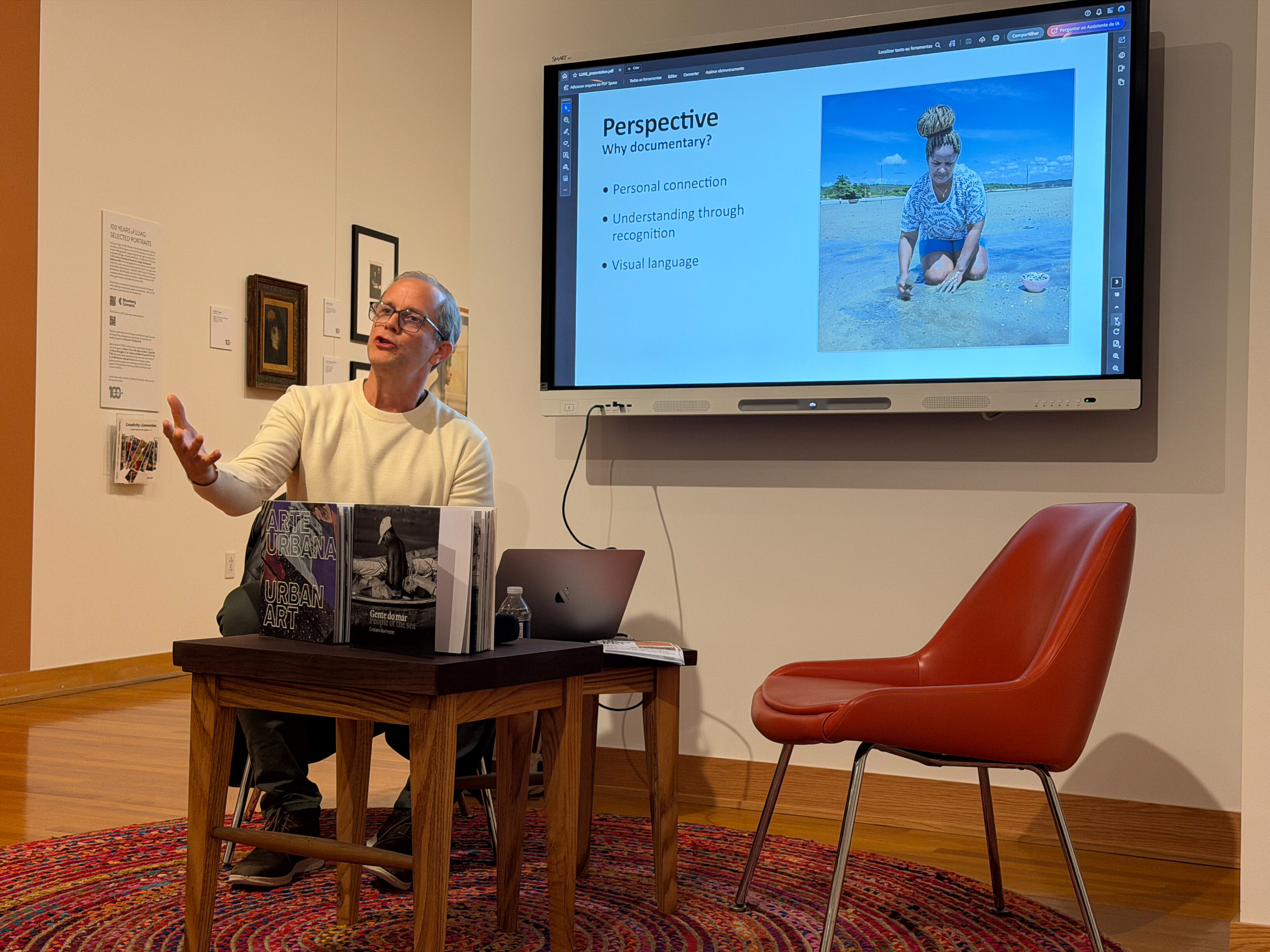
Cristiano Burmester said he has always felt a visual connection to the world.
Burmester is from Sao Paulo, Brazil, with a career that spans different forms of media including film, magazines and documentaries. He said he’s touched by stories on communities connected to nature.
On Tuesday evening, Burmester, a scholar and photographer, guided over 40 students, faculty and other community members on a journey of visual storytelling through the history of photography and his own practice.
The event took place in the Lehigh University Art Gallery (LUAG), in collaboration with the International Relations and Global Studies Departments.
When Burmester presses the shutter on a camera — whether it’s film, digital or 35mm, he said he expects a connection.
“I envision the image because of the emotional connection that I have to the situation I’m observing,” Burmester said.
To connect with his subjects, Burmester said he builds time into his projects.
He said he makes sure the subjects of his images feel recognized. He said if they don’t, he works to adjust, understand why and make them comfortable with his work.
He said photography is a tool that forces us to look at reality and context.
LUAG’s curator of education, Stacie Brennan, ‘03, said her role is to help “Activate the (gallery’s) collection” through programs, classes and experiences.
“Photography is one form of art that is a great way to bring attention to the human condition,” Brennan said.
She said Burmester’s work was an example of how different types of artmaking can bring attention to issues surrounding social change.
One of Burmester’s projects, Paranaíta, highlights a fishing community in central Brazil through aerial videography and confessional style interviews.
He said he intends for his work to expand to broader topics, prompting questions about ethics of fishermen, indigenous land use in the Amazon and culture of the people of Paranaíta.
In another project titled People of the Sea, Burmester captured pages of photos from traditional fishing communities along the Brazilian coast.
Burmester said working on People of The Sea inspired him to start another project, focused on specific Women of the Tide, where he used video as the medium.
The audience for this project, Burmester said, are the clients of the Iberostar hotel chains who wanted to know where their fish and seafood were coming from.
The project also served the communities well, noticeable from clips of Burmester’s videos that began to circulate and gain traction on social media.
He said these types of projects have helped him answer questions and address topics in a different way from the mainstream media.
Burmester said his practice, however, is journalistic.
“I understand journalism as a way of communicating that addresses the reality, the social context and daily lives of people,” Burmester said.
While he’s not necessarily following a deadline, he said his goal of communicating reality lines up well with journalistic practice.
International relations professor Jaimie Bleck said she invited Burmester to Lehigh to speak in her Big Question Seminar class titled “What is Democracy,” as well as a class focused on understanding social capital.
She said Burmester takes an interesting interdisciplinary approach, while his work focuses on the importance of photography and visual arts in storytelling, it’s guided by social science and research questions.
“If you’re just offering survey numbers or demographic reports, we get a really different feel from spending time visually and allowing people to tell their own stories,” Bleck said.
She said infusing that kind of storytelling and media into a story or research project can make a difference in the multimodal outcome.
Bleck said Burmester provided an example of communities working together to achieve positive outcomes.
Comment Policy
Comments posted to The Brown and White website are reviewed by a moderator before being approved. Incendiary speech or harassing language, including comments targeted at individuals, may be deemed unacceptable and not published. Spam and other soliciting will also be declined.
The Brown and White also reserves the right to refuse the publication of entirely anonymous comments.