



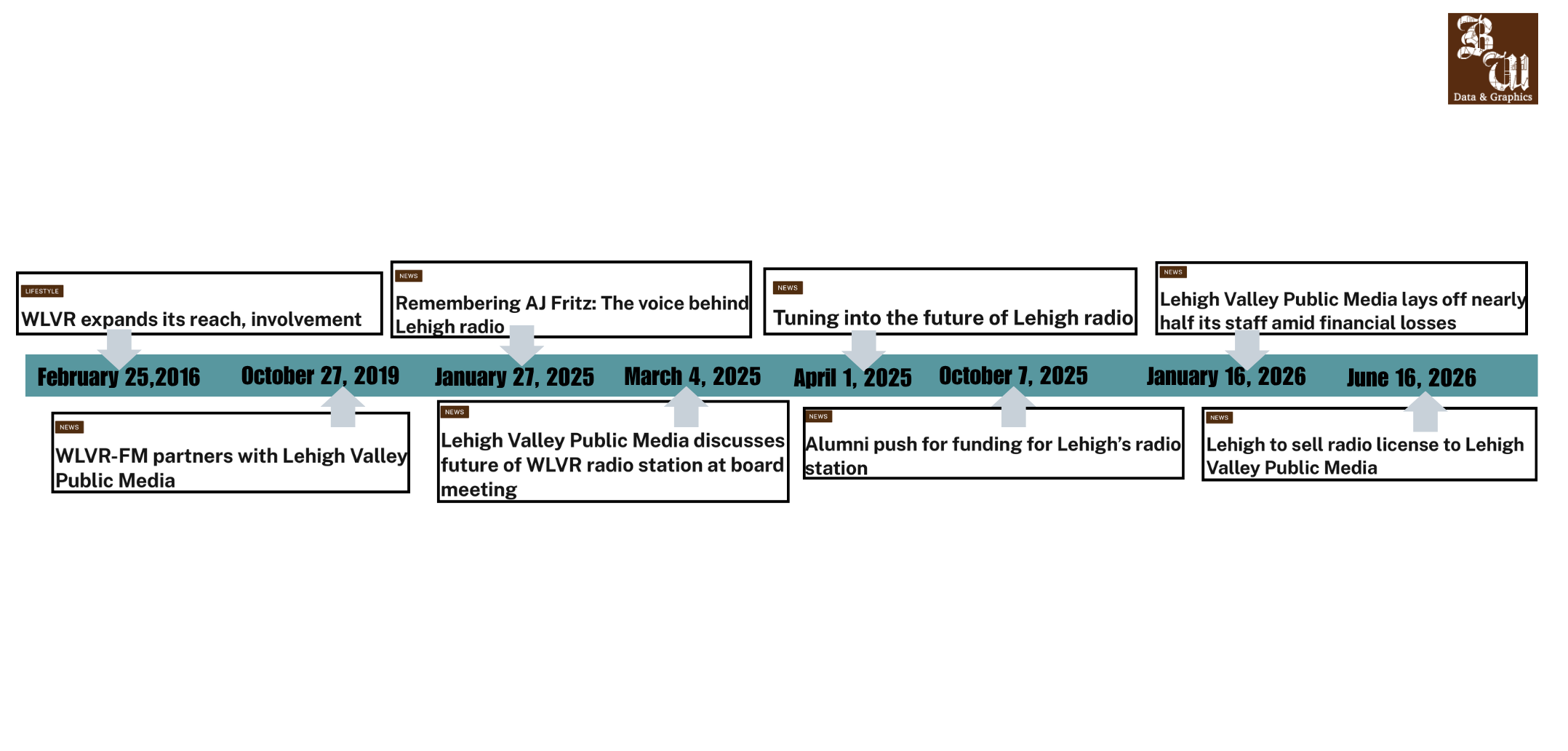
Lehigh’s 91.3 WLVR-FM FCC license, which has been held for more than 50 years, was sold to Lehigh Valley Public Media in June 2026 after being in the university’s ownership for over 50 years.
Chris Senft, ‘89, chief operator of the Lehigh University Student Radio Station, said he wasn’t part of the conversation about selling the license which has now been finalized.
Senft, alumni and students part of the radio station said they didn’t hear about the $55,000 sale from the provost’s office that made the decision to sell the license.
Senft said the radio station also wasn’t consulted when the university signed a lease agreement with Lehigh Valley Public Media in 2019, granting them control of the radio signal in exchange for student internships, station funding and other student opportunities. Lehigh retained an HD radio signal and streaming of the station, as well as the Federal Communication Commission license.
Senft explained in a previous investigation from The Brown and White that Lehigh Valley Public Media did not uphold their side of the lease agreement, and Lehigh didn’t appear to hold them accountable.
The media organization has struggled financially in recent years, with a $3 million deficit resulting from years of operating deficits, high overhead for employees and large losses in federal funding.
The organization cut half of its staff in January 2026. In September, CEO Hasanna Birdsong resigned after 15 months, followed by Paul Acompora, the vice president of development, according to the Morning Call.
Senft said the initial plan was to get the license back, so that students could practice advertising and marketing skills by broadcasting in the community.
He said, now that the license was sold, this form of community engagement will no longer be possible.
Jim Cameron, ‘72, said he felt betrayed by the provost office’s choice to sell the station’s FCC license, after he and David Polakoff, ’86, had conversations with Provost Nathan Urban and other faculty at Lehigh about options for the station, including not selling the license.
Cameron said from his perspective, Lehigh made a mistake by not holding Lehigh Valley Public Media accountable for their side of the lease contract and ultimately deciding to sell the license.
“They made this deal (with Lehigh Valley Public Media), and then they dropped the ball,” Cameron said. “Nobody within the university was checking to see if there was compliance on the deal. Provost wasn’t looking. The dean wasn’t looking, and suddenly, they now find themselves like holy shit, (Lehigh Valley Public Media) owes us money.”
Senft said despite funding and staffing challenges in recent years, especially after chief operator of the station AJ Fritzinger unexpectedly died in 2024, student interest in the radio is still prevalent on campus.
He said the station tabled at the club fair this year for the first time in years, leading to around 40 interest sign-ups, and 12 new DJs trained this fall.
The Brown and White requested an interview or a written statement from Provost Urban, a month ago and hasn’t received comment.
On two separate occasions, Urban cancelled interviews with The Brown and White on the day they were supposed to occur. The Brown and White then reached out to Urban for an interview via email on Oct. 8. After two follow-up emails, Urban hasn’t responded as of Monday.
Tracey King, associate vice president of external affairs, wasn’t available for an interview and said in an email statement that Lehigh had observed a decrease in student engagement in the radio station in recent years.
From King’s statement via email, “Over the last several years, the university has observed student engagement and career interest significantly shift away from traditional broadcast radio and toward on-demand, digital-first media.”
WLVR’s history
Lehigh has had a campus radio station since 1948. The station originally started as affiliated with The Brown and White, who struggled with the funding for the station. According to the WLVR website, electrical engineers at Lehigh helped launch the station, then called WLRN, and made the equipment work for them. The 1960s led to WLR AM radio and it wasn’t until 1973 when WLVR-FM officially got on the air with the FCC go ahead.
Cameron said the radio outlet allowed students to have their own radio shows during the school year and community members to fill otherwise empty slots in the summer.
Senft said without the license, community outreach is more difficult, because few people in the area can listen on the HD signal since most don’t have HD radios or signals in their cars, narrowing the listener base for the station. There’s also no local advertisements, which remove relationships with businesses in the area.
Cameron’s experience
Cameron said when arriving at Lehigh as a civil engineering major, he couldn’t predict the impact WLVR would have on him. In his second semester of his first year, he became program director of WLVR, launching his career in radio, and after graduating a career in media consultations.
He never stopped keeping up with the station and has continued to donate to Lehigh, reaching Tower Society status, who according to its website, recognizes “donors who have provided for Lehigh through a confirmed bequest intention, life income gift, or created an endowed fund.”
After the station’s FCC license was sold in June, Cameron said he’s not donating to the university anymore.
“I love the university, I love the students and I love the journalism department,” Cameron said. “But I’m not gonna give the university another dime, because we were literally lied to.”
Cameron said he and other alumni connected to WLVR, many of whom are a part of the Lehigh Radio Alumni Facebook group, weren’t hearing much from WLVR-HD after Fritzinger died, and were worried about the state it was in.
Polakoff said he and Cameron tried to set-up meetings with Urban, Ashley Lemmons, assistant vice president and dean for student life, and professors in the journalism department starting last year.
In January 2026, Cameron said he had a phone call with the provost, during which he asked him if the university was planning to sell the license.
“I asked (the provost), point blank, ‘I just want to make sure you’re not going to do anything foolish, like give up the (station’s FCC) license,’” Cameron said. “And he said, ‘no.’ And then he turned around and did exactly that. So I feel betrayed.”
Cameron said he knows selling the license was not an alumni decision and Urban has a lot on his plate, but the station was also for the community, and was built by alumni.
Polakoff said he sent two emails to Urban, advocating for the importance of student-operated radio on the WLVR station and WLVR-HD.
In an email Polakoff wrote to Urban on March 5, he said “While the pandemic and four years of undergraduate turnover have diminished WLVR’s presence on campus, Lehigh’s WLVR alumni can help showcase the value of student-run radio and reignite interest among the current undergraduate community. Broadcast and streamed radio still offer a unique and valuable experience. Radio remains a relevant platform.”
Cameron said he didn’t hear from the provost’s office between the call in January when Urban said he would not sell the license and when the license was sold in June.
One of Cameron and Polakoff’s largest concerns with the sale was that the license went to Lehigh Valley Public Media, a financially struggling organization, rather than a thriving station like WDIY or a local college such as Muhlenberg or Lafayette with student-operated FM broadcast stations.
“And so if (Lehigh Valley Public Media is) in trouble…WLVR is just going to be an afterthought,” Polakoff said. “If Lehigh wants to transfer (the license), and we can’t stop this at this point, at least transfer to somebody who’s a better caretaker than Lehigh Valley Public Media, because they’re so screwed up.”
Lehigh Valley Public Media contract and new management
In 2019, Lehigh signed a leasing agreement with Lehigh Valley Public Media, granting them control over the 91.3 WLVR-FM signal. In return, they had to provide Lehigh funding, student internships and opportunities at the radio station.
According to previous reporting from The Brown and White, former Chief Operator Fritzinger was the main communicator with Lehigh Valley Public Media, and after he died, partnership accountability became difficult.
Fritzinger was passionate about the station, and was quoted in a 2015 Lehigh News article emphasizing the importance of the radio station being student-run in a time when many colleges sold their FCC licenses and many stations were operated by outside entities.
Senft, who had been assisting Fritzinger since 2015, took over the radio station as chief operator.
Senft said the transition was difficult after Fritzinger died. Although he was expected to take over eventually, he said nobody was prepared for Fritzinger’s death, and it took a while to get the station running again.
He said he had to figure out the software and advocate for funding a necessary new computer system. Senft said the station eventually received enough funding from the university to update the system, around the end of the 2025 spring semester.
Senft is the only staff member actively working on the radio station, while maintaining a full-time job as a product manager for Verizon.
“This is a side gig for me, but it’s a passion,” he said. “Our license, when we were FM, was an educational license. I really want it to be an educational experience for the students.”
Senft said despite the sale of the license, he’s positive about student radio at Lehigh. Currently, the Lehigh University Student Radio Station streams the station on their website, luradio.org. Lehigh Valley Public Media is using the WLVR station as a multichannel HD broadcast station NPR affiliate, meaning it has multiple digital audio streams.
But with the future of Lehigh Valley Public Media currently uncertain, so is the station’s.
Senft said the opportunity for student radio at Lehigh to have a stronger online presence is exciting and opens further opportunities for growth.
He also said he hopes to make student radio more visible at Lehigh, through moving the station from the third floor of Grace Hall to the University Center, and by having professors, guest speakers and more talk shows on the radio.
Senft said the station is currently receiving minimal funding from the university.
“We’ve been on a very tight budget,” Senft said. “We don’t really need a lot. We will need some going forward because again, we have to establish a new website – we have to pay for that. We’ll have to get some additional software. We need additional equipment.”
Bryce Shanafelt, ’28, a civil engineering major, joined the radio station last semester.
Shanafelt said he found out about the station through Lehigh’s list of clubs and started his own show last spring called “Sheer Flow with the Brick,” where he discusses and plays music he enjoys.
Two other students were involved with the radio last semester, and Shanafelt said he helped table at the club fair this fall. He wasn’t surprised that students showed interest in radio.
“I think radio is a classic thing you do in college,” Shanafelt said. “I was surprised that no one knew about it beforehand, but I think during COVID, just the amount of people that were doing it really fell off, so it took a while to bring it back.”
Shanafelt said it’s nice to be on the radio and feel like he’s sharing a part of himself through the process. He said he’s happy there was so much interest at the club fair and hopes the interest will show the university that people care about the station.
Senft said his primary focus is moving forward despite challenges to the station.
He said he thinks there was always a hope that the leasing arrangement would end, and Lehigh would get the FM signal back, and then they’d be able to do all those things with the Bethlehem community and students.
“But again, it’s kind of out of my decision authority, someone else made that decision for us and we just have to move forward in a positive way that’s best for the students,” Senft said.
7 Comments
WLVR’s FCC license was a hidden gem that Lehigh undervalued.
By relinquishing it, Lehigh is missing an interdisciplinary opportunity for students to gain practical experience in journalism, market research, public relations, engineering, broadcasting, rights management, and public speaking.
While incorporating artificial intelligence into campus and classroom life is now all the rage, students still need hands-on opportunities to develop skills that AI cannot replace or replicate. WLVR offered a practical learning environment where generations of students could experiment, create, communicate, and develop skills that proved invaluable long after they left the studio.
Lehigh was shortsighted in abandoning this valuable educational asset. Embracing new technology should not mean abandoning established opportunities for students to learn by doing.
If you are interested in being a part of the Lehigh University Student Radio Station, please send an email to [email protected] We would love to have more students enjoy this great learning and growing experience.
As a Lehigh and WLVR alum, I feel the University sold out the students. To be fair in my day the University showed little interest in the station (I was GM in the 80s). Live radio provides an excellent educational experience and gives Lehigh an unmatched voice in the community. Muhlenberg and Lafayette have embraced their student run stations and their broadcast programming reflects that. Lehigh should be the leader in the Lehigh Valley and their student-run radio station should be a gem.
I totally agree, Steve. Muhlenberg’s and Lafayette’s stations are thriving, so it makes you ponder Lehigh’s shortcomings in supporting WLVR.
And contrary to Lehigh administrators’ comments that radio is kaput, check out “College Radio Keeps it Cool” in the New York Times, November 20, 2025, “Despite digital disruption, student radio has proven resilient, relevant, and enduring nationwide.”
As a proud Lehigh University graduate (BSEE 1973) and a two time WLVR-FM volunteer (1973 and 2019-2022) I have had a long career in AM, FM and TV broadcasting, The university’s behavior in this matter is shameful. Their decision to sign a lease management agreement (LMA) in 2019 with Lehigh Valley Public Media (LVPM) was a decision void of merit, logic and reason and was made by the then Board Of Directors and President almost all of whom are now gone. The attitude of the current administration is that “nobody wanted” WLVR when the facts are that they and the former administration(s) never embraced its existence nor potential. As recently as a few years before they leased the station to LVPM it was routinely winning awards as best non commercial station in the Lehigh Valley. It would be difficult to name an industry other than broadcasting that integrates more of what Lehigh or any university for that matter offers including but not limited to Arts, Business and Engineering. A radio license remains a valuable asset and all the decisions the University has made about the LMA and subsequent reassignment of the license were made without notice or involvement of students, faculty, alumni, station personnel or even a few representatives of those groups. The current administration rudely did not respond to inquiries about what was going on and routinely lied to Chief Operator the late Al Fritzinger, Jr. I have emails from Al about this and it’s hard to believe that such deception and insincerity is how the University administration operates. Now that the reassignment (sale) of WLVR-FM to LVPM is consummated, it has been revealed that LVPM plans to attempt to resell the station for profit which they apparently are unaware cannot be realized when one non profit transfers a radio license to another non profit. The malfeasance and ignorance abounds. Shameful.
Look at Lehigh Valley Public Media’s history of financial follies and mismanagement, and then ponder, why did Lehigh University even consider this deal?
Also LVPM’s meeting minutes indicate Lehigh might get a share of the proceeds of a sale of the license.
That raises questions about the nature of the deal.
I sent an email to the Provost pointing out the value of learning collaboration in college radio. Unlike many campus clubs, radio requires cooperation and coordination among management, sales and marketing, programming and engineering. If collaboration is lacking, there is no product: the classical “dead air” so dreaded in broadcasting. Lehigh was losing this critical learning experience at the time the administration was touting collaboration and “making something” as crucial in education. I really did not expect a substantive reply, but did not get the even the courtesy of an acknowledgment. Late this spring, there was a message on my answering machine (yeah, I really still had one). A member of the Provost staff said sorry to have missed you – will try again soon. There was no follow up. Ok, they are busy. I am not a financial supporter of the University. My association with WLRN/WLVR was more than five decades ago. But when Jim Cameron, a broadcasting and communications professional, who supported Lehigh with his presence and contributions, says the Provost lied to him, there is a serious disconnect.
Comment Policy
Comments posted to The Brown and White website are reviewed by a moderator before being approved. Incendiary speech or harassing language, including comments targeted at individuals, may be deemed unacceptable and not published. Spam and other soliciting will also be declined.
The Brown and White also reserves the right to refuse the publication of entirely anonymous comments.