



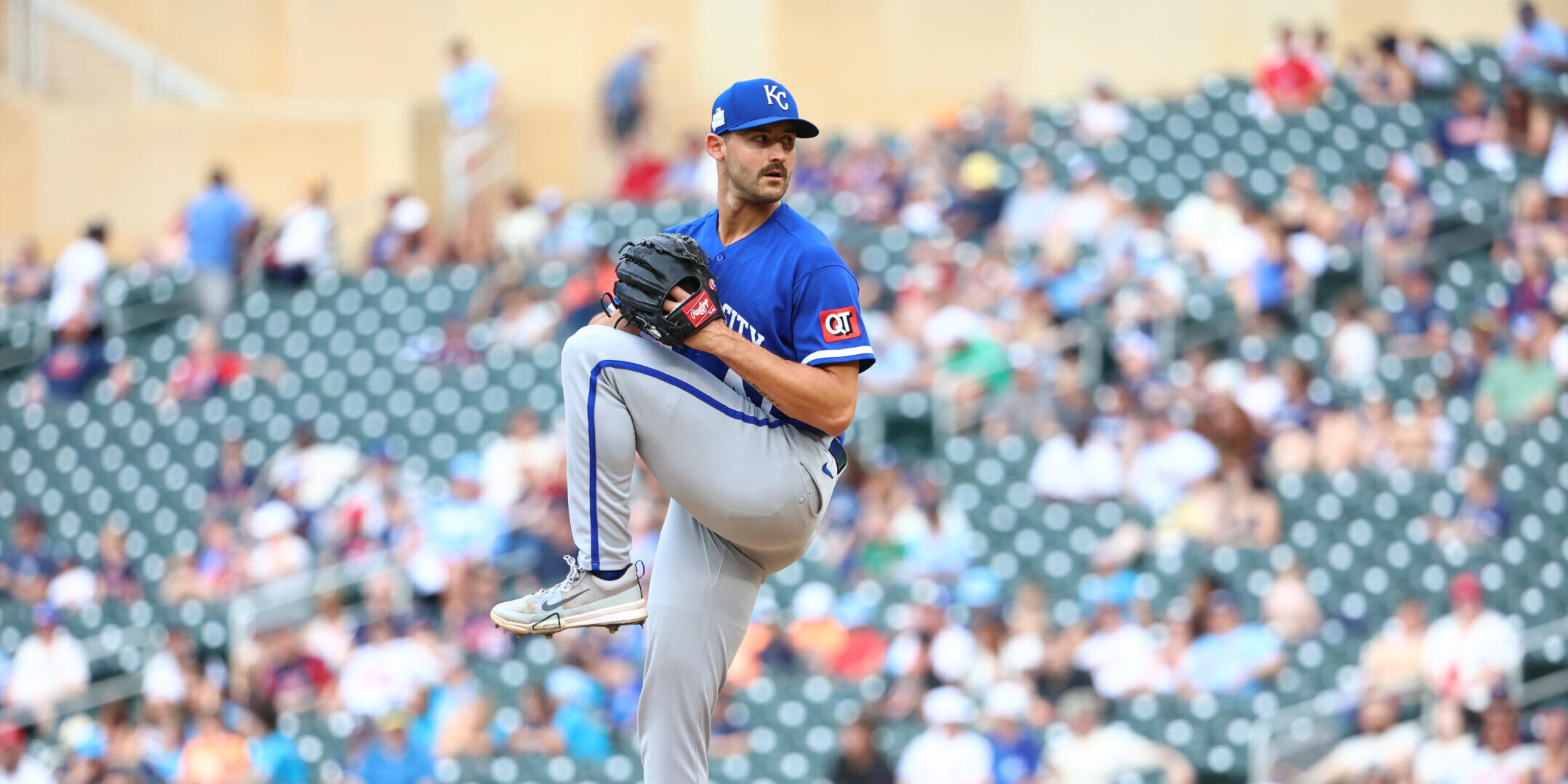
Mason Black had completed his first inning of his Major League Baseball career when he took a moment to look into the stands at Citizens Bank Park.
Black retired the Philadelphia Phillies in his first inning when he struck out the batting lineup in order on May 6, 2024. As he walked off the mound, he looked toward a section filled with family, friends and familiar faces who had made the trip to Philadelphia to watch him pitch.
Among the expected sea of Phillies red, Black said Lehigh’s signature brown caught his eye
“I probably had like 300 people there at that game,” Black said. “That was just surreal, that whole moment.”
Black’s debut marked the realization of a goal that had taken shape years earlier during his collegiate student-athlete years at Lehigh —competing in MLB.
So far, Black’s MLB career consisted of four years with the San Francisco Giants. In November 2025, he was traded to the Kansas City Royals, who he currently plays for. During the 2026 season, he appeared in 17 major league games for Kansas City.
Black said his current MLB career wasn’t at the front of his mind when he arrived at Lehigh in 2018.
He said his initial focus entering college was largely academic. As a Mountain Hawk, he was a bioengineering major and had grown up with the idea that he was a student first, and an athlete second.
After a successful first year season at Lehigh, he earned an opportunity to play in the Cape Cod Baseball League over the summer.
“I figured that maybe there could be something there as far as having a professional career,” Black said.
Lehigh baseball head coach Sean Leary remembers seeing Black’s possibility for a professional career even earlier.
During Black’s recruiting process, Leary said he was still relatively new to pitching, previously spending significant time as a catcher. On a recruiting visit, Black told the coaching staff that by the time he arrived on campus, he would be throwing roughly 90 miles per hour.
Leary said he remembered turning to his assistants afterward and recognizing Black’s confidence was different.
“That’s a different level of just determination,” Leary said.
Leary was used to selling recruits on Lehigh that when Black began selling himself to the program, he knew he wanted Black on the team.
By his first-year fall, Black’s prediction was already becoming a reality.
During Lehigh’s scout day, an opportunity for athletes to be watched by professional scouts, Black threw 95 miles per hour in front. Leary said Black had yet to receive an offer to play in the Cape Cod League, so he asked scouts in attendance if anyone could help put in a recommendation.
The following day, Leary said Black had three opportunities.
“He just kept his head down and kept pushing,” Leary said.
As a junior in 2021, he went 7-3 with a 3.11 ERA and struck out 95 batters across 13 starts. He was named Patriot League Pitcher of the Year and became Lehigh’s highest-drafted pitcher when the Giants selected him 85th overall in the third round of the 2021 MLB Draft.
Black was also named an Academic All-American.
For those who played alongside him, however, Black’s physical talent only explained part of his success.
Former Lehigh catcher Joe Yupp said catching for Black required matching an intensity that was difficult to replicate.
Away from baseball, Yupp described Black as easygoing. However, once a bullpen session or game began, however, he said Black could switch into a different level of focus.
“He kind of went to a different place mentally,” Yupp said.
That approach carried beyond game days.
Yupp said Black was one of the hardest-working players he encountered during his baseball career, whether the team was lifting, practicing individually during the fall or during the season.
“Once you cross over to the other side of the mountain, it’s like 110% with everything you’re doing,” Yupp said.
Leary said he saw the same qualities in Black.
He described Black as having a “quiet confidence” when he arrived at Lehigh. Although Black understood his own talent, Leary said he remained humble and made becoming the hardest worker on the team one of his priorities.
Leary said the combination allowed the two to begin discussing goals such as becoming Patriot League Pitcher of the Year and eventually being selected in the MLB draft early in Black’s college career.
Black’s former teammates also remember a side of him that never appeared in the box score.
Yupp and Black became close during their later years at Lehigh, when several members of the baseball team lived in neighboring houses on East Fifth Street.
Yupp remembers “jogger-flops weather,” the period during the fall and spring when he and Black would wear joggers with flip-flops around campus. He said he also remembers the two making what they called a “Mega Pancake” — one oversized chocolate chip pancake filling the largest pan they could find.
Yupp said those small memories stand out as much as anything that happened on the baseball field.
“I couldn’t tell you what his pitching line was against Navy in game one of the first playoff series of senior year,” Yupp said. “But I can tell you how we dressed in the middle of October.”
The relationships Black formed at Lehigh continued after he left South Mountain.
Following his first professional season, Black returned to Lehigh and served as the program’s director of operations during the fall and winter while continuing work toward his degree.
Leary said he has continued following Black’s career closely, even buying the MLB package so he could watch Black and other former Lehigh players pitch.
“I don’t think I missed an inning over the last two or three summers that they’ve been in,” Leary said.
He also said Black’s continued connection to the program is indicative of the player and person he coached.
Their relationship has stretched beyond baseball. Leary said Black recently invited him to his wedding, something he said made him feel humbled that he remains part of his former player’s life years after coaching him at Lehigh.
Black said he has also stayed connected with former Lehigh teammates who entered professional baseball. He said he competed against former Mountain Hawks Levi Stoudt and Matt Svanson while progressing through the minor leagues and eventually in the majors.
The minor leagues presented a different challenge than college baseball.
Black said one of the hardest parts was learning to handle the repetition and mental strain of professional baseball. Every day required him to show up with the same approach regardless of what happened the night before.
The public nature of professional sports added another layer.
“My uncle can go on and check and see how I did today,” Black said. “Your bad days are public.”
That mental adjustment has remained important in the majors.
Black said he’s worked on preventing a bad inning from carrying into the next one. One technique he adopted is simple: between innings, he looks around the stadium and reads advertisements on the outfield walls.
The exercise, which Black said grew out of a conversation with a mental skills coach, helps redirect his attention to the present instead of what happened moments earlier.
“You can’t change what’s happened in the past,” Black said.
After making his MLB debut with the San Francisco Giants in 2024, Black spent time between Triple-A and the majors before joining the Kansas City Royals ahead of the 2026 season. His goal now is no longer simply reaching the majors, but to stay there.
Black said he wants to establish himself permanently at the major league level, help his team win and eventually compete in the postseason.
His path has also become something Leary can point to when talking with the next generation of Lehigh players.
Leary said recruits sometimes believe they must choose between receiving a strong education and pursuing professional baseball. Black’s career, along with other former Mountain Hawks who’ve reached professional baseball, gives the program a tangible example that the two don’t have to be mutually exclusive.
“We have a roadmap, so to speak, of how that’s worked for our guys here,” Leary said.
Black has seen that impact himself.
When teammates throughout professional baseball have asked where he went to college, Black said some initially think he means “Lee High School” when he answers Lehigh.
That reaction has become another small source of motivation.
“You always want to just represent the place that helped you get to where you’re at,” Black said. “Every time I’m out there, a small part of me is representing Lehigh.”
Comment Policy
Comments posted to The Brown and White website are reviewed by a moderator before being approved. Incendiary speech or harassing language, including comments targeted at individuals, may be deemed unacceptable and not published. Spam and other soliciting will also be declined.
The Brown and White also reserves the right to refuse the publication of entirely anonymous comments.