



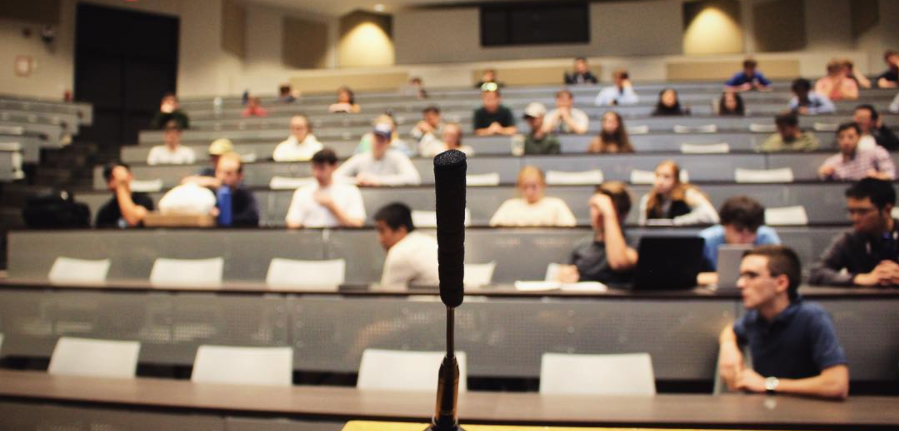
Jordan Caloras, ‘23, stood behind the podium, his opponents’ eyes shifting anxiously between him and their laptops.
He glanced around the University of Pennsylvania classroom, straightened his black suit and cleared his throat. Caloras had spent hours preparing for this—his first college debate tournament—researching and rehearsing why Microsoft was superior to Apple.
For him, those hours of preparation would now come down to a six minute argument, which would comprise a portion of a 45 minute debate.
Caloras knew the facts: Microsoft has quick download speeds, unbeatable data storage and overall better efficiency. However, while he had memorized the statistics, Caloras understood that perfecting the art of persuasion required more than just research.
Confidence was key.
“You don’t want to stutter,” Caloras said. “You want to make sure you know what you’re saying and that you have everything you want to say prepared enough to last the duration of time—six, seven minutes—but you also want to say it the right way.”
Having debated in high school, Caloras was no amateur to public speaking. He knew the importance of inflection and consciously controlled his voice to emphasize his most hard-hitting points.
Caloras stepped into his role as co-president of the Lehigh University Debate Society during the spring semester of his freshman year and has remained there ever since.
The club’s structure includes two forms of discourse: the debate team, led by Caloras, and the debate society, run by club president Jeremy Stoddard, ‘22.
Through regulated debate team meetings and more informal debate society discussions, members are encouraged to share unique perspectives, play devil’s advocate and experiment with the subtle techniques needed to make a convincing argument.
“The goal of the debate team and debate society is to enhance people’s speaking skills, argumentative skills and just to help students at Lehigh become better orators of what they want to say,” Caloras said.
Debate team meetings, which are held on Thursdays, give members the chance to practice formal parliamentary procedure and prepare for tournaments. The team typically attends two tournaments a semester held at different universities in the Northeast.
Debate society meets on Tuesdays as an open forum to discuss politics, current events and anything deemed newsworthy.
Stoddard said in his experience when most people think of debate, they think of polarizing topics: abortion, gun control and climate change. While these subjects are pressing, Stoddard said he finds less mainstream questions more interesting to explore.
At debate tournaments, the “government” pair poses a question and chooses its own stance on that issue. The “opposition” team is told the topic upon arrival and has a few minutes to prepare an opposing argument. Subject matter ranges from serious to more lighthearted content, all depending on the government’s choice.
Stoddard said one of his favorite tournament topics was a niche one: whether giraffes would wear neckties on their shoulders or at their collar bones. Stoddard and his partner argued in favor of the shoulder alternative. They lost.
At tournaments, participants are required to advocate the same stance the whole time, regardless of a dwindling argument. Stoddard said he prefers the informal debate society discussions because they allow for more free-flowing conversation.
“In the more formal (discussions), you pick a side and stick with it,” Stoddard said. “You focus on arguing for your side. I like the more informal. You can have your opinion evolve and learn new things.”
To kick off the fall 2021 semester, the debate society welcomed newcomers with a conversation about whether the COVID-19 vaccine should be mandated.
Caloras and Stoddard sat at the front of Room 270 in Maginnes Hall, the club’s home base, and explained how debate society would work. The two co-presidents would pose a general question and the group would loosely discuss it until a disagreement arose. At this point, members would dive deeper into the dispute, given the chance to freely express and debate their opinions.
Caloras opened the floor up to the room.
The group of students, primarily freshmen, were dispersed throughout the classroom. Their eyes darted back and forth above their masks, uncertain.
The silence was palpable. No one dared to be the first to speak.
Four seconds felt like four minutes, until a student in the second row slowly raised his hand. Jared Gill, ‘24, tapped his black sneaker rhythmically against the floor as he spoke.
Due to the pandemic, Gill’s freshman year was spent studying remotely from his home in Allentown, Pennsylvania. As a political science major, Gill was eager to meet new people and hear new perspectives.
Gill plans to join both Lehigh’s Democrat and Republican Clubs in an effort to hear perspectives from both sides.
“Even if I’m playing devil’s advocate, even if I know I’m wrong, I’d rather get involved just to get that practice,” Gill said.
A self-proclaimed introvert, Gill acknowledged that a quieter, more perceptive personality could give debaters a unique edge. While extroverts may be louder and more dominant in conversation, Gill said that introverts will know how to attack one’s argument.
For example, Gill said at a pro-choice versus anti-abortion rally, an attendee would most likely find people shouting the same kind of insults at each other, instead of attempting to empathize with the other side. He said if people don’t make a conscious effort to understand other perspectives, disputes become nothing more than an “I’m right, you’re wrong” argument.
“The reason I’m going into policy is not left or right based, it’s more so the fact that if we can’t exchange ideas and discussion, the next step up is typically violence, and I would rather avoid that,” Gill said. “So debate is something I find very important.”
Comment Policy
Comments posted to The Brown and White website are reviewed by a moderator before being approved. Incendiary speech or harassing language, including comments targeted at individuals, may be deemed unacceptable and not published. Spam and other soliciting will also be declined.
The Brown and White also reserves the right to refuse the publication of entirely anonymous comments.