



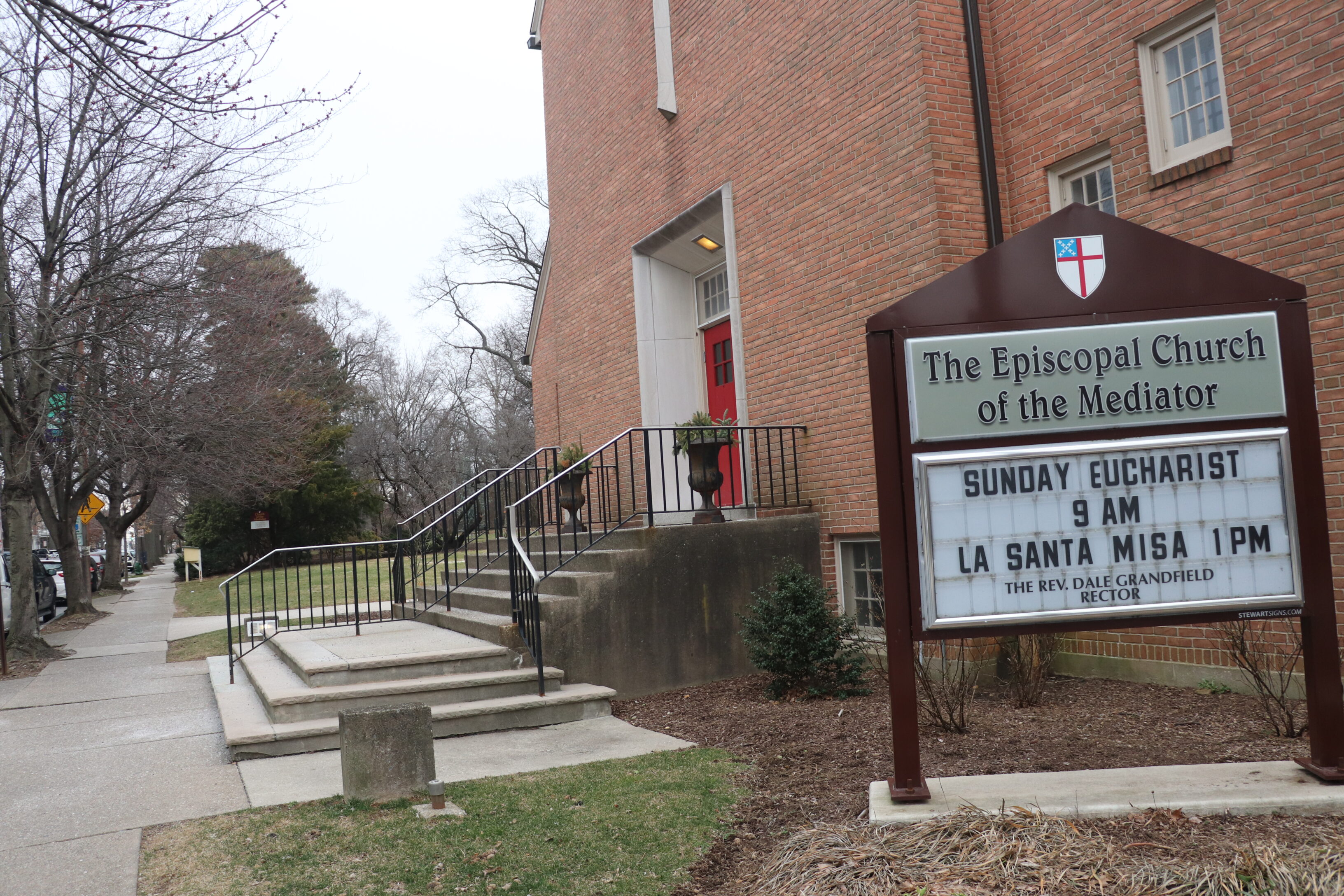
In the basement of the Church of the Mediator in Allentown, Pennsylvania, a toddler wearing a Disney princess T-shirt and fairy wings decorates a Halloween art project.
In the next room, her parents learn English.
In an adjacent classroom, an instructor writes, “Why should I hire you?” on a whiteboard.
A young Sudanese woman raises her hand.
“Because I need a job!” she exclaims. The class erupts in laughter.
This is a typical morning at the Allentown Refugee Center. It has an enrollment of approximately 50 students, all of whom are refugees from about 13 different countries.
Rising costs of living and unreliable public transportation in the Lehigh Valley can make it difficult for refugees to resettle. However, refugees from around the world have come to call it home.
“It’s all the countries you see in the news,” center coordinator Jess Entwistle said.
The primary resettlement agencies and centers in the Lehigh Valley offer resources including citizenship classes to sponsorship programs that help refugees acclimate to the area.
Entwistle said the Allentown Refugee Community Center started in 2016 when members of the church wanted to know how they could “help thy neighbor” after an influx of Syrian refugees arrived in the Lehigh Valley.
“In 2016, it was primarily Syrians, then we’ve seen since then a good number of refugees from Eritrea, Sudan, Myanmar (and) Burma,” Entwistle said. “But very recently we’ve seen a lot of Afghans, Ukrainians and also Cubans.”
The center uses a trauma-informed approach. Entwistle said this means moving slowly, leaving space for students to get up and leave the room, and taking intentional snack breaks so people can talk and take a breather.
It offers English as a second language (ESL) classes for adults, a preschool readiness program for children, citizenship classes for refugees who become eligible and informal community dinners and baby showers.
All Allentown Refugee Center services are volunteer-run.
A Discriminatory System
According to the United Nations High Commissioner for Refugees (UNHCR), refugees are defined as those “who have fled war, violence, conflict or persecution and have crossed an international border to find safety in another country.”
Entwistle said, in many cases, refugees will flee their home country for a safe haven country, such as Jordan, and then must wait in a camp until they are able to apply to the United Nations for refugee status.
According to the UNHCR, less than 1% of refugees get approved by the UN to resettle in a third country.
In recent events, Entwistle said, the treatment of refugees has exposed the reality of a discriminatory system. Refugees from Eastern Europe may be able to fly straight to the U.S. and file for asylum, whereas other refugees, like those from the Middle East, must wait years to get resettlement status at refugee camps.
Entwistle said the U.S. government doesn’t handle refugee resettlement mostly because it is a benevolent, rather than profitable, program. It is deferred by the government to nine mostly faith-based, non-profit organizations known as “The Big Nine.”
“It’s just the people willing to do it honestly,” Entwistle said. “I don’t think there’s a reason other than that. You have to have a certain level of organization and stability.”
The Benefits of the Lehigh Valley
Bethany Christian Services is an affiliate of Lutheran Immigration and Refugee Service — one of the “Big Nine” agencies for refugee resettlement.
Katharine Woodward is the community engagement coordinator for Bethany Christian Services of the Greater Delaware Valley, based out of Allentown. Bethany works with local faith centers — mosques, churches, synagogues — to find co-sponsors for refugee families.
Woodward said these co-sponsors are groups of around eight individuals who help families acclimate to the area in their first six months through initial apartment expenses, financial literacy, in-home tutors and other services.
She said for the October 2022 to September 2023 fiscal year, Bethany is projected to take in 159 more refugees at their Allentown location. She said Allentown is the preferable city of the three main cities within the Lehigh Valley, mainly due to its affordability.
“One of the reasons Allentown is a great place to resettle refugees is that we already have established refugee communities in the area,” Woodward said. “We have a Burmese communities, Congolese communities, (and) Afghan communities, just to name a few.”
Access to ethnic grocery stores and an effective transportation system also make Allentown a comparably easier city for resettlement, she said.
Woodward said the Bethany Center works closely with the Allentown Refugee Center and recently coordinated to help find transportation for one of their clients, an Afghan refugee, who specifically requested a female driver to get to ESL lessons.
The Language Barrier
Katherine Kaiser, an ESL teacher at the Allentown Center, said one of the greatest struggles for refugees is the language barrier, coupled with learning the everyday vocabulary to get what they need.
Kaiser said the center recently moved to the Minnesota Literacy Council’s curriculum, which is developed with refugees and immigrants in mind by teaching language to understand everyday issues.
She said one of the units they are currently studying is health problems, which covers topics such as how to go to the doctor.
“We have people from all over the world in the Lehigh Valley,” Kaiser said. “When people come here, they’re struggling to learn the language, but also just to find a community, work and deal with whatever health problems they’ve often had no way to get medical care while they were in refugee camps.”
For many, learning English is not the first obstacle. Some refugees, such as Afghan women, may have never received a formal education.
For some, Kaiser said learning sessions may be as fundamental as the alphabet and how to hold a pencil.
The Citizenship Process
Khoi Nguyen and My Lien Nguyen are volunteers at the Allentown Refugee Center. The Nguyens were Vietnamese students in the U.S. in the 1970s. After the Vietnam War, they became refugees here. Their families eventually joined them, fleeing Vietnam under life-threatening circumstances.
My Lien Nguyen teaches the citizenship class, which teaches students comprehensive American history and civics to prepare them for the citizenship exam.
“When I teach U.S. citizenship, I try my best to make them good citizens in terms of responsibilities and in terms of knowing their rights, as well as making myself a good advocate,” Nguyen said.
According to U.S. Citizenship and Immigration Services, refugees become eligible to take the citizenship exam once they have been a permanent resident for at least 5 years with what is known as a “green card.”
The process is confusing. Entwistle said a student who recently passed her citizenship exam was not informed that she then had to change her citizenship status at the Social Security office.
This general disconnect between the federal government and refugees is not limited to the naturalization exam.
When Eurdice Arvelo, the Church of the Mediator administrator and an immigrant from Venezuela, went to renew her driver’s license at the DMV, she gave the workers at the front desk her green card.
Instead of giving Arvelo her ID back, the workers misinterpreted her green card for a military card and began to thank her.
“She took my picture, (and) I’m waiting for her to give me my ID,” Arvelo said. “She gives me my ID and all of a sudden all of the people that were working in there say, ‘Thank you for your service,’ and they all stand up and everybody starts to clap. And I was like, ‘You’re welcome!’”
Culture Shock
The Northeast, and the Lehigh Valley in particular, are not popular resettlement areas, Entwistle said, due to the high costs of living. Resettlement is typically best in areas with high-quality social services, low costs of living and good entry-level jobs. In the U.S., this is often the South or the Midwest.
For those who do land in the Lehigh Valley, whether it be because of proximity to family or lower costs of living compared to neighboring cities, refugees struggle with culture shock.
“It’s in the U.S. government’s best interest that someone resettles well,” Entwistle said. “They pay these nine resettlement organizations to find people housing, a job and get them to have what’s called cultural orientation, which teaches people in-home safety and laws that could inadvertently get you in trouble.”
She said cultural orientation includes topics such as public assistance, immigration status, neighborhood acclimation, local laws, culture and information relating to acclimation.
Another major struggle for refugees is the sacrifice parents make to give their children a better life. Entwistle said parents often have to take on low-paid jobs despite being qualified for highly competitive occupations in their home countries.
“When refugees come here, they’re taking entry-level jobs,” Entwistle said. “These people with advanced degrees and really good careers are working at Amazon and in meatpacking until they can master the language and find someone to give them a chance.”
While the Lehigh Valley may be a difficult place to acclimate to, the center has provided a sense of community for many.
Entwistle said the community atmosphere of the Allentown Center allows refugees to find comfort through shared experiences.
She said, recently, two students from Ukraine were able to step aside during class and talk about what was happening back at home during a tumultuous time of the war.
“This work is beautiful,” Entiwistle said. “And we’re so glad to be able to provide that little bit of community for people.”
1 Comment
Hello,
This is me Dr. AHMADSHAH from Afghanistan I came to USA by getting humanitarian Parole, I was practicing as cardiologist doctor back home.
I got my SSN, EAD and driving license.
Currently i am living in Stratford street Bethlehem. I am looking for job.
My phone no 4843793524
My email [email protected]
Best regards
A.Shah
Comment Policy
Comments posted to The Brown and White website are reviewed by a moderator before being approved. Incendiary speech or harassing language, including comments targeted at individuals, may be deemed unacceptable and not published. Spam and other soliciting will also be declined.
The Brown and White also reserves the right to refuse the publication of entirely anonymous comments.