



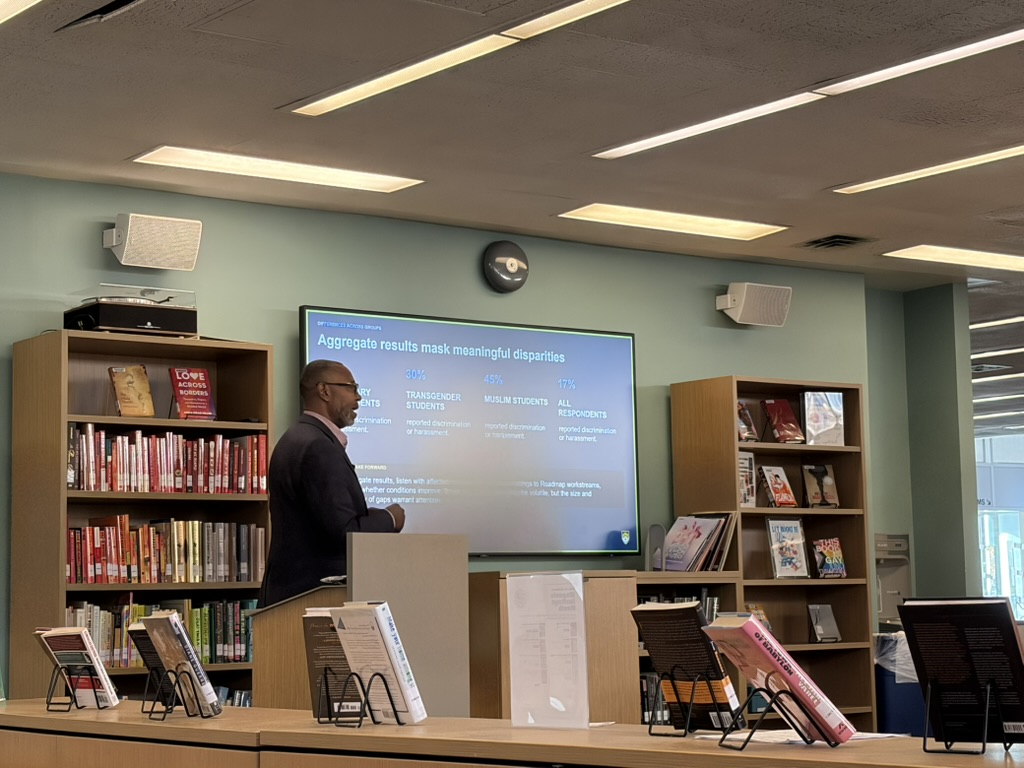
Vice President for Equity and Community Donald Outing led a community town hall in Fairchild-Martindale Library on Wednesday, outlining recent updates from the “A Lehigh for Everyone” strategic initiative.
During the town hall, Outing also presented the results of the Higher Education Data Sharing Campus Climate Survey, which assessed levels of harassment and discrimination on campus, and was released to students in March 2026
“A Lehigh for Everyone” strategic plan initially began in 2022. According to Christine Lake, the project’s manager, years one through three focused on surveying various aspects of the Lehigh community. Year four, she said, involves different aspirations.
During the meeting, Outing presented three priorities for year four of the strategic plan to a room of 15 individuals and approximately 20 attendees on Zoom. The priorities were the four level Belonging framework, the Belonging Roadmap and Title VI bystander training.
Four Level Belonging framework
Outing said that a large part of the work being done by the strategic plan team — composed of Outing, Lake and Katherine Lavinder, vice president for student affairs — was crafting a shared definition of “belonging.”
Outing said this definition is informed by the prongs of the Four Level Belonging Framework — self, campus, profession and world.
He also said the team crafted a “big question” to stimulate community conversation around what belonging looks like on Lehigh’s campus. He said they’re planning to disseminate it to the Lehigh community soon. The question reads, “what does it mean to belong to oneself, to a campus community, to a professional path and to the larger world?”
“This framework,” Outing said, “gives us a shared way to discuss belonging across the university without forcing a single static definition on the campus.”
Using the framework, he said the team hopes to have at least 50% of “academic and administrative units” incorporate the question into their conversations throughout the year.
Neither Outing nor Lavinder offered a timeline for when this question would be implemented into these “units.”
Lavinder expanded on Outing’s introduction to the framework plans, explaining how one of their primary goals is to “grow the capacity for community-building conversation.”
She also said enrolling at least 25% of the undergraduate and graduate student population in Title VI bystander training and having students complete the training by the end of the academic year will help them reach this goal.
Lavinder said they’re aiming to have 25 to 30 trained facilitators across campus and 500 students in formal community-building conversations.
According to Jessica White, the Equal Opportunity Compliance coordinator who was also in attendance at the town hall, Title VI pertains to issues of discrimination and harassment on the basis of race, nationality and shared ancestry.
Lavinder said the Title VI training functions are an initiative of the work of the anti-discrimination working group.
“As we met with student groups in the spring, across groups, what we heard again and again was that bystander intervention training works,” she said. “It makes us feel comfortable with content that can feel challenging and difficult, and it gives us tools that feel usable.”
Lavinder said the bystander trainings will equip students to recognize concerning situations, weigh safe and realistic response options in the moment and connect peers with support and action-based resources.
Outing and Lavinder said the student outreach needed to initiate these trainings will likely be facilitated through the Belonging Roadmap, steering committee and the community impact committee, recently established by the anti-discrimination working group.
At this time, however, no timeline has been decided on when student outreach for the trainings will be conducted or which students will be contacted and enrolled.
“There are steps before we get to ‘how’ and ‘where,’” Lavinder said. “We’ve got to decide what platform we’re going to use, whether that’s online, whether it’s in person, and I think a lot of those things are going to dictate how it plays out and how we decide when and how folks will interact with more information.”
The Belonging Roadmap
Following the presentation of the framework, Outing highlighted the belonging roadmap and steering committee and their corresponding belonging roadmap. He said it consists of six bodies of work — a shared definition, dashboard, resource inventory, fellows program composed of faculty and staff fellows, inclusive pedagogy and an advisory board.
Outing said one graduate student sits on the committee, while the rest is composed of faculty and staff.
“The roadmap really builds on work that’s already underway,” he said. “We set it up to minimize the amount of new programming that we create, and really to draw on those successful programs that have already been tried and true here into the work that we’re doing.”
According to Outing, a part of the belonging roadmap and steering committee’s work also involves reinvigorating the work of the council for equitable community.
Outing said during his presentation that the council for equitable community hasn’t been operational in years.
He said the belonging roadmap and steering committee’s work would extend to re-thinking how the council could evolve in its role as an advisory board for the Office of the Vice President for Equity Community.
Outing also said the committee has made progress this semester on drafting the shared definition and building the “resource inventory.”
Work on the fellows program, dashboard, inclusive pedagogy and advisory board, Outing said the work will carry into the spring 2027 semester and beyond. He said for the fellows program, in particular, it’s in the very early stages of development.
A review of the 2026 Campus Climate Survey results
In the town hall’s final minutes, Outing unveiled data from the 2026 Higher Education Data Sharing Campus Climate Survey, which polled the community in the aftermath of multiple racist incidents occurring on Lehigh’s campus in succession. The survey first opened to students, faculty, staff and administrators in a school-wide email on Mar. 16 and closed on Apr. 17.
“The survey is capturing perceptions during a period of heightened concern about racism, safety and belonging,” Outing said.
Outing said the school struggled to boost survey participation, noting that just 8% of the undergraduate population and 4% of the graduate population submitted responses.
Lehigh found that of those who participated in the survey, 44% of non-binary, 30% of transgender and 45% of Muslim respondents reported discrimination or harassment. Out of all respondents, 17% reported harassment or discrimination of some kind.
The data also demonstrated a “less favorable climate” and poor support for non-binary and LGBTQ+ respondents. The campus climate for Black employees was deemed “less than favorable” as well.
Outing said multiple times during the meeting that while this data is important to take seriously, it only represents a small portion of the community’s experiences.
Closing out the event, he said he believes Lehigh is a “really good place” for most students, but many are frustrated with these “episodic” incidents of discrimination.
“There’s a lag time, so unfortunately, students don’t really feel the effects of their input to this,” he said. “It’s really the next group that comes behind that will see the impact.”
Outing said students’ short duration on campus informed the project team’s decision to pilot programming for faculty and staff before piloting any for students.
Lake said she’s proud of the project’s accomplishments so far, but believes there’s more they can do.
“I don’t think it’s work that’s ever finished because students change, faculty change, it’s a constantly evolving process about the things that we learn about each other, both as individuals and as a larger group,” she said. “To me it is very energizing and exciting to create a space where people can come and be the best ‘them’ that they can be.”
Comment Policy
Comments posted to The Brown and White website are reviewed by a moderator before being approved. Incendiary speech or harassing language, including comments targeted at individuals, may be deemed unacceptable and not published. Spam and other soliciting will also be declined.
The Brown and White also reserves the right to refuse the publication of entirely anonymous comments.